
Can Mid-Cap AI Stocks Outperform the Magnificent Seven by 2030?
The investment thesis for mid-cap AI stocks is defined by a multi-year, multi-trillion dollar infrastructure buildout. This is not a fleeting trend but a structural shift in global capital allocation, creating a massive secular growth runway. The numbers paint a clear picture of explosive demand. The global AI infrastructure market is projected to grow from USD 182.07 billion in 2025 to USD 394.46 billion by 2030, representing a compound annual growth rate of 19.4%. This expansion is being driven by the relentless demand for high-performance computing to train and run increasingly complex generative AI models.
The scale of this buildout is staggering, extending far beyond the chips themselves. It is a power-intensive revolution. According to the Electric Power Research Institute, total AI power demand in the U.S. could increase tenfold by 2030, surging from an estimated 5 GW to more than 50 GW. This would mean AI, including both training and inference, could consume over 5% of the nation's total generation capacity. The implications are profound: a single frontier AI training run could rival the output of a major power plant, forcing a complete rethinking of grid planning and energy sourcing.
This power demand is the engine for a colossal capital expenditure cycle. The U.S. data center construction market alone, the physical backbone of this infrastructure, is forecast to grow from about $88.1 billion in 2024 to $152.7 billion by 2030. This isn't just about building more servers; it's about constructing entire campuses with unprecedented power, cooling, and connectivity requirements. The race is on to secure sites with cheap, reliable power and fiber connectivity, creating a wave of construction activity that will span years.
For mid-cap companies, this sets up a powerful opportunity. They are positioned to capture a disproportionate share of this spending. While the headline-grabbing capital is often deployed by the giants, the real growth is in the specialized components, software, and services that make the infrastructure work. This includes everything from advanced cooling systems and power distribution units to network interconnects and specialized software stacks. The multi-year runway, extending well into the next decade, provides ample time for these companies to scale their operations, capture market share, and deliver sustained revenue growth. The buildout is just beginning.
The Growth Investor's Edge: Why Mid-Caps Can Outperform
The market's focus has been laser-sharp on the Magnificent Seven, a group that collectively accounts for over a third of the S&P 500. Their dominance is staggering, with Alphabet alone boasting a market cap of $3.8 trillion. These are the titans, the beneficiaries of AI's first wave, and their sheer size makes them the market's engine. Yet for the growth investor, the most compelling opportunity often lies not with the giants, but with the mid-sized companies that have the runway to outperform them.
The contrast in growth potential is stark. Consider Cipher MiningCIFR--, a mid-cap with a $6.4 billion market cap. Its path to value creation is defined by explosive percentage growth. The company is capitalizing on the AI infrastructure boom, recently closing a 15-year deal with Amazon Web Services for $5.5 billion. For a company of its size, this is a transformative contract that could scale its annual recurring revenue into the billions. This is the scalability premium: a mid-cap can double or triple its top line with a single major deal, a feat that would move the needle only slightly for a $3.8 trillion behemoth. The growth trajectory is simply steeper.
Historical data supports this edge. The Russell Midcap Index has delivered an annualized return of 12.8% from 1978 to 2024, outperforming large-caps over the longest timeframes. This isn't a story of chasing volatility; it's about capturing consistent, compounding growth. Mid-caps have historically grown revenues faster than large-caps while maintaining healthier fundamentals, like higher EBIT margins and lower debt levels. They strike a balance-more stability than small-caps, more growth potential than the giants.
The current setup amplifies this opportunity. Large-cap valuations are stretched, leaving little room for error. In contrast, mid-caps often trade at a discount to large-caps, offering a valuation advantage. This is the growth investor's sweet spot: buying companies with proven business models and strong growth catalysts at a more reasonable price. The path to outperformance isn't about betting against the Magnificent Seven, but about diversifying into the companies that can grow into their own market caps, not just ride the coattails of the market leaders.
The Scalable Mid-Cap Playbook: From Energy to Construction
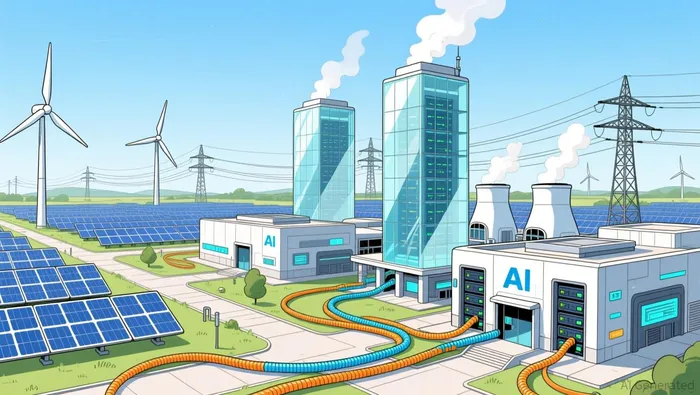
The AI infrastructure buildout is a multi-year capital project, and the companies capturing the most value are often mid-sized players with focused, scalable models. These firms are not chasing the headline-grabbing AI chipmakers but are instead building the essential physical and logistical backbone. Their business models are designed for predictable, recurring revenue from long-term contracts, offering a more tangible path to market share capture than pure-play software.
Cipher Mining exemplifies the scalable energy infrastructure play. The company's core model is selling megawatts of power and data center space to hyperscalers. Its recent 15-year, $5.5 billion lease agreement with Amazon Web Services is the cornerstone, generating approximately $367 million in annual recurring revenue. This deal is more than a single contract; it's a validation of Cipher's strategy to source high-quality sites nationwide. The company's 3.4-gigawatt pipeline represents a massive, scalable asset base. Each gigawatt is 1,000 megawatts, meaning this pipeline could support ten more deals like the AWS one. For a growth investor, Cipher's model is a direct play on the power shortfall that is a critical bottleneck for AI expansion. Its ability to secure and develop sites quickly, as shown by its first non-Texas acquisition, indicates a scalable execution engine.
Argan provides the construction muscle for this energy transition. The company's model is built on long-term project backlog, which it recently turned into a record $3 billion. This backlog is underpinned by contracts for roughly 6 gigawatts of power-generating assets, directly feeding the demand that Cipher is trying to meet. Argan's financial strength is a key differentiator: it entered its latest quarter with zero debt and a cash position that soared to over $700 million. This fortress balance sheet provides the flexibility to take on large, capital-intensive projects without financial strain. The company's improved gross margin of 18.7% also signals operational efficiency. For investors, Argan represents a leveraged play on the physical buildout, converting its backlog into sustained earnings over a multi-year horizon.
Then there is Ondas Holdings, a more speculative but high-growth play in the AI-powered robotics supply chain. Its model is scaling rapidly through acquisitions and strategic investments. The company's Q3 revenue of $10.1 million was a more than sixfold increase year-over-year, and it has set a preliminary 2026 revenue target of $110 million, representing a more than threefold increase. This explosive growth is fueled by its focus on autonomous systems for defense and critical infrastructure. The company's strong balance sheet, with a pro-forma cash balance of $840.4 million, provides the capital to aggressively deploy in this niche. Ondas's playbook is about capturing a specific, high-demand segment of the AI ecosystem-autonomous platforms-through strategic M&A and product development.
The bottom line is that the AI infrastructure chain is creating distinct opportunities for mid-cap companies with specialized, scalable models. Cipher Mining owns the power pipeline, Argan builds the plants, and Ondas Holdings supplies the autonomous systems. Each company's metrics-Cipher's gigawatt pipeline and AWS deal, Argan's record backlog and zero debt, Ondas's triple-digit revenue growth-show a clear path to capturing a meaningful share of this multi-year buildout. For a growth investor, these are the companies positioned to profit from the physical realization of the AI boom.
Valuation and Growth Trajectory: The Growth Investor's Lens
For the growth investor, the path to riches is rarely about buying cheap. It's about identifying scalable assets in massive markets and paying up for the right to participate in that growth. The current landscape offers three distinct plays, each with a compelling growth trajectory but a valuation that demands near-perfect execution.
Cipher Mining exemplifies the scalable asset play. Its recent 15-year deal with Amazon Web Services for $5.5 billion is a blueprint. That contract, providing 300 megawatts of capacity, generates roughly $367 million in annual recurring revenue. The company's strategic move to acquire a 200-megawatt site in Ohio has expanded its total pipeline to 3.4 gigawatts. Each gigawatt is 1,000 megawatts, meaning this pipeline could support ten more deals like the AWS contract. The math is straightforward: billions in potential ARR by the end of 2026. The growth investor sees a company with a proven model, a vast addressable market, and a clear path to monetize its energy infrastructure. The risk is execution and demand volatility, but the scalability is the core thesis.
Argan presents a different, more defensive growth story. Its Q3 2026 results show a company with a fortress balance sheet and a record backlog. The company posted a record $3.0 billion project backlog, nearly double its position from the start of the year. This backlog, under contract for roughly 6 gigawatts of power generation, provides multi-year revenue visibility. Crucially, Argan is also improving profitability, with gross margins rising to 18.7% and net income increasing. Its financial health is impeccable, with $726.82 million in cash and zero debt. For the growth investor, Argan is a high-quality compounder. It's not a hyper-growth stock, but its record backlog and improving margins suggest a steady, profitable ramp as it converts work into earnings. The valuation is likely more reasonable than pure growth names, offering a risk-adjusted return from a company with a clear, funded growth path.
Then there's SoundHound AI, the pure-play growth bet. Management projects 50% organic growth or greater for the foreseeable future, a rate that would leave even the Magnificent Seven in the dust. Recent quarterly revenue growth of 217% year-over-year underscores the momentum. Yet the stock trades at over 50 times sales. This valuation prices in a flawless execution of that growth trajectory for years. The growth investor must weigh the massive TAM for AI voice technology against the extreme premium. The risk is that a single quarter of slower growth or a competitive disruption from a hyperscaler could trigger a sharp re-rating. The opportunity is that if SoundHound can sustain its growth, the current price is a bargain.
The bottom line is a spectrum of growth profiles. Cipher Mining offers a scalable asset play with a clear path to billions in ARR. Argan provides a high-quality, profitable ramp with a record backlog and a fortress balance sheet. SoundHound AI is a pure, high-risk/high-reward bet on sustained hyper-growth, priced for a miracle. For the growth investor, the choice depends on where they see the best risk-adjusted return: in a scalable infrastructure play, a high-quality compounder, or a pure growth story priced for a miracle.
Catalysts, Risks, and the Path to 2030
For growth investors, the path to 2030 is defined by a few critical catalysts and risks that will determine whether the AI infrastructure boom delivers on its promise. The near-term runway is being set by companies that have secured large, multi-year contracts. Cipher Mining's recent execution of a $5.5 billion, 15-year lease agreement with Amazon Web Services is a prime example. This deal, which includes delivering 300 MW of capacity in 2026, provides a concrete revenue anchor and validates the company's thesis of partnering with hyperscalers. Similarly, Argan's record $3 billion project backlog offers strong visibility into future earnings, driven by urgent power plant construction. These contracts are the essential first steps, converting ambitious plans into tangible, contracted cash flow.
Yet the long-term opportunity is threatened by a potential squeeze from the very giants these suppliers serve. The dominance of the "Magnificent Seven" tech stocks, which are the primary beneficiaries of AI, could intensify if they vertically integrate more of the AI stack. As these companies build their own chips and data centers, they may reduce their reliance on mid-cap suppliers for key components and services. This risk is already evident in the market's mixed performance, where some of the seven have underperformed due to tariff impacts and other headwinds. If their capital expenditure shifts inward, it could compress margins and growth for the broader infrastructure ecosystem.
The ultimate determinant of the sector's health will be supply and demand dynamics, signaled by data center occupancy and power grid constraints. Goldman Sachs Research forecasts that AI's share of data center power will double to 30% within two years, with overall consumption jumping 175% from 2023 levels by 2030. The industry's ability to build capacity fast enough will be tested. Occupancy rates are a key metric: a tight market with rates peaking near 93% supports high returns, while a slack market could pressure earnings. More fundamentally, the power grid itself is a bottleneck. The Electric Power Research Institute projects AI's power demand in the U.S. could increase tenfold by 2030, consuming over 5% of national generation capacity. Projects like Cipher's Colchis site, with its 1-GW Direct Connect Agreement with American Electric Power, are attempting to solve this by securing dedicated power. The pace at which these power solutions can be deployed will dictate whether the data center boom can keep pace with AI's insatiable appetite.
The bottom line is a need for a balanced view. The catalysts are real and visible in signed contracts, but the risks of vertical integration and physical constraints are material. For the long-term investor, the path to 2030 hinges on monitoring two things: the execution of these large contracts and the relentless pressure on power supply. Success in both areas will separate the sustainable builders from the overhyped.





Comentarios
Aún no hay comentarios