
Why MicroStrategy (MSTR) Was One of the Worst Stocks of 2025 – A Post-Mortem on Its Crypto and AI Bets
In 2025, MicroStrategy (MSTR) emerged as one of the most volatile and underperforming stocks in the financial markets, with a staggering -47.53% annual return according to financial data. This dramatic reversal from its 2024 surge of 358.54% as reported in financial charts underscores the perils of overconcentration and speculative leverage. A post-mortem of MSTR's strategy reveals critical lessons for investors, particularly in an era where crypto and AI bets increasingly dominate corporate agendas.
The Crypto Gamble: Volatility and Leverage
MicroStrategy's aggressive allocation to BitcoinBTC--, which accounted for a significant portion of its treasury, became a double-edged sword in 2025. While the company's Q2 2025 financials highlighted unrealized gains from Bitcoin holdings, the subsequent decline in crypto prices exposed the fragility of this approach. By mid-2025, MSTR's stock had swung between a 52-week high of $457.22 and a low of $151.42 according to market data, reflecting the inherent instability of tying corporate value to a single, highly volatile asset.
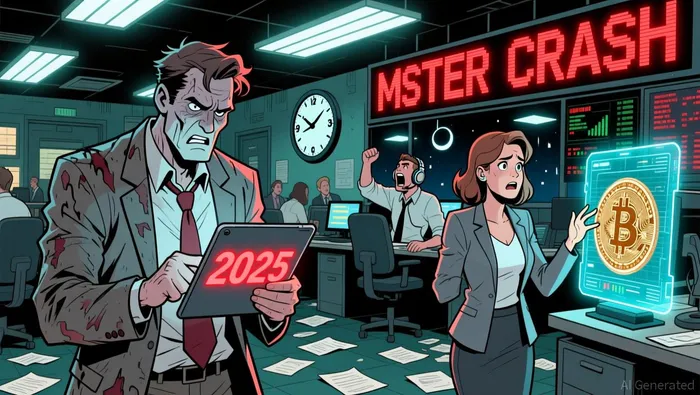 The company's reliance on equity financing and high-yield preferred stock (STRC) to fund further Bitcoin accumulation as per industry analysis exacerbated risks. Despite a reduction in default probability to 0.010 by mid-2025, MSTR's $8.2 billion debt load as of December 2024 according to financial reports raised concerns about its ability to weather prolonged downturns. This contrasts sharply with traditional software firms, where revenue streams and operational cash flows-not speculative assets-anchor valuation.
AI Positioning: A Missed Opportunity?
MicroStrategy's foray into AI in 2025 was inextricably linked to its Bitcoin strategy, with data analytics tools marketed as complementary to its digital-asset holdings according to company announcements. However, this approach failed to position the company as a standalone AI innovator. While competitors like NVIDIA and Palantir leveraged AI to drive revenue growth and operational efficiency, MSTR's AI initiatives remained secondary to its crypto-centric narrative.
NVIDIA, for instance, reported Q3 2025 revenue of $57 billion-a 62% year-over-year increase according to financial reports-supported by robust cash reserves ($57 billion in liquidity according to financial data) and a conservative debt profile ($8.5 billion in funded debt as reported). This financial discipline allowed NVIDIA to scale AI infrastructure without overreliance on speculative gains. Palantir, meanwhile, achieved a 63% revenue growth in 2025 according to financial data, albeit at a valuation of 156 times 2026 earnings as reported, which reflects heightened expectations and risks.
The Cost of Overconcentration
MicroStrategy's experience highlights the dangers of conflating corporate strategy with speculative bets. By prioritizing Bitcoin accumulation over diversified revenue streams, the company exposed itself to market forces beyond its control. In contrast, stable AI-focused firms like NVIDIA demonstrated resilience through balanced capital structures and innovation-driven growth.
The broader AI sector's shift toward debt-fueled expansion in 2025 according to industry analysis further underscores the importance of prudent leverage management. While MSTR's debt levels improved mid-2025 as reported, its reliance on equity dilution and volatile asset valuations created shareholder distrust. For investors, this serves as a cautionary tale: high-risk, high-reward strategies can deliver outsized returns in bull markets but often falter when volatility resurfaces.
Lessons for Investors
- Diversification Over Speculation: MSTR's underperformance underscores the need to balance speculative assets with core operational strengths.
- Leverage Discipline: Excessive debt or equity dilution to fund volatile holdings can amplify downside risks, as seen in MSTR's 2025 struggles.
- Market Timing Pitfalls: The crypto market's 2025 correction revealed the perils of timing bets on a single asset class, particularly when macroeconomic conditions shift.
In an era of rapid technological disruption, investors must prioritize companies that combine innovation with financial prudence. MicroStrategy's 2025 performance serves as a stark reminder that even the most audacious strategies can falter without a foundation of stability and diversification.







Comentarios
Aún no hay comentarios