
MicroStrategy's Index Exclusion Risk and the Future of Bitcoin Treasury Companies
MSCI's Proposed Criteria: A 50% Threshold and Reclassification Debate
According to MSCI's consultation, the index provider is considering whether to exclude companies where digital assets constitute 50% or more of total assets from its Global Investable Market Indexes. This threshold directly targets firms like MicroStrategy, whose Bitcoin holdings are nearly equivalent to its market capitalization according to Seeking Alpha. The reclassification debate hinges on whether such companies should be treated as traditional equities or as investment funds. MSCI's consultation period, open until December 31, 2025, seeks to determine whether criteria like "self-definition" (how a company categorizes itself) and "financing purpose" (whether Bitcoin is held for operational or speculative reasons) should influence index eligibility according to Coin Edition.
Critics argue that the 50% threshold is arbitrary and fails to account for structural distinctions. For example, MicroStrategy's founder, Michael Saylor, has defended the company as a "Bitcoin-backed structured finance company," emphasizing its operational model of generating revenue through Bitcoin appreciation rather than passive holding according to Cointelegraph. However, index providers like MSCI and Nasdaq appear to prioritize asset composition over business model nuances, creating a regulatory gray area that could redefine the classification of entire sectors.
The $9 Billion Outflow Risk and Market Implications
If MSCI excludes MicroStrategy from its indices, the resulting passive outflows could be catastrophic. JPMorgan estimates that MSTR's removal from the MSCI USA and MSCI World indices alone could trigger $2.8 billion in outflows, with total outflows reaching up to $8.8 billion if other index providers follow suit. This is not hypothetical: recent data shows that MSTR's stock has already experienced sell-offs driven by fears of index exclusion, independent of Bitcoin's price movements according to CoinDesk.
The ripple effects extend beyond MicroStrategy. As a key component of the Nasdaq 100 and other major indices, MSTR's exclusion could signal a broader reclassification of Bitcoin treasury companies, potentially destabilizing the entire sector. Passive funds, which track indices without discretion, would be forced to divest MSTR shares, exacerbating downward pressure on its stock and Bitcoin's price. This dynamic is already playing out in the ETF space, where U.S. spot Bitcoin ETFs have seen $4.34 billion in cumulative outflows over four weeks, with BlackRock's IBIT alone shedding $1.09 billion in a single week according to The Block.
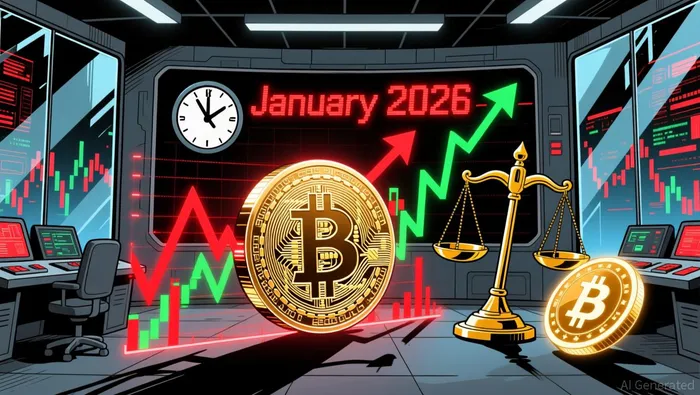 The broader reclassification debate reflects the growing tension between innovation and traditional finance. Bitcoin treasury companies represent a novel use case for corporate capital allocation, leveraging Bitcoin's store-of-value properties to hedge against inflation and diversify balance sheets. However, regulators and index providers remain skeptical, fearing that such firms blur the lines between equities and investment vehicles.
This debate is far from settled. While MSCI's consultation period ends in late 2025, the outcome could set a precedent for how other index providers and regulators treat Bitcoin treasury companies. If MSCI proceeds with its 50% threshold, it may force firms to restructure their balance sheets or abandon Bitcoin holdings altogether. Conversely, a decision to retain MSTR in indices could validate the sector's legitimacy and encourage broader corporate adoption of Bitcoin.
For investors, the stakes are high. On one hand, the potential $9 billion outflow scenario presents a significant downside risk for MSTR and similar firms. A forced divestment by passive funds could lead to liquidity crises, depressed valuations, and reduced access to capital markets. On the other hand, Bitcoin treasury companies offer unique upside potential. If Bitcoin's price recovers and gains broader institutional acceptance, firms like MSTR could see their valuations soar, particularly if they retain index inclusion.
The key lies in diversification and timing. Investors bullish on Bitcoin's long-term prospects might consider hedging against index exclusion risks by allocating to a mix of Bitcoin treasury companies and direct Bitcoin exposure (e.g., ETFs or futures). Conversely, those wary of regulatory uncertainty may prefer to avoid the sector until clearer guidelines emerge.
Conclusion: A Pivotal Moment for Bitcoin Treasury Companies
The coming months will determine the future of Bitcoin treasury companies in equity indices. MSCI's decision in early 2026 could either validate or invalidate this innovative asset class, with cascading effects on capital flows, corporate strategy, and Bitcoin's price. While the $9 billion outflow risk is real, it also underscores the sector's growing influence in traditional finance. For investors, the challenge is to navigate this uncertainty by balancing risk mitigation with the potential rewards of a redefined financial landscape.







Comentarios
Aún no hay comentarios