
MicroStrategy's Bitcoin Strategy: A New Benchmark for Corporate Treasury Innovation
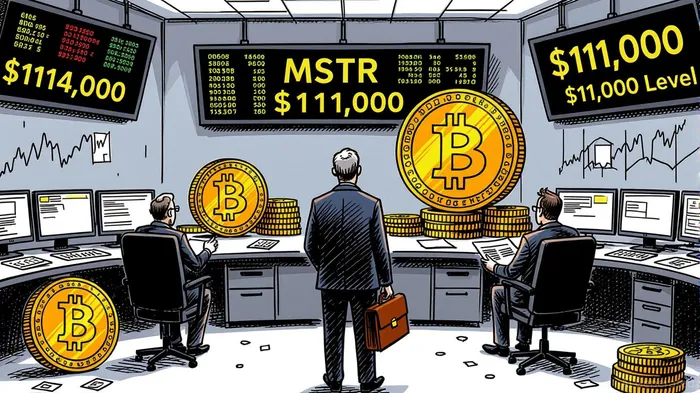
In the wake of MicroStrategy's (MSTR) exclusion from the S&P 500 in September 2025, the company's Bitcoin-centric strategy has emerged as a compelling case study in how corporate innovation can outperform traditional financial benchmarks. While the S&P 500 committee cited volatility and recent profitability as reasons for the snub, MicroStrategy's stock and BitcoinBTC-- holdings have continued to defy conventional metrics, offering a blueprint for institutional adoption of digital assets.
Strategic Rationale: Bitcoin as a Corporate Treasury Asset
MicroStrategy's decision to treat Bitcoin as a primary treasury reserve asset—rather than a speculative play—has redefined corporate finance. By August 2025, the company held 638,460 BTC, valued at $71.685 billion at current prices, with an average purchase price of $66,384.56 per coin. This aggressive accumulation, funded through stock offerings and debt, reflects a long-term bet on Bitcoin's role as a hedge against macroeconomic instability and a store of value in a low-interest-rate environment.
The company's strategy contrasts sharply with traditional index inclusion criteria, which prioritize stable earnings and diversified revenue streams. While the S&P 500 excluded MicroStrategy due to its Bitcoin-driven volatility, the company's financials tell a different story: $14 billion in Q2 2025 operating income and a $10 billion net profit under new FASB fair-value accounting rules. These figures, though tied to Bitcoin's price swings, demonstrate a novel path to profitability—one that challenges the status quo of corporate treasury management.
Market Implications: Beyond the S&P 500
The S&P 500's exclusion of MicroStrategy highlights a critical gap in traditional indices: their reluctance to embrace disruptive business models. While the index added RobinhoodHOOD-- (HOOD) for its diversified fintech model, MicroStrategy's Bitcoin treasury strategy—despite its volatility—has generated outsized returns.
Post-exclusion, MSTR's stock fell 3% in after-hours trading but rebounded to a 23% year-to-date yield in 2025, outperforming the S&P 500's 8% return. This resilience underscores the growing demand for Bitcoin exposure through equities, as MicroStrategy's stock acts as a “clean proxy” for institutional investors wary of direct crypto trading. Analysts estimate that the company's Bitcoin holdings could drive $16 billion in passive fund inflows had it been included in the S&P 500—a missed opportunity that now positions MSTRMSTR-- as a high-conviction growth stock.
Long-Term Investment Potential
MicroStrategy's strategy is not without risks. Its stock's volatility, tied to Bitcoin's price, and shareholder concerns over dilution from stock offerings, remain challenges. However, the company's $73.5 billion Bitcoin portfolio—now worth $70.2 billion at a $111,491 BTC price—provides a robust asset base. With $357 million in August 2025 Bitcoin purchases and a disciplined approach to buying at discounts to market price, MicroStrategy is building a legacy as the “Microsoft of Bitcoin,” as CEO Phong Le has described.
For investors, the key takeaway is clear: corporate Bitcoin adoption is no longer a niche experiment. MicroStrategy's success demonstrates that companies willing to embrace digital assets as core treasury holdings can outperform traditional benchmarks by aligning with macro trends like inflation hedging and decentralized finance. While the S&P 500's exclusion may have delayed short-term gains, it has accelerated MicroStrategy's role as a pioneer in institutional Bitcoin adoption.
Investment Advice: Balancing Risk and Reward
MicroStrategy's stock remains a high-risk, high-reward proposition. Investors should consider:
1. Bitcoin's macroeconomic role: As central banks grapple with inflation and currency devaluation, Bitcoin's adoption as a corporate reserve asset could gain traction.
2. Dilution risks: The company's reliance on stock offerings to fund Bitcoin purchases may pressure share prices, but its growing Bitcoin reserves offset this risk.
3. Strategic diversification: While MicroStrategy's AI and business intelligence software operations provide a revenue base, its Bitcoin treasury remains the primary driver of value.
In conclusion, MicroStrategy's S&P 500 snub is a testament to the evolving landscape of corporate finance. By prioritizing Bitcoin over conventional benchmarks, the company has carved a unique path—one that challenges investors to rethink the future of treasury management and the role of digital assets in a post-traditional economy. For those willing to bet on innovation, MicroStrategy's strategy offers a compelling long-term investment thesis.





Comentarios
Aún no hay comentarios