
Microsoft and TSMC: The Scalable Engines of AI's Decade-Long Growth
The investment case for AI is no longer about a fleeting trend. It is about a decade-long expansion powered by a fundamental mismatch: insatiable demand colliding with a supply chain that cannot keep pace. This structural constraint creates a multi-year tailwind for the scalable leaders who can navigate it. For investors, the thesis is clear: the companies that own the critical, constrained nodes in this chain are positioned to capture outsized growth.
The epicenter of this bottleneck is advanced packaging, specifically CoWoS. TSMC's CEO has been unequivocal, stating the company's CoWoS capacity is very tight and remains sold out through 2025 and into 2026. This isn't a temporary hiccup; it's the defining constraint for high-end AI accelerators. The demand narrative is tangible and pre-sold. Memory, the other critical component, is similarly locked up. SK Hynix's CFO confirmed that the company has already sold out our entire 2026 HBM supply, a position echoed by MicronMU-- and TSMCTSM--. This creates a clear, multi-year timeline for these bottlenecks to persist.
The implications for scalable leaders are profound. For a company like MicrosoftMSFT--, which is aggressively scaling its Azure AI services, this supply constraint translates directly into pricing power and revenue visibility. Its contracted backlog has surged to nearly $400 billion, a figure that reflects multiyear demand already secured. For TSMC, the structural demand justifies its massive capital investments, like the intra-group financing and guarantees supporting its global capacity build-out. The company's dominance in the foundry market, with a nearly 72% share, means it is the primary beneficiary of this capital expenditure cycle.
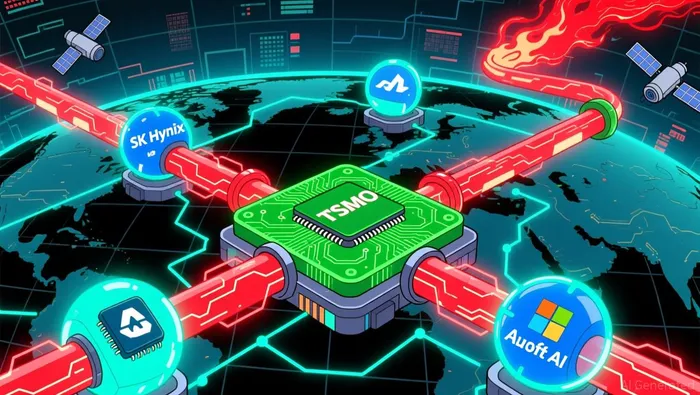
The bottom line is that the AI growth engine is now fueled by scarcity. The sold-out capacity for both CoWoS and HBM through 2026 sets a clear horizon for supply constraints. This structural reality provides a durable foundation for the revenue growth and market expansion that scalable leaders like Microsoft and TSMC are engineered to deliver.
Microsoft: Scaling the Cloud and AI Software Stack
For a growth investor, Microsoft's story is one of deep market penetration and a scalable software stack. Its contracted backlog of nearly $400 billion is the clearest signal of pre-sold demand, representing a multiyear horizon of revenue visibility. This isn't just a cloud services figure; it's a measure of the Total Addressable Market (TAM) the company has already captured through its enterprise integration. The scale is staggering, reflecting a software layer that is becoming indispensable to business operations.
That integration is now being powered by real-world AI adoption. Microsoft's AI features have crossed the threshold from novelty to necessity, with over 900 million monthly active users for its AI offerings. More specifically, its Copilot platform has achieved significant traction, with 150 million monthly active Copilot users. The data shows this isn't a superficial rollout. A recent analysis of user conversations revealed that Copilot has become a vital daily companion, with health-related queries dominating mobile usage-a sign of deep, embedded integration into personal and professional routines. This kind of adoption is the hallmark of a scalable platform, moving beyond productivity tools to manage workflows across Microsoft 365, GitHub, and security.
Yet, the stock's recent path presents a potential inflection point. After a strong run, Microsoft shares have pulled back, falling below $500 in September and trading around $487 as of late October. This underperformance is notable, as the stock gained about 16.65% in 2025, slightly trailing the S&P 500 and significantly lagging peers like Nvidia and Alphabet. The pullback, which saw the stock fall below key technical levels, may reflect a rotation out of some of the year's best performers. For a growth-focused investor, this volatility can create a more attractive entry point, especially when viewed against the durable, multi-year growth embedded in that $400 billion backlog and the deepening user base for its AI software stack.
TSMC: The Scalable Foundry Backbone
For a growth investor, TSMC is the ultimate scalable backbone. Its business model is built on being the indispensable manufacturer for the world's most advanced chips, a role that has driven explosive revenue growth. The numbers are staggering: full-year 2025 revenue surged 31.6% year on year to NT$3,809.1 billion. This isn't just a cyclical bounce; it's the sustained acceleration of a foundry that is the single largest beneficiary of the AI hardware build-out. The scale of this growth is the clearest evidence of a model that can absorb massive, multi-year demand.
That growth has been rewarded with a premium valuation that reflects market confidence in its dominant capacity. TSMC shares have gained more than 52% in the past year and now trade at a trailing P/E of 33x. This multiple expansion is a direct bet on the company's ability to deliver on its sold-out capacity through 2026 and beyond. Analysts see this as justified, with JPMorgan noting that most "mission-critical" 2nm projects will go to TSMC, even as competition like Intel's foundry gains traction. The premium is a market price for the economic moat created by being the sole, proven leader in advanced packaging and next-generation nodes.
The company is committing massive capital to ensure it can scale that capacity globally. Evidence of this commitment is found in its financial structure, with intra-group financing and guarantees supporting its overseas operations, including its Washington plant. This isn't just a regional expansion; it's a strategic, capital-intensive build-out to secure supply chains and meet pre-sold demand from its key customers. The scale of these investments, backed by intra-group loans, underscores the long-term, multi-year horizon of the AI growth cycle that TSMC is engineered to serve.
The bottom line is that TSMC's growth trajectory is defined by its role as the essential, scalable partner. Its revenue growth proves the model works, its premium valuation prices in its dominance, and its overseas investments signal a commitment to scaling capacity for the decade ahead. For the growth investor, TSMC represents the foundational layer of the AI stack, where the scalability of manufacturing directly translates to the scalability of the entire industry.
Catalysts, Risks, and the Decades-Long Hold
The decade-long growth thesis for AI's scalable engines hinges on a few critical future events and potential threats. The primary catalyst is the successful ramp of next-generation manufacturing nodes and the resolution of advanced packaging bottlenecks. For TSMC, this means executing flawlessly on its 2nm and 1.6nm technology transitions while expanding CoWoS capacity to meet pre-sold demand. The company's intra-group financing and guarantees for its global build-out, including its Washington plant, are the financial fuel for this expansion. For Microsoft, the catalyst is the execution of its own massive capacity plans, aiming to increase its AI capacity by over 80% in fiscal 2026 and double its data center footprint. The successful scaling of both the hardware backbone and the cloud software stack will determine if the current growth trajectory can be sustained.
A key risk to this thesis is a shift in enterprise AI adoption or a slowdown in generational sentiment that could impact the Total Addressable Market for software and cloud services. While current demand is pre-sold, the long-term TAM depends on continued enterprise spending and seamless integration into workflows. Evidence of potential friction exists in the form of user anxiety, as a Walton-GSV-Gallup survey found 41% of Gen Zers feel anxious about AI. This disconnect between exposure and guidance could, over time, slow adoption rates if not addressed by education and clear workplace policies. For Microsoft, whose software stack is deeply embedded in enterprise operations, a broad-based slowdown in AI enthusiasm could dampen the growth of its Copilot platform and Azure AI services, even with a massive backlog.
The critical validation point for both companies is the execution of capacity expansions and the monetization of their large backlogs. For TSMC, this means converting its sold-out capacity through 2026 into consistent, high-margin revenue as it navigates the complexities of overseas expansion. For Microsoft, it means converting its nearly $400 billion contracted backlog into quarterly revenue growth that meets or exceeds the 26% cloud revenue increase seen last quarter. The successful monetization of this backlog will confirm the scalability thesis and justify the premium valuations that reflect multi-year growth. Conversely, any significant delay or cost overrun in capacity builds would be a major red flag, signaling that the structural supply constraints may not be as durable as currently priced in. The next 12 to 24 months will be the proving ground for the decade-long hold.





Comentarios
Aún no hay comentarios