
Microsoft's Strategic AI Expansion in the UAE and Its Implications for Tech Stock Valuation
A Geopolitical Power Play with Strategic Safeguards
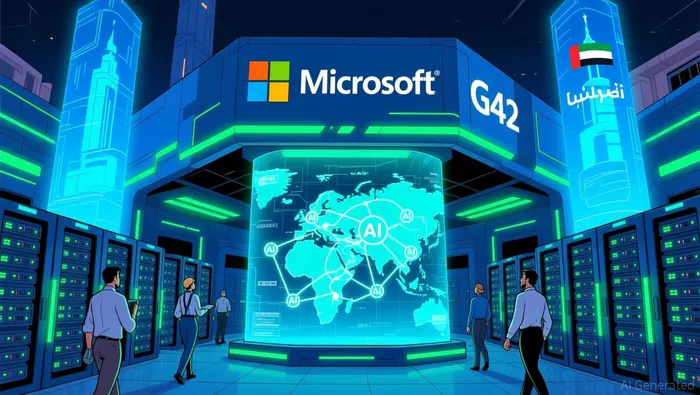
The UAE's ambition to become a global AI hub by 2031 is no longer a distant dream. Microsoft's collaboration with G42 and the JAHIZ platform-backed by U.S. export licenses for advanced NvidiaNVDA-- chips, as detailed in a Menafn report-highlights a calculated effort to navigate U.S. export control policies while securing cutting-edge infrastructure. , as noted in a report from ARN News, already outpaces global peers, and Microsoft's investment aims to accelerate this trend.
Yet, the geopolitical risks are real. The UAE's $1.4 trillion investment in U.S. energy and AI projects, as described in a Microsoft blog, must contend with regional competition, a Digital Bricks AI report. Microsoft's mitigation strategy? A $1.5 billion equity stake in G42, paired with an Intergovernmental Assurance Agreement (IGAA) to align with U.S. cybersecurity and export control standards, as reported by a Carbon Credits article. This framework not only de-risks technology transfer but also positions the UAE as a testbed for U.S. AI diplomacy in the Middle East.
Financial Projections and the AI-Driven Valuation Equation
Microsoft's AI infrastructure spending is staggering. By 2025, the company plans to invest $80 billion in data centers globally, as noted in a TechCrunch report, with $4.6 billion already allocated to UAE projects. This aligns with its Climate Innovation Fund (CIF), , as detailed in a Market.us report. For investors, the question is whether these capital expenditures will translate into sustainable returns.
The answer lies in the AI process optimization market, , as reported by a Market.us report. Microsoft's partnerships with ADNOC and Masdar to develop AI-driven energy solutions, as reported in a Computer Weekly article, are not just about ESG compliance-they're about capturing a slice of this booming market. However, , as reported in a Financial Content article, underscores investor skepticism. , the market is questioning whether the long-term payoff justifies the short-term pain.
Talent Development: The Unsung Catalyst
While infrastructure and geopolitics dominate headlines, , as reported in a TechCrunch report. By upskilling government employees, students, and faculty, MicrosoftMSFT-- is building a local talent pipeline that reduces dependency on foreign labor and accelerates AI adoption. This human capital investment, though less tangible, is a critical component of long-term value creation.
The Bottom Line: Balancing Risk and Reward
Microsoft's UAE strategy is a masterclass in balancing ambition with caution. The company is hedging against geopolitical volatility by securing U.S. export licenses, investing in local talent, and aligning with global sustainability goals. Yet, , as reported in a Financial Content article-reminds us that even the most strategic moves can face headwinds.
For investors, the key takeaway is this: Microsoft's AI expansion in the UAE is not just a regional play-it's a blueprint for navigating the intersection of technology, geopolitics, and capital. While short-term volatility is inevitable, the long-term potential for value creation is immense, provided the company can maintain its innovation edge and geopolitical agility.





Comentarios
Aún no hay comentarios