
The Microsoft-Nebius AI Infrastructure Pact: A Game-Changer for Cloud Computing Markets?
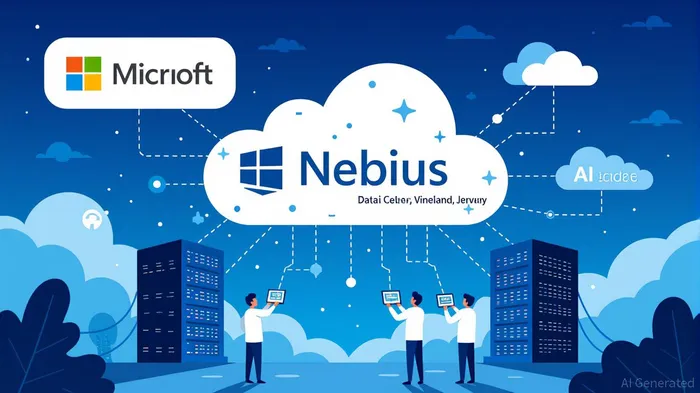
The recent $17.4–$19.4 billion partnership between MicrosoftMSFT-- and Nebius GroupNBIS-- has sent shockwaves through the AI infrastructure and cloud computing markets, signaling a pivotal shift in how tech giants secure and scale their AI capabilities. This multiyear agreement, which grants Microsoft access to dedicated GPU computing capacity from a new data center in New Jersey, underscores the surging demand for AI-driven services and the urgent need for resilient infrastructure. For investors, the deal raises critical questions: How will this partnership reshape market dynamics? What long-term implications does it hold for competitors and the broader industry?
Microsoft's Strategic Gambit: Securing AI's Future
Microsoft's collaboration with NebiusNBIS-- is a calculated move to address its own AI capacity constraints. Despite record investments in data centers, the company has struggled to keep pace with the explosive growth in AI workloads, particularly for generative AI and large language models . By outsourcing GPU infrastructure to Nebius, Microsoft adopts a hybrid strategy—combining in-house development with third-party partnerships—to ensure scalability without overextending its capital expenditures .
This approach mirrors Microsoft's broader cloud strategy, where it has increasingly relied on specialized partners like CoreWeaveCRWV-- to diversify its supply chain and mitigate risks tied to hardware bottlenecks . The Nebius deal, however, is the most significant to date, with its potential to expand to $19.4 billion by 2031. Analysts argue this reflects a growing industry trend: long-term infrastructure agreements to lock in capacity amid global chip shortages and rising demand .
Nebius's Rise: From Yandex Spinoff to AI Infrastructure Powerhouse
For Nebius, the partnership is a validation of its business model and a springboard to global prominence. As a former Yandex subsidiary spun off in 2022, Nebius has rapidly positioned itself as a specialized AI infrastructure provider, leveraging its expertise in GPU clusters and cloud optimization. The Microsoft deal not only secures $17.4 billion in guaranteed revenue but also accelerates its expansion into the U.S. market, a critical step for long-term growth .
Financially, the impact is already evident. Nebius reported a 625% year-over-year revenue surge to $105.1 million in Q2 2025, driven by this partnership, and raised its annual recurring revenue guidance to $900 million–$1.1 billion . Its stock price soared 47% post-announcement, reflecting investor optimism about its scalability and profitability . Yet, challenges remain. Nebius faces intense competition from hyperscalers like AmazonAMZN-- and Microsoft itself, while its high Price/Book ratio of 4.7X suggests a speculative valuation that could be vulnerable to execution risks .
Market Implications: A New Era of Collaboration or Competitive Frenzy?
The Microsoft-Nebius pact is likely to catalyze a wave of similar partnerships in the AI infrastructure space. As generative AI adoption accelerates, companies will prioritize securing GPU capacity through long-term contracts rather than building entirely new data centers—a costlier and time-intensive approach . This could lead to a bifurcation of the market: hyperscalers like Microsoft and Amazon will dominate through scale and partnerships, while smaller, specialized firms like Nebius and CoreWeave will carve niche roles as infrastructure enablers.
However, the deal also raises concerns about market concentration. If Microsoft's Azure becomes increasingly reliant on third-party GPU providers, it could face pricing pressures or supply chain vulnerabilities. Competitors may respond by accelerating their own infrastructure investments or forming rival alliances. For example, Amazon's recent expansion of its EC2 AI-optimized instances suggests it is preparing for such a scenario .
Investment Considerations: Opportunity or Overhype?
From an investment perspective, the partnership presents a dual narrative. For Nebius, the deal offers a clear path to profitability and market leadership—if it can execute on its expansion plans. However, its stretched valuation and reliance on a single client (Microsoft accounts for a significant portion of its projected revenue) pose risks. Investors should monitor its capital expenditure efficiency and ability to diversify its customer base beyond Microsoft .
Microsoft, meanwhile, appears to be in a stronger position. The partnership reinforces its dominance in AI cloud services, particularly with the integration of models like OpenAI's GPT into Azure. Truist analysts have raised their price target for Microsoft stock, citing sustained momentum in cloud and AI growth . Yet, the company's reliance on external partners could complicate its ability to differentiate its offerings in a crowded market.
Conclusion: A Win-Win or a Precarious Balance?
The Microsoft-Nebius partnership is a landmark deal that highlights the urgency of securing AI infrastructure in a rapidly evolving landscape. For Microsoft, it's a pragmatic solution to capacity constraints; for Nebius, it's a transformative opportunity. However, the long-term success of this collaboration will depend on execution, market dynamics, and the ability of both parties to adapt to technological shifts. Investors should view this deal as a sign of the times: AI infrastructure is no longer a commodity but a strategic battleground where partnerships and innovation will define the next decade.





Comentarios
Aún no hay comentarios