
Microsoft and HCA Healthcare: A Value Investor's Look at Durable Moats
The market's record highs have left many investors feeling conflicted. On one hand, the relentless climb is exciting. On the other, some indicators suggest we are playing with fire. The most famous of these is the Buffett indicator, which compares the total market capitalization of U.S. stocks to the nation's GDP. As of this writing, it stands at a record nearly 234%. Warren Buffett himself has used this ratio to spot dangerous valuations, warning that when it approaches 200%, you are "playing with fire." For a value investor, this isn't a call to sell everything, but a stark reminder that the margin of safety-the cushion between price and intrinsic value-is thin.
A true value investment is not about catching a falling knife or timing the market's next move. It is about identifying companies with a wide and durable economic moat, capable of compounding earnings for decades. In uncertain times, the focus must shift from short-term noise to long-term resilience. The primary risk is not a single event, but a protracted period of stress that reveals the strength of a company's underlying business. That is the test.
This sets the stage for a disciplined analysis. We are looking for businesses that can navigate volatility, maintain their competitive position, and continue to generate cash flow even when the broader economy stumbles. The goal is not to predict the market's next swing, but to build a portfolio of companies whose intrinsic value grows steadily, regardless of the headlines. For 2026, that means focusing on the quality of the business, not the price of the stock.
Microsoft: The Software Moat and Cash Flow Engine
For a value investor, MicrosoftMSFT-- presents a classic case of a durable moat meeting a disciplined capital allocation policy. The company's strength is not in a single product, but in a vast ecosystem of software and services that are deeply embedded in the daily operations of businesses and individuals worldwide. This creates high switching costs and a pricing power that is difficult to challenge, forming the foundation of its economic moat.
A key driver of this moat's expansion is its cloud computing business. The company's Azure revenue has grown at a 34% clip, a figure that speaks to both scalability and competitive advantage. This growth is not just about adding new customers; it's about deepening relationships with existing ones, locking them into a platform that integrates with its operating systems, productivity tools, and AI offerings. In a downturn, this stickiness provides a buffer, as businesses are less likely to abandon a core infrastructure component.
Financially, the company operates like a cash-generating machine. Its 23-year dividend history and 19 consecutive years of dividend growth are hallmarks of a mature, cash-rich business with predictable earnings. This track record signals management's confidence in the sustainability of its profits and its commitment to returning capital to shareholders-a discipline that compounds value over the long term. The company's balance sheet strength is a further testament to this resilience. With the highest credit rating available, even above that of the U.S. government, Microsoft possesses a formidable financial buffer to navigate any macroeconomic stress.
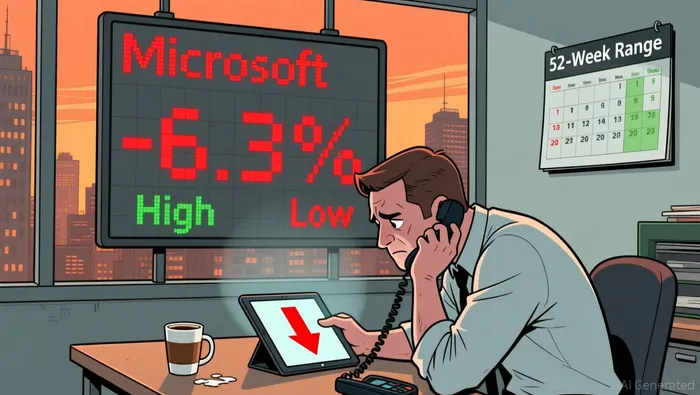
The stock's recent performance reflects the market's broader volatility. Over the last 120 days, shares have declined by 6.3%, a move that has brought the price down from its 52-week high of $555.45 to around $478. Yet, it remains well above the 52-week low of $344.79. This pullback, while notable, appears to be a normal correction within a long-term uptrend rather than a fundamental breakdown. The underlying demand for its products and services, evidenced by the continued growth in Azure and the unwavering dividend policy, suggests the intrinsic value of the business has not diminished.
For a long-term investor, the current price offers a chance to buy a wide-moat business at a discount to its historical highs. The key is to look past the short-term noise and focus on the company's ability to compound earnings through its entrenched software and cloud platforms. In a market where the Buffett indicator warns of thin margins of safety, Microsoft's combination of durable competitive advantages and disciplined capital returns makes it a cornerstone holding.
HCA Healthcare: Recession-Resilient Cash Flows and Strategic Growth
For a value investor, HCA HealthcareHCA-- represents the classic defensive characteristic of a durable moat: a business that generates stable cash flows regardless of the broader economic cycle. The company operates a vast network of hospitals and healthcare facilities, and the demand for medical services is inherently less sensitive to recessions than, say, discretionary consumer spending. As the evidence notes, patients won't stop demanding medical services in the event of a market crash, and third-party payers often cover a significant portion of the bill. This creates a natural shock absorber, allowing HCAHCA-- to maintain relatively consistent financial results when other sectors falter.
Management's long-term perspective is evident in its strategic focus. Over the past 15 years, the company has prioritized patient outcomes and market share growth, a disciplined approach that builds a competitive moat. This isn't about chasing quarterly earnings; it's about investing in quality and scale. A key driver of this growth strategy is the company's focus on technology. By investing in systems that improve clinical outcomes and operational efficiency, HCA aims to enhance its service quality, attract more patients and physicians, and solidify its position in a consolidating healthcare landscape. This is the kind of patient, value-oriented capital allocation that compounds intrinsic value over decades.
The primary catalyst for HCA is continued market share gains. As the industry consolidates, a well-capitalized operator with a proven track record of quality care is well-positioned to acquire assets and expand its footprint. This organic and inorganic growth path is the engine for future earnings expansion. The main risk, as with any regulated business, is changes in regulation or reimbursement policies. However, the company's scale and operational expertise provide a buffer against these headwinds, allowing it to adapt and maintain profitability.
In the current environment, where the labor market shows signs of resilience but economic uncertainty persists, HCA's model offers a clear advantage. Its ability to generate stable cash flows during downturns, combined with a strategic growth plan focused on quality and scale, makes it a compelling holding for investors seeking durable compounding in a volatile market.
The Value Investor's Checklist
With the market's record highs and the Buffett indicator flashing a warning, the question for any value investor is whether the wide moats we've identified are still priced in. The answer hinges on a careful evaluation of margin of safety for each candidate.
For Microsoft, the valuation metrics are a clear double-edged sword. The stock trades at a P/E TTM of 33.87 and a P/B of 9.79. These are not the numbers of a bargain; they reflect the market's high expectations for continued, high-growth execution in cloud and AI. This leaves little room for error. A stumble in growth or a shift in competitive dynamics could quickly challenge these multiples. Yet, the stock's recent path provides a partial buffer. At $478.11, it is still 14% below its 52-week high of $555.45. This pullback, while modest, offers a bit more of a cushion than if the shares were trading at their peak. The key for a value investor is to weigh the premium for a durable moat against the risk of those expectations being met or exceeded.
HCA Healthcare presents a different calculus. Its business model offers a natural defensive moat, as the evidence notes that patients won't stop demanding medical services in the event of a market crash. This inherent stability is a powerful long-term advantage. However, a true margin of safety requires scrutinizing its balance sheet. The company operates with significant leverage to fund its growth and acquisitions. In a prolonged downturn, even a recession-resilient cash flow can be strained if interest rates remain elevated or reimbursement changes. The valuation must therefore account for this financial risk, not just the quality of its operations.
The overarching question for both is whether their wide moats and cash flows are already priced in, or if a market downturn could create a buying opportunity. In the current environment, where the labor market shows resilience but economic uncertainty persists, the answer leans toward the latter. The market's thin margin of safety, as signaled by the Buffett indicator, suggests that even high-quality businesses may face volatility. For Microsoft, the margin of safety is a function of growth expectations meeting reality. For HCA, it is a function of leverage meeting stress. Both are compelling businesses, but the value investor must ask: at today's prices, are they still being paid for the future, or are they being sold at a discount to their long-term intrinsic value?
Catalysts, Risks, and What to Watch
For a value investor, the goal is to identify the specific factors that will confirm or challenge a company's durable moat. It's about building a monitoring framework that separates long-term business quality from short-term market noise.
For Microsoft, the key watchpoint is the sustainability of its cloud growth and the company's ability to navigate AI spending cycles without margin compression. The company's cloud division has been a primary driver of its recent success, and maintaining that momentum is critical. However, the market has recently shown concern over AI spending, with tech stocks suffering in December amid these worries. The risk is that as AI investments mature, the company could face pressure to reduce spending or see slower adoption, which might compress margins. The positive catalyst is that Microsoft's high switching costs and integrated ecosystem provide a natural buffer. If cloud growth remains robust and the company can manage its capital allocation discipline, it will continue to compound value. The bottom line is that Microsoft's moat must be tested by its ability to convert massive investments into sustained, profitable growth.
For HCA Healthcare, the primary risk is regulatory or reimbursement changes, while the catalyst is continued market share gains in a consolidating healthcare landscape. The company's defensive moat relies on stable cash flows, but these are vulnerable to shifts in government or insurance policies that alter payment rates. The evidence notes that patients won't stop demanding medical services in the event of a market crash, but payers might. The positive catalyst is the industry's consolidation trend. As a well-capitalized operator, HCA is positioned to acquire assets and expand its footprint, driving future earnings. The key for investors is to monitor both the pace of these acquisitions and any early signals of regulatory pressure.
The overarching catalyst for both companies is a market environment that forces a re-rating of quality businesses. In a period of stress, the market often revalues companies based on their resilience. Microsoft's rock-solid balance sheet and high credit rating act as a shock absorber, while HCA's recession-resilient cash flows provide a similar buffer. The current market conditions, with the labor market showing resilience but economic uncertainty persisting, create a setup where these defensive characteristics become more apparent. If a broader market correction occurs, the value of these wide moats and their ability to generate cash through volatility could lead to a re-rating. For now, the watch is on the specific drivers: cloud execution for Microsoft and regulatory/consolidation dynamics for HCA.







Comentarios
Aún no hay comentarios