
Microsoft's EU Regulatory Navigation and Competitive Resilience: A Strategic Assessment for Enterprise Software Dominance
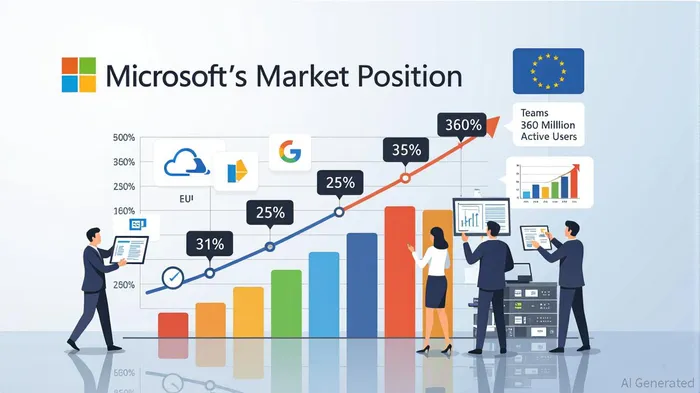
In the evolving landscape of European technology regulation, Microsoft's ability to navigate antitrust scrutiny and align with emerging AI governance frameworks will be pivotal to its long-term growth resilience. The company's recent concessions to unbundle Teams from its Office 365 and MicrosoftMSFT-- 365 suites, accepted by the European Commission in late 2025, underscore its strategic adaptability in a market where regulatory pressures are intensifying[1]. This settlement, which avoids potential fines of up to 10% of annual global revenue, reflects Microsoft's proactive approach to balancing compliance with competitive positioning[2].
Regulatory Compliance: A Double-Edged Sword
Microsoft's decision to unbundle Teams from its productivity software suite—initially implemented in Europe in October 2023 and expanded globally in April 2024—addresses EU concerns over anti-competitive bundling practices[3]. By offering Teams-less pricing packages and enhancing interoperability with rivals like Slack and ZoomZM--, Microsoft has mitigated regulatory risks while preserving its core enterprise software ecosystem. According to a report by Bloomberg Law, this agreement not only averts a costly antitrust penalty but also signals the company's willingness to modify its business model to align with EU competition law[1].
However, these concessions come with trade-offs. The unbundle could theoretically empower competitors to capture market share in collaboration tools, particularly as enterprises seek alternatives to Teams. Yet, Microsoft's dominance in adjacent markets—such as cloud infrastructure (Azure holds 25% of the global cloud infrastructure market[4]) and productivity software (Office 365 secures 31% of the global office-productivity market[5])—provides a buffer against such threats. The EU's broader regulatory environment, including the AI Act and Data Act, further complicates the competitive landscape, but Microsoft's participation in the General-Purpose AI (GPAI) Code of Practice demonstrates its commitment to preemptively aligning with EU standards[6].
Market Dynamics: Growth Amidst Regulatory Headwinds
The European software market, valued at €205.4 billion in 2025 and projected to grow at a 3.8% compound annual rate through 2031[7], remains a critical battleground for enterprise software providers. Microsoft's hybrid cloud dominance (38% market share[4]) and its AI-driven innovations, such as Copilot integration in 95% of Microsoft 365 enterprise tenants[8], position it to capitalize on digital transformation trends. Despite regulatory constraints on Teams, the platform's 360 million monthly active users as of Q1 2025[8] highlight its entrenched role in enterprise workflows.
Competitive pressures persist, however. GoogleGOOGL-- Apps' 44% global share in office productivity software[5] and the EU's emphasis on data portability under the Data Act could erode Microsoft's market share. Yet, the company's regulatory compliance efforts—such as adjusting Teams licensing structures to ensure transparency[9]—mitigate these risks by fostering trust with EU regulators and customers.
Long-Term Resilience: Strategic Adaptability in a Regulated Era
Microsoft's resilience hinges on its capacity to harmonize regulatory compliance with innovation. The GPAI Code of Practice, which the company signed alongside peers like Google and OpenAI, offers a voluntary framework to demonstrate adherence to the EU AI Act[6]. This proactive stance reduces administrative burdens and positions Microsoft as a collaborator in shaping EU AI policy, a critical advantage in an environment where non-compliance could lead to operational disruptions.
Moreover, the EU's focus on systemic risk mitigation for high-impact AI models aligns with Microsoft's Enterprise AI Services Code of Conduct, which mandates human oversight and secure deployment practices[10]. By embedding compliance into its product development lifecycle, Microsoft not only avoids penalties but also reinforces its reputation as a responsible AI leader—a differentiator in risk-averse European markets.
Conclusion: A Calculated Path to Sustained Dominance
While regulatory challenges in the EU present short-term constraints, Microsoft's strategic concessions, coupled with its leadership in cloud and AI, reinforce its long-term competitive edge. The company's ability to transform compliance obligations into opportunities—such as leveraging the GPAI Code to streamline AI governance—demonstrates a maturity that few rivals can match. For investors, Microsoft's EU strategy exemplifies how regulatory navigation, when executed with foresight, can coexist with market dominance.





Comentarios
Aún no hay comentarios