
Microsoft Corp: Unlocking Intrinsic Value Through AI and Cloud Dominance in the 2025-2030 Era
In the rapidly evolving landscape of artificial intelligence (AI) and cloud computing, Microsoft CorpMSFT-- (MSFT) has emerged as a defining force, leveraging its strategic investments and ecosystem integration to secure a commanding position. As of Q3 2025, Microsoft's Intelligent Cloud segment , . This performance, coupled with a long-term vision that projects AI and cloud technologies to generate $22.3 trillion in global economic value by 2030, underscores a compelling case for intrinsic value rooted in sustainable profitability and innovation.
Financial Performance: Scaling AI Infrastructure Amid Margin Pressures
Microsoft's Q3 2025 results highlight both the opportunities and challenges inherent in scaling AI capabilities. , , with in the cloud market. However, due to the capital-intensive nature of AI infrastructure expansion. This trade-off is intentional: , , .
The company's aggressive capital expenditures (capex) further illustrate its commitment to long-term gains. In 2025, , with -a pace outstripping competitors like Amazon (AWS) and Google, . These investments are not merely defensive but strategic, as AI workloads increasingly dictate cloud demand. For instance, , with AI services (particularly OpenAI-powered tools like ChatGPT) driving customer adoption.
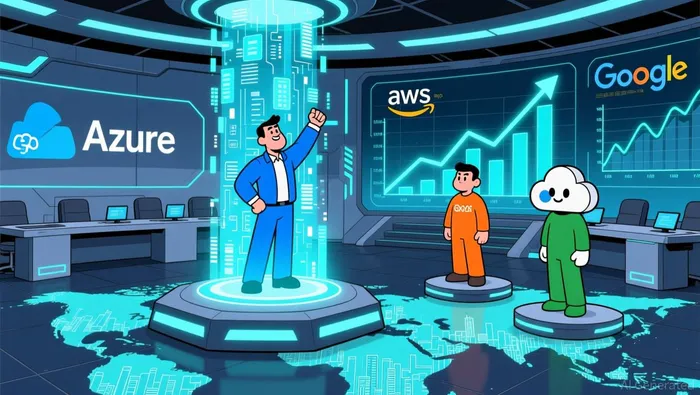
Strategic Ecosystem Integration: A Competitive Moat
Microsoft's intrinsic value is fortified by its integrated ecosystem of AI and cloud services. The company's partnership with has created a flywheel effect: Azure provides the infrastructure to power OpenAI's models, while OpenAI's innovations enhance Azure's appeal to enterprise clients. This synergy is evident in . By contrast, AWS remains focused on traditional AI, , .
The and Azure AI Foundry further exemplify the company's ability to monetize AI across verticals. These tools enable enterprises to deploy customized AI solutions at scale, creating recurring revenue streams and deepening customer lock-in. As stated by Microsoft in its FY25 Q3 performance report, the company's focus on "operational efficiency and new revenue streams through advanced AI workloads" is central to its sustainable profitability model.
Competitive Positioning: Leading the AI-Cloud Convergence
Microsoft's dominance in the AI-cloud convergence is reshaping market dynamics. As of Q2 2025, , . This leadership is underpinned by its ability to balance aggressive AI investments with profitability. While AWS and Google Cloud are expanding data centers at historic rates, , driven by Azure's scalability.
The company's market position is further strengthened by its open-source collaborations and enterprise partnerships. For example, , enabling them to train and deploy without building proprietary infrastructure. This approach not only accelerates AI adoption but also aligns with Microsoft's long-term goal of becoming the "operating system for AI", a vision articulated in its FY25 Q3 investor materials.
Sustainable Profitability: Balancing Capex and Long-Term Returns
Critics may question whether Microsoft's AI and cloud investments will erode margins, but the company's financial discipline and scale suggest otherwise. , driven by AI engineering investments, -a sign that economies of scale are offsetting costs. Moreover, reflects investor confidence in its ability to monetize AI infrastructure over time.
The key to sustainable profitability lies in Microsoft's ability to transition from infrastructure costs to recurring revenue. For instance, Azure's AI services are already generating incremental revenue through APIs and enterprise licensing, . These monetization strategies, combined with , position it to deliver compounding returns for shareholders.
Conclusion: A Defining Investment in the AI Era
Microsoft's intrinsic value is not merely a function of its current financials but a reflection of its strategic foresight in aligning with the AI and cloud computing revolution. By investing aggressively in infrastructure, fostering an integrated ecosystem, and maintaining operational discipline, . For investors, the company's ability to balance capex with profitability-while outpacing competitors in both AI and cloud adoption-makes it a cornerstone holding in the next decade of technological transformation.





Comentarios
Aún no hay comentarios