
Microsoft’s Brand Value Surges 23% as Market Overlooks Erosion of U.S. Global Trust
The numbers tell a story of powerful, conflicting forces. On one hand, the U.S. brand market is booming, with the top 500 brands valued at $6.44 trillion, a 10% year-on-year increase. This growth is anchored by tech giants like AppleAAPL--, MicrosoftMSFT--, and GoogleGOOGL--, which collectively represent over half the value of the entire global brand market. On the other hand, the nation's international reputation is slipping, with the U.S. suffering a 4.6-point decline in the Brand Finance Global Soft Power Index-the steepest drop among 193 countries.
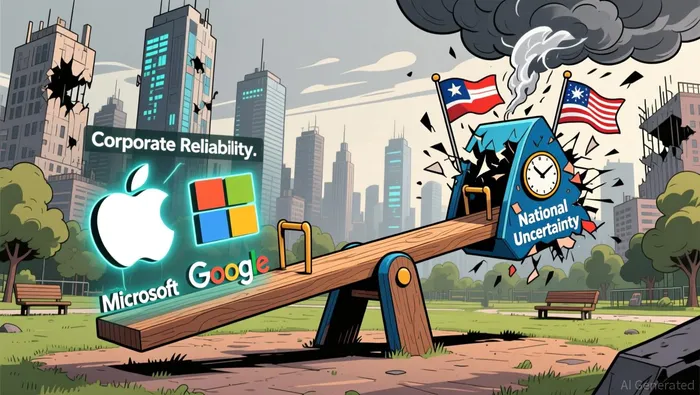
This is the core anomaly. The market is assigning premium valuations to U.S. corporate brands even as the broader national brand perception weakens. The explanation lies in a fundamental shift in what investors are valuing. The market is not pricing U.S. brands on their national influence or geopolitical stability. It is pricing them on perceived corporate reliability and operational excellence-a classic case of behavioral finance at work.
Investors are exhibiting a form of cognitive bias known as "corporate insulation." They are focusing on the internal strength and innovation track record of these dominant firms, treating them as self-contained entities with predictable cash flows. The high Brand Strength Index scores and AAA+ ratings for Apple, Microsoft, and Google signal to the market a level of corporate stability and trustworthiness that feels insulated from the broader national uncertainty. This creates a psychological disconnect: the market is prioritizing the perceived safety and dominance of these corporate giants over the perceived risks and instability in the country that houses them. The result is a valuation that reflects investor psychology-a preference for corporate reliability-rather than a rational assessment of national brand power.
Behavioral Drivers: The Biases Behind the Valuation
The market's focus on corporate brand strength over national sentiment is not a rational calculation. It is a predictable outcome of several well-documented cognitive biases that distort investor judgment. These biases create a feedback loop where the perceived stability of dominant tech firms reinforces their market dominance, while broader geopolitical concerns are systematically downplayed.
The first driver is a powerful form of loss aversion. Investors are not just seeking growth; they are seeking safety. The high Brand Strength Index scores and AAA+ ratings for firms like Apple, Microsoft, and Google signal a level of corporate reliability and operational excellence that feels insulated from external shocks. This perceived stability acts as a psychological anchor, reducing the fear of catastrophic failure. In a world of rising uncertainty, the market is overweighting the lower "failure risk" of these established giants. The sheer scale of their brand value-Apple alone worth more than most national GDPs-creates a powerful illusion of invincibility that is difficult to ignore.
This perception is then amplified by herd behavior and confirmation bias. The dominance of tech giants in the world's most valuable brands list is undeniable. Apple, Microsoft, and Google collectively represent more than $1.6 trillion in brand value, and they anchor the U.S. digital dominance. This creates a self-reinforcing narrative: American innovation is synonymous with these high-profile names. When investors see these companies consistently leading, they are more likely to follow the crowd, assuming that if everyone else is buying, it must be the right move. This herd instinct is reinforced by confirmation bias, where investors selectively notice and give weight to news that supports the narrative of corporate strength while dismissing or minimizing negative geopolitical headlines that challenge it.
Finally, valuations are heavily anchored to recent corporate performance and market leadership. The evidence is clear: these brands are not just big, they are growing. Technology leaders Apple (brand value up 6%), Microsoft (up 23%), and Google (up 5%) are all expanding their brand value year-on-year. This recent track record of financial success and market leadership provides a concrete, positive anchor point for valuation. It overshadows the more abstract and longer-term concerns about national brand perception. The market is essentially saying, "These companies are delivering strong results now, so we'll focus on that." This anchoring effect makes it difficult for broader, more intangible risks to shift the narrative, even as the underlying national brand sentiment weakens.
Financial Impact and Valuation Implications
The behavioral biases driving the market's focus on corporate strength are translating directly into financial performance and valuations. The top 500 U.S. brands grew at a 10% year-on-year pace, a robust expansion that underpins their market dominance. This growth is led by the tech giants whose brand value is surging. Microsoft's brand value climbed 23%, while Apple and Google also posted solid gains of 6% and 5%, respectively. This isn't just accounting; it's a reflection of real market power. The sheer scale of their growth-Microsoft's brand value now at $565.2 billion-creates a powerful feedback loop. Strong performance justifies high valuations, which in turn fund further innovation and market expansion, reinforcing the narrative of corporate invincibility.
This corporate strength is the bedrock of current market valuations. The high Brand Strength Index scores and AAA+ ratings for these leaders signal to investors a low-risk profile, directly supporting premium price-to-earnings multiples and market caps. The market is essentially paying for perceived safety and predictable cash flows. Yet this creates a clear vulnerability. The valuation regime is built on a disconnect between corporate brand power and national trust. As the report notes, the U.S. suffered a 4.6-point decline in its global soft power index, the steepest drop among nations. This erosion of national credibility is not yet reflected in corporate valuations, but it introduces a latent risk. If geopolitical tensions or policy uncertainty intensify, the psychological anchor of "corporate insulation" could weaken. A shift in investor sentiment from "safe haven" to "exposed asset" could trigger a re-rating, as the market recalibrates the risk premium for these giants.
Looking ahead, the structural demand for these high-value brands appears secure. The broader investment landscape is expanding, with the global investments market projected to surge to $6.44 trillion by 2030. This growth, driven by digital platforms and diversified portfolios, will continue to funnel capital toward the most trusted and established brands. The market's appetite for stability is likely to persist, supporting the current valuation regime. However, the sustainability of this premium depends entirely on the continued separation between corporate and national narratives. For now, the market's behavioral biases are holding the line. The real test will come if the national brand perception continues to deteriorate without a corresponding decline in corporate performance-a scenario that could force a painful reckoning between psychology and reality.
Catalysts and Risks: What Could Close the Trust-Value Gap
The current market dynamic is a bet on the durability of the corporate-insulation narrative. For that bet to hold, the psychological disconnect between national perception and corporate strength must remain intact. Several forward-looking events and psychological triggers could rapidly close that gap.
A major catalyst would be a significant geopolitical event or a sustained negative news cycle specifically targeting U.S. tech. The market's current valuation is anchored in the perceived safety and operational excellence of giants like Apple, Microsoft, and Google. If a crisis-be it a major regulatory crackdown, a high-profile data scandal, or a geopolitical standoff-were to directly implicate these firms, it could shatter the illusion of insulation. The herd behavior that currently supports these valuations could quickly reverse, as investors scramble to exit what suddenly looks like an exposed asset. The recent 4.6-point decline in the U.S. Soft Power Index signals growing international doubt about U.S. leadership and reliability; a concrete corporate crisis could accelerate that shift from abstract concern to concrete risk.
The more insidious risk, however, is internal erosion. The current high valuations may not be sustainable if consumer trust in U.S. brands themselves begins to wane. This process could be accelerated by a series of product failures, scandals, or perceived missteps that damage brand credibility. The evidence shows that trust is a fragile, category-specific asset. For instance, brands like Lansinoh, Freshpet, and Land O'Lakes are trusted for their reliability in sensitive areas like infant care and food. A major failure in any of these trusted categories could trigger a wave of cognitive dissonance among consumers, forcing a reassessment of the entire U.S. brand ecosystem. If the psychological anchor of "trusted quality" weakens, it could undermine the very foundation of the premium valuations assigned to corporate giants.
The key watchpoint is the early warning signs. Investors should monitor the Brand Finance Global Soft Power Index and consumer trust surveys like the BrandSpark Most Trusted Awards for shifts in perception. A continued decline in national credibility metrics, coupled with a drop in the number of brands topping trust surveys, would signal a broader breakdown in trust. This would be the first tangible evidence that the market's behavioral biases are out of sync with a changing reality. The market's focus on corporate strength is a powerful force, but it is ultimately a human construct. When the collective psychology of safety and trust begins to fracture, the valuation gap between corporate brand power and national perception could close in a hurry.





Comentarios
Aún no hay comentarios