
Microsoft's $6.2 Billion Norway AI Bet: A Blueprint for Sustainable Infrastructure and ESG-Driven AI Leadership
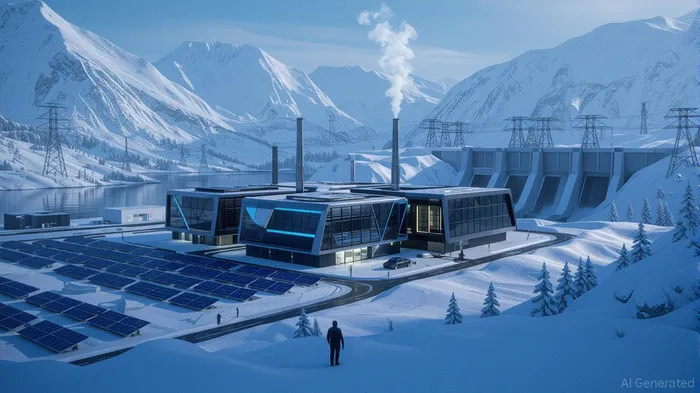
In September 2025, MicrosoftMSFT-- sealed a $6.2 billion agreement with the Aker-Nscale joint venture to build a state-of-the-art AI computing hub in Narvik, Northern Norway. This deal, spanning five years and beginning with staged deployments in 2026, marks a pivotal moment in the tech giant's strategy to dominate the AI infrastructure race while aligning with global sustainability goals. The project, powered entirely by Norway's renewable hydropower and secured grid capacity, underscores Microsoft's dual ambition: to scale AI capabilities and to position itself as a leader in ESG-aligned technology.
Strategic Infrastructure Positioning: Norway as a Sovereign AI Hub
The choice of Narvik is no accident. Norway's cold climate inherently reduces cooling costs for data centers, while its abundant hydropower—accounting for over 90% of the country's electricity—provides a near-zero-emission energy source. According to a report by Bloomberg, Microsoft's investment will leverage these advantages to create a “sovereign AI infrastructure” hub in Europe, reducing reliance on U.S. and Asian hyperscale providers[1]. This aligns with broader European Union goals to achieve climate neutrality by 2050 and to localize critical digital infrastructure[4].
The project also reflects Microsoft's aggressive global expansion. By 2028, the company plans to invest $80 billion in AI-optimized data centers, with Norway joining similar initiatives in the UK and the U.S. The Aker-Nscale joint venture, expected to be formally established by Q3 2025, will scale up to 100,000 NVIDIANVDA-- GPUs by late 2026, ensuring Microsoft can meet surging demand for AI compute power[3]. This vertical integration—controlling both the physical and digital layers of AI infrastructure—positions Microsoft to optimize performance and scalability, as noted in a Forbes analysis of its $30 billion Global AI Infrastructure Investment Partnership (GAIIP) fund[4].
ESG Alignment: Renewable Energy as a Competitive Edge
Microsoft's Norway project is a cornerstone of its 2030 sustainability targets, which include becoming carbon negative, water positive, and zero waste. The 2025 Environmental Sustainability Report highlights that the company has already contracted 34 gigawatts of carbon-free electricity across 24 countries, an 18-fold increase since 2020[2]. The Narvik facility, powered entirely by renewables, will further reduce Microsoft's Scope 1 and 2 emissions while supporting its goal to replenish more water than it consumes globally.
The ESG benefits extend beyond Microsoft. Norway's National Strategy for Artificial Intelligence emphasizes ethical AI development and data sovereignty, creating a regulatory environment that attracts ESG-conscious investors. As stated by Microsoft Norway CEO Kristine Dahl Steidel, the project balances AI's risks with its potential to drive innovation in healthcare, education, and energy—sectors critical to Norway's economic future[2].
Global AI Investment Trends: A Green Shift
Microsoft's move signals a broader industry trend. Global AI spending is projected to reach $1.5 trillion in 2025, with data centers accounting for a significant share. However, energy demands for AI infrastructure are 2-3 times higher than traditional data centers, prompting tech firms to prioritize renewable energy partnerships. Microsoft's collaboration with Constellation EnergyCEG-- to restart the Three Mile Island nuclear facility and its exploration of small modular reactors exemplify this pivot[3].
The Norway deal also highlights the growing role of public-private partnerships in scaling green AI. Aker-Nscale's joint venture model—combining energy expertise with tech innovation—could serve as a template for other regions. As noted in a Reuters analysis, the Nordic region's efficient energy infrastructure is ideal for data center expansion, with Norway's market projected to grow to $2.79 billion by 2030[3].
Conclusion: A Model for the Future
Microsoft's Norway AI project is more than a strategic investment—it's a blueprint for sustainable, ESG-aligned AI infrastructure. By leveraging Norway's renewable energy, the company is addressing the environmental challenges of AI while reinforcing its leadership in a $1.5 trillion global market. For investors, this deal signals a shift toward green AI, where sustainability and scalability are no longer competing priorities but complementary forces. As the world races to harness AI's potential, Microsoft's approach in Narvik may well define the next era of digital innovation.





Comentarios
Aún no hay comentarios