
Micron: Valuation, Risks, and the Memory Market Outlook in 2025
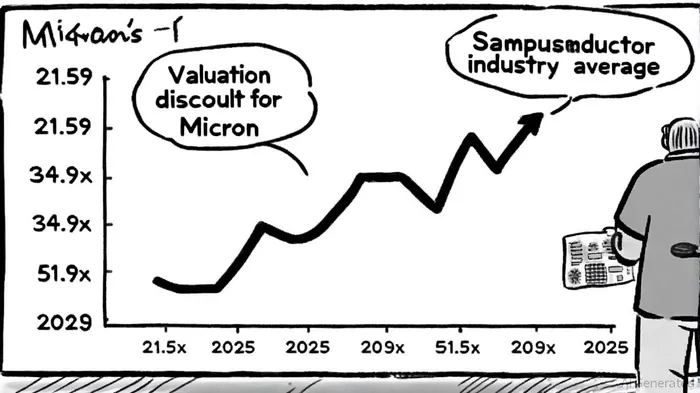
The stock of Micron TechnologyMU-- (MU) trades at a significant discount to its peers and the broader semiconductor industry, raising the question: Is this a buying opportunity or a warning sign of deeper structural challenges? The answer lies in dissecting the interplay of valuation metrics, market dynamics, and geopolitical risks shaping the memory sector in 2025.
Valuation: A Discount Amid Divergent Signals
Micron's trailing P/E ratio of 21.59 and forward P/E of 10.02 are starkly lower than the peer average of 51.5x and the semiconductor industry average of 34.9x, according to a Simply Wall valuation. Its EV/EBITDA ratio of 10.28 also lags behind the industry average, suggesting undervaluation relative to earnings and cash flow, per the Simply Wall valuation. However, a Discounted Cash Flow (DCF) analysis estimates an intrinsic value of $107.85 per share, implying overvaluation given the current price of $156.50 in the Simply Wall valuation. This divergence reflects conflicting assumptions: the DCF model likely discounts Micron's growth prospects, while the low P/E ratio signals optimism about its AI-driven earnings potential.
A proprietary Fair Ratio of 34.4x, which incorporates growth, profitability, and risk, further underscores the valuation gap cited in the Simply Wall valuation. Micron's P/B ratio of 3.39 and P/S ratio of 4.26 also suggest undervaluation relative to book value and sales, though its P/E ratio of 136.81 (as cited in some sources) appears anomalous and likely conflates metrics across timeframes, according to a Nasdaq competitor analysis. For now, the consensus leans toward a valuation discount driven by cyclical skepticism rather than structural pessimism.
Market Dynamics: AI-Driven Growth vs. Cyclical Headwinds
The memory market in 2025 is being reshaped by two forces: the AI boom and the transition from DDR4 to DDR5 and High Bandwidth Memory (HBM). AI-driven demand for HBM has surged, with revenue projected to nearly double to $34 billion in 2025 and account for 50% of the DRAM market by 2030, as projected in a GlobeNewswire report. Micron's strategic pivot to HBM—expanding production capacity by 300%—positions it to capture this growth, according to the GlobeNewswire analysis. Q3 2025 results underscore this momentum: revenue hit $9.3 billion, a 37% year-over-year increase, driven by HBM demand, as shown in Micron Q3 results.
Historical data on Micron's earnings events since 2022 provides additional context. Over 14 earnings releases, the stock has averaged a +1.0% close-to-close move on the day after the report, with a 57% win rate, according to an earnings backtest. However, no time horizon up to 30 trading days has shown statistically significant returns at the 95% confidence level in that backtest. This suggests that while the market occasionally reacts positively to earnings surprises, the effect is muted and insufficient to form a standalone trading strategy without additional filters.
Yet, the sector remains cyclical. DDR4 prices spiked as manufacturers like Samsung and SK hynix delayed phase-outs to meet unexpected demand, creating short-term volatility, according to an Evertiq analysis. While this tightens supply, it also risks overcapacity if demand softens. Micron's inventory levels, however, are near target ranges, mitigating this risk as reported in the Q3 results. The broader market's resilience—bolstered by AI and datacenter upgrades—suggests the current discount may reflect cyclical fears rather than a permanent earnings contraction.
Financial Resilience and Strategic Risks
Micron's financials in Q3 2025 were robust: a 37% revenue increase, a 20.27% net margin (above peers), and $8.4 billion in R&D spending, per the GlobeNewswire analysis. Its debt-to-equity ratio of 0.3, despite a rise in long-term debt to $15 billion, remains manageable, as noted in the Nasdaq competitor analysis. Strategic investments, including a $200 billion U.S. manufacturing expansion under the CHIPS Act, aim to secure a 25% share of the advanced HBM market, detailed in the Q3 results.
Geopolitical risks, however, linger. U.S. export controls and Chinese advancements in 3D NAND and DDR5 production could disrupt Micron's access to key markets, as covered by Evertiq. Chinese firms like YMTC are closing performance gaps, though they still trail leaders like Samsung. Tariffs on memory products further pressure margins, but Micron's focus on high-margin HBM and diversification into automotive and edge computing may offset these costs, according to the GlobeNewswire analysis.
Competitor Landscape: Strengths and Weaknesses
Micron's 32.64% market share in Q2 2025 reflects its competitive edge, particularly in profitability (20.27% net margin vs. industry averages), as described in the GlobeNewswire analysis. However, its ROE of 0.75% and EBITDA of $2.82 billion lag behind peers like Samsung, which dominates DRAM with 44% market share and higher R&D investment, per the Nasdaq competitor analysis. While Micron's AI-driven growth narrows these gaps, structural challenges—such as scaling HBM production to rival Samsung's scale—remain.
Conclusion: A Cyclical Discount or Structural Risk?
Micron's valuation discount appears to reflect cyclical skepticism rather than structural weakness. The company's strong financial performance, strategic alignment with AI-driven HBM demand, and proactive R&D investments position it to capitalize on a $100 billion HBM market by 2030, according to the Q3 results. While geopolitical risks and competition from Chinese firms pose headwinds, these are manageable through diversification and domestic manufacturing.
For investors, the key question is whether the market is overcorrecting for short-term volatility or underestimating the long-term potential of AI-driven memory demand. Given Micron's robust earnings, aggressive HBM expansion, and manageable debt profile, the current discount seems more like a buying opportunity than a warning sign—provided the company can sustain its innovation edge in a rapidly evolving sector.







Comentarios
Aún no hay comentarios