
Micron's Valuation and Market Exposure: Is a Pre-Emptive Exit Justified?
Micron Technology (MU) has emerged as a standout performer in the semiconductor sector, driven by surging demand for AI-related memory solutions. However, investors must weigh its robust fundamentals against significant financial and legal risks to determine whether a pre-emptive exit is warranted ahead of potential volatility.
Valuation Metrics: Undervalued or Overlooked?
Micron's Q2 results show revenue surged 38% year-over-year to $8.05 billion, propelled by strong demand for DRAM and NAND in data centers and AI applications. Non-GAAP net income reached $1.78 billion, translating to a 20% profit margin-a 6 percentage point improvement from Q2 2024. Despite these gains, Micron's trailing P/E ratio of 22.86 as of September 2025, per its MU trailing P/E, lags far behind the U.S. semiconductor industry's average P/E of 62.2x, according to the industry average P/E. This discrepancy suggests the market may be underappreciating Micron's near-term profitability relative to its peers, who trade at a premium due to long-term growth expectations in AI and 5G.
However, the valuation gap also reflects lingering concerns. Analysts at Zacks.com project a $125.27 target price for MicronMU--, implying a 29% upside from its September 2025 price of $96.61, as noted in the Zacks projection. Yet this optimism clashes with the company's recent legal setbacks, including a $445 million patent infringement verdict upheld by a federal appeals court in the Netlist verdict, which could erode investor confidence.
Industry Positioning: A Leader in the AI Memory Revolution
Micron reported HBM revenue exceeded $1 billion in Q2 2025 and is projected to reach a $6 billion annual run-rate by year-end. Strategic partnerships with Nvidia and AMD, coupled with U.S.-based manufacturing investments, position Micron to capitalize on the AI memory boom. The global semiconductor market is forecast to grow 11.2% in 2025, with AI chips alone expected to surpass $150 billion in sales, according to the Deloitte outlook. Micron's leadership in HBM3E 12hi technology and LP server DRAM further cements its role in this high-growth segment, as highlighted in a Micron Q3 analysis.
Yet, the industry's R&D costs-52% of EBIT in 2024-pose a challenge. While Micron's operating cash flow of $3.94 billion in Q2 2025 provides flexibility, sustaining innovation in a capital-intensive sector requires disciplined spending.
Financial Health: Debt and Legal Risks Cloud the Outlook
Micron's balance sheet reveals a mixed picture. The company ended Q2 2025 with $9.6 billion in cash and equivalents, but its long-term debt stands at $14.625 billion, with significant maturities scheduled for 2028–2030, according to a debt analysis. While manageable for now, rising interest rates or a slowdown in AI demand could strain liquidity. Additionally, a class-action suit alleging misleading statements about NAND demand-triggered by a 16% stock plunge after revised guidance-introduces reputational and financial risks.
Legal costs alone have already cost Micron $1.124 billion in FY2025, per a Secsense analysis, and ongoing litigation with Netlist and YMTC could further pressure margins. These risks, combined with a debt-to-EBITDA ratio that, while not disclosed, is implied to be elevated, warrant caution.
Conclusion: Exit or Hold?
Micron's valuation appears attractive relative to its peers, supported by strong margins, cash flow, and AI-driven growth. However, the company's exposure to legal liabilities and debt obligations introduces asymmetry: while the upside from AI adoption is clear, downside risks could materialize if litigation escalates or debt servicing becomes burdensome.
For risk-averse investors, a pre-emptive exit might be prudent, particularly if legal outcomes remain uncertain. Conversely, those with a longer time horizon may find value in Micron's discounted valuation, betting on its ability to navigate challenges and maintain its leadership in the AI memory revolution. The key will be monitoring the resolution of lawsuits and the trajectory of HBM demand.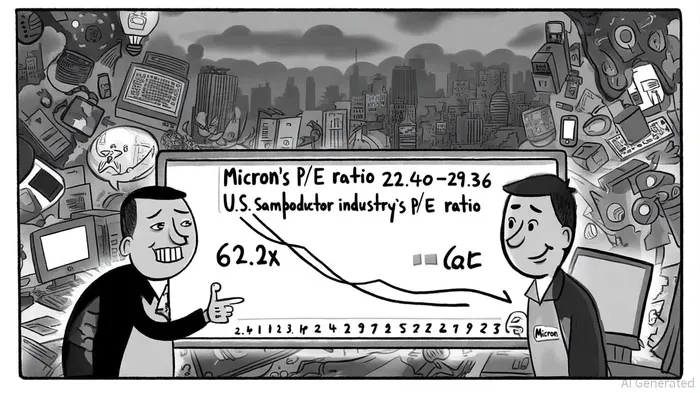





Comentarios
Aún no hay comentarios