
Micron Technology's Strategic Expansion in Japan and Its Implications for AI-Driven Memory Demand
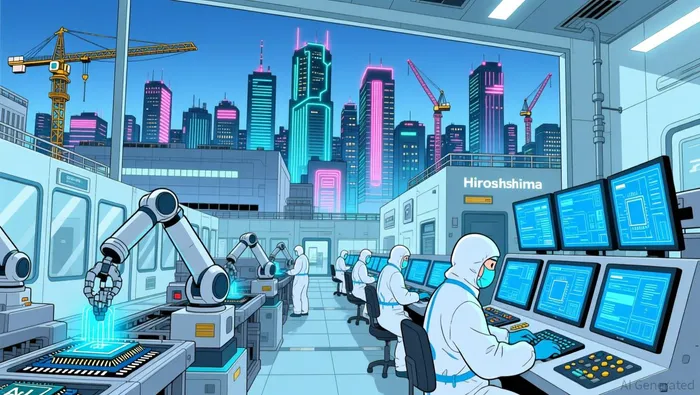
The global semiconductor industry is undergoing a seismic shift, driven by the explosive growth of artificial intelligence (AI) and the urgent need to secure resilient supply chains. At the center of this transformation is Micron TechnologyMU--, which has announced a $9.6 billion investment in Japan to build a high-bandwidth memory (HBM) plant in Hiroshima. This move, supported by up to ¥536 billion ($3.63 billion) in subsidies, underscores Micron's ambition to capture a larger share of the AI memory market while diversifying its production footprint away from Taiwan. As AI infrastructure demand surges, the strategic implications of this expansion-and Micron's competitive positioning-deserve close scrutiny.
Strategic Rationale: Diversification and Policy Incentives
Micron's decision to anchor its new HBM facility in Japan is not merely a response to market demand but a calculated maneuver to align with global policy trends. Japan's Ministry of Economy, Trade, and Industry (METI) has pledged to subsidize up to 36% of the project's capital expenditures and R&D costs, reflecting the country's broader strategy to revive its semiconductor manufacturing sector. This aligns with a global race to localize production, exemplified by the U.S. CHIPS Act and similar initiatives in Europe. For Micron, the investment mitigates geopolitical risks associated with over-reliance on Taiwan, where it currently produces most of its HBM chips.
The timing is critical. AI-driven workloads are fueling a 30% annual growth rate in HBM demand. By 2030, the HBM market is projected to reach $5.34 billion, with a compound annual growth rate (CAGR) of 13% from 2025 to 2030. Micron's Hiroshima plant, expected to begin production, in 2028, aims to achieve 40,000 wafers per month by 2030, positioning the company to capitalize on this surge.
Competitive Positioning: Challenging SK Hynix's Dominance
Micron's expansion must be evaluated against the backdrop of a fiercely competitive HBM market. As of Q2 2025, SK Hynix holds a commanding 62% market share, followed by MicronMU-- at 21% and Samsung at 17%. SK Hynix's dominance is underpinned by its early lead in HBM3E production and its role as the primary supplier for Nvidia's AI GPUs. However, Micron is closing the gap. The company is ramping up production of HBM3E and HBM4, with plans to sell out its 2026 supply. Its U.S. facility in Idaho, supported by the CHIPS Act, further bolsters its capacity.
The key differentiator lies in Micron's ability to leverage subsidies and scale production. While SK Hynix is also investing in new fabrication lines, its reliance on South Korea's domestic market and limited financial support from the South Korean government may constrain its flexibility compared to Micron's dual support from Japan and the U.S. This could enable Micron to reduce costs and accelerate innovation, particularly as HBM4 becomes the industry standard by late 2025.
Long-Term Earnings Potential: A Market in Expansion
The financial implications of Micron's strategy are profound. The HBM market is forecasted to grow from $2.93 billion in 2024 to $16.72 billion by 2033, with a CAGR of 21.35%. Given that over 55% of HBM demand is tied to AI training workloads, Micron's focus on AI memory aligns perfectly with this trajectory. The company's current 20% DRAM market share suggests a similar trajectory for HBM, which could translate to $4.3 billion in annual HBM revenue by 2030 if it maintains its current market position.
Government subsidies further amplify this potential. The Japanese subsidies reduce Micron's capital burden, allowing it to reinvest in R&D and scale production more efficiently. This is critical in an industry where technological obsolescence is rapid. For instance, HBM4, with its higher bandwidth and lower power consumption, is expected to dominate by 2027, and Micron's early investments position it to lead this transition.
Risks and Challenges
Despite its strengths, Micron faces significant challenges. SK Hynix's entrenched position and aggressive expansion could limit Micron's ability to capture market share. Additionally, the Hiroshima plant's construction timeline-starting in May 2026 and shipping in 2028-means it will take years to realize the full benefits of the investment. During this period, demand could outpace supply, creating a window of opportunity for competitors.
Moreover, the global semiconductor subsidy race introduces uncertainty. If other nations offer more favorable terms, Micron may face pressure to redirect resources. However, its dual presence in Japan and the U.S. provides a buffer against such risks.
Conclusion: A Calculated Bet on the Future
Micron's Japan expansion is a bold, well-calculated move to secure its position in the AI memory market. By leveraging subsidies, diversifying production, and aligning with AI demand, the company is positioning itself to challenge SK Hynix's dominance. While risks remain, the long-term growth of the HBM market-driven by AI's insatiable appetite for high-performance memory-suggests that Micron's strategic bets could pay off handsomely. For investors, this represents a compelling case of a company adapting to macroeconomic shifts while capitalizing on a structural growth trend.







Comentarios
Aún no hay comentarios