
Micron Technology Remains a Must-Hold AI Infrastructure Play in 2026
Structural Demand for HBM: A Long-Term Tailwind
Micron's HBM business is the cornerstone of its AI infrastructure strategy. The company has already secured pricing agreements for most of its 2026 HBM3E supply, with demand visibility extending well into the next year. This is no surprise: HBM's vertically stacked architecture delivers the bandwidth and power efficiency required for AI accelerators, making it indispensable for hyperscalers and cloud providers. In Q1 2026, HBM revenue alone reached $2 billion, with CEO Sanjay Mehrotra projecting an annualized run rate of nearly $8 billion.
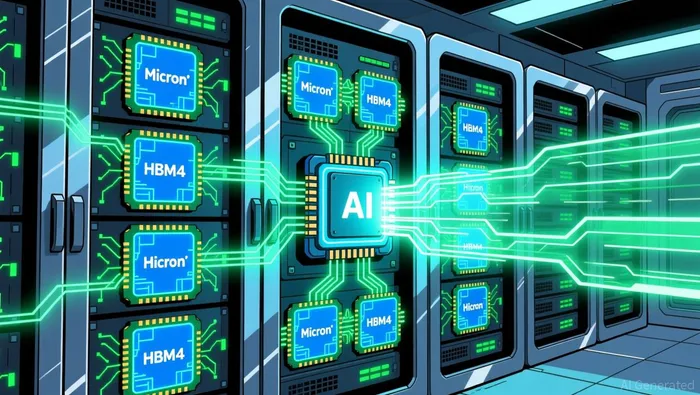 The transition to HBM4 is further solidifying Micron's leadership. Early samples of HBM4 demonstrate industry-leading bandwidth and power efficiency, positioning the company to outpace competitors in the next phase of AI infrastructure scaling. Meanwhile, Micron's exit from the consumer memory market-discontinuing its 29-year-old Crucial brand by February 2026-ensures that wafer capacity is prioritized for high-margin HBM and DDR5 production. This strategic reallocation of resources is critical, as AI-driven demand for HBM is expected to outstrip supply through 2026.
Revenue Growth and Margin Expansion: A Dual Engine
Micron's financial performance in 2025 and 2026 underscores its transformation into a high-margin AI infrastructure leader. Fiscal 2025 revenue hit $37.38 billion, a near 50% increase from the prior year, with 56% of total revenue derived from data center and AI applications. Q1 2026 revenue of $13.64 billion marked a 56.7% year-over-year jump, and management projects Q2 2026 revenue to reach $18.3–$19.1 billion-a 132% increase from Q2 2025.
This growth is underpinned by margin expansion. In Q1 2026, non-GAAP gross margins hit 56.8%, a significant improvement from the low-margin consumer memory segment. By exiting the Crucial brand, MicronMU-- has shifted its focus to multi-year contracts with enterprise and AI customers, which offer stable pricing and predictable demand. This shift mirrors broader industry trends, as competitors like Samsung and SK Hynix also prioritize HBM over DDR4 and consumer-grade products.
Strategic Differentiation in the AI Memory Value Chain
Micron's unique position in the AI memory value chain stems from its technological leadership, strategic partnerships, and vertical integration. The company has secured design wins with top AI chipmakers like NVIDIA and AMD, leveraging its HBM3E and HBM4 roadmap to meet the power and performance demands of next-generation AI accelerators. Its comprehensive portfolio-spanning HBM, DDR5, LPDDR5X, and CXL modules-enables it to address every tier of the AI data hierarchy, from edge computing to hyperscale data centers.
This system-level approach creates a competitive moat. By offering tailored HBM solutions through its Cloud Memory Business Unit, Micron acts as a strategic partner rather than a component supplier, locking in long-term relationships with hyperscalers. Additionally, its $20 billion 2026 capital expenditure plan-funded by the CHIPS Act and onshore manufacturing investments-ensures it can scale production to meet surging demand while mitigating geopolitical risks.
A Must-Hold for Long-Term Investors
Micron's alignment with the AI infrastructure supercycle is both structural and sustainable. Its sold-out 2026 HBM capacity, 49% YoY revenue growth, and exit from low-margin consumer segments position it to capture value across the AI memory value chain. With a $130 billion HBM market projected by 2033 and a $200 billion onshore DRAM production plan, Micron is not just adapting to the AI era-it is building the infrastructure that will power it. For investors seeking exposure to the next decade of technological innovation, Micron remains an irreplaceable holding.





Comentarios
Aún no hay comentarios