
Micron's Strategic Shift to High-Value AI Memory and Its Implications for Long-Term Growth
Strategic Rationale: Prioritizing Profitability in AI-Driven Markets
The consumer memory segment, while historically a revenue generator, has long been characterized by thin profit margins. According to a report by Artificial Intelligence News, Micron's decision reflects the economic reality that enterprise clients-particularly those in AI and data centers-are willing to pay significantly higher prices for memory solutions compared to individual consumers. This aligns with broader industry trends, as manufacturers like Samsung and SK Hynix also pivot toward advanced memory technologies such as HBM3E and DDR5, which cater to AI's insatiable demand for high-performance storage.
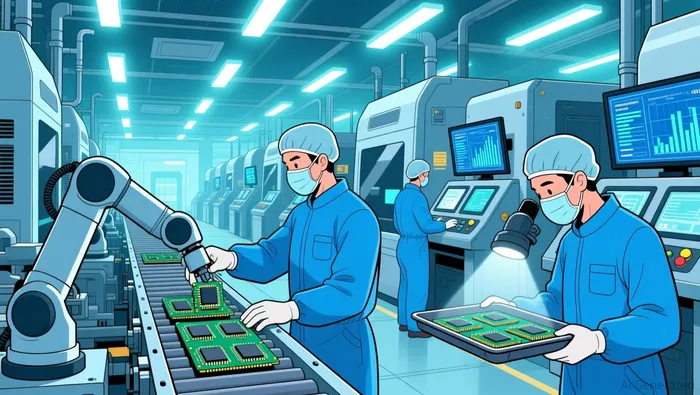 Micron's exit from the consumer market is further justified by the growing scarcity and pricing power in AI-related memory. UBS analysts project DRAM prices to rise by 35% in Q4 2025, with additional gains expected into early 2026, driven by tight supply and robust demand for HBM. By focusing on these high-value contracts, Micron can optimize its production capacity for products with superior margins, a critical advantage in an industry where profit pools are increasingly concentrated in niche, high-tech applications.
Financial Implications: Margin Expansion and Capital Allocation
The shift is expected to enhance Micron's gross margins, as enterprise and AI memory products command higher prices than consumer-grade alternatives. While the company has not disclosed Crucial's exact revenue contribution, experts estimate its impact on overall sales to be minimal, with the greater financial benefit stemming from an improved product mix. This reallocation also supports Micron's $14 billion fiscal 2025 investment in HBM and back-end manufacturing, underscoring its commitment to scaling AI infrastructure capabilities.
Analysts highlight that exiting the consumer segment allows MicronMU-- to avoid the pricing pressures inherent in commoditized markets. As stated by CNBC, the company's focus on strategic partners-such as AMD, whose AI chips require vast amounts of memory-ensures a stable revenue stream from clients with deep pockets and long-term growth trajectories. This approach mirrors the strategies of industry peers, who are increasingly prioritizing capital efficiency in response to AI-driven demand.
Market Dynamics: A $250 Billion Opportunity in AI Memory
The AI memory market is poised for explosive growth, with HBM demand surging at unprecedented rates. Data from TechInsights indicates that the HBM market grew by 150% in 2023, 200% in 2024, and is projected to expand by 70% in 2025. This trajectory is fueled by AI applications requiring massive data processing capabilities, which in turn drive demand for memory solutions with higher bandwidth and lower latency.
Memory prices are also set to climb sharply, with EE Times reporting a 50% increase in 2025, followed by an additional 30% rise in Q4 2025 and 20% in early 2026. These trends suggest that Micron's pivot to AI memory is not only timely but also strategically aligned with a market that is expected to exceed $250 billion in revenue in 2025. By securing a leadership position in this space, Micron can leverage its R&D expertise and manufacturing scale to outperform competitors in commoditized segments.
Conclusion: A Calculated Bet on the Future of Computing
Micron's decision to exit the consumer memory market is a calculated risk with substantial long-term rewards. By redirecting resources to AI and data center applications, the company is aligning itself with the most lucrative and innovation-driven segment of the memory industry. This move not only addresses immediate profitability concerns but also positions Micron to benefit from the multi-year growth cycle of AI infrastructure. As the demand for HBM and other advanced memory solutions accelerates, Micron's strategic pivot could prove to be a defining moment in its evolution from a commodity memory supplier to a cornerstone of the AI era.





Comentarios
Aún no hay comentarios