
Micron's Record High and the Tech Sector's Momentum: A Strategic Buy Signal?
The semiconductor sector has entered a new era of growth, driven by insatiable demand for memory chips and AI-driven innovation. Micron TechnologyMU-- (MU), a bellwether of this transformation, has surged to record highs in 2025, fueled by robust earnings, favorable valuation metrics, and macroeconomic tailwinds. But is this momentum a strategic buy signal, or is the stock overextended?
Valuation: A Premium Justified by Growth
Micron's current valuation appears anchored to its outperformance relative to industry benchmarks. With an enterprise value (EV) to revenue ratio of 2.66x for 2025[1], the stock trades at a slight premium to the sector's revenue multiple of 2.5x for companies with $1-$5M in revenue[2]. However, this premium is justified by Micron's unique positioning in high-bandwidth memory (HBM), a niche where it commands a 23-24% market share[3]. HBM revenue has doubled year-over-year, reflecting the chipmaker's ability to capitalize on AI infrastructure demand[3].
The stock's price-to-earnings (P/E) ratio of 12.6x[1] also appears reasonable when compared to the industry's average EBITDA multiple of 9.4x[2]. While this suggests investors are paying a slight premium for earnings, Micron's projected 37% year-over-year revenue growth and 42% gross margins in Q4 2025[3] indicate strong operational leverage. Analysts argue that the company's ability to scale HBM production and maintain pricing power in DRAM markets[3] could further justify a higher multiple.
Earnings Trends: Sequential and Structural Strength
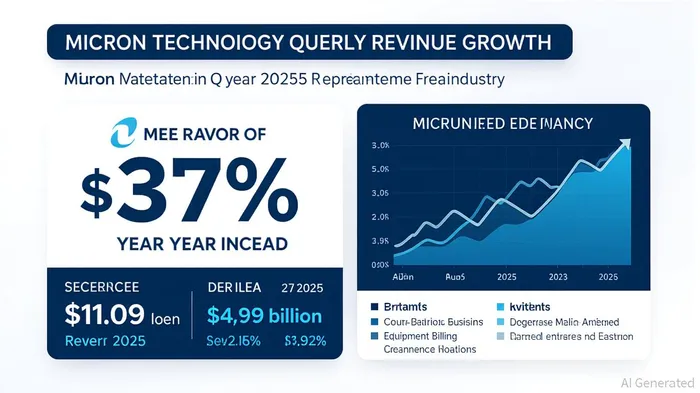
Micron's earnings trajectory underscores its structural advantages. Q3 2025 revenue of $9.3 billion marked a 15% sequential increase and 37% year-over-year growth[3], driven by a 51% YoY surge in DRAM revenue[3]. This outperformance is not an anomaly but a reflection of the company's strategic focus on high-margin segments. For Q2 2025, analysts forecast revenue of $11.09 billion and earnings per share (EPS) of $2.85[2], signaling sustained momentum.
The broader semiconductor industry also shows strength, with global equipment billings hitting $33.07 billion in Q2 2025—a 24% year-over-year increase[3]. Peer companies like ACM ResearchACMR-- and indie SemiconductorINDI-- reported gross margins of 48.5% and 49.1%, respectively[1], aligning with the sector's 47.56% average gross margin[2]. Micron's projected 42% gross margin in Q4 2025[3] lags slightly behind these benchmarks but reflects its capital-intensive manufacturing model. The gapGAP--, however, is narrowing as the company optimizes production for HBM and advanced DRAM.
Macroeconomic Tailwinds: AI and Global Demand
The most compelling catalyst for Micron's long-term growth lies in macroeconomic tailwinds. The AI boom has created a structural shift in demand for memory chips, particularly HBM, which is critical for training large language models. Micron's leadership in this space—bolstered by its 23-24% market share[3]—positions it to benefit from multiyear growth.
Meanwhile, global semiconductor demand remains resilient. The industry's EBITDA margin of 36.2% in Q2 2025[2] highlights its profitability, while SK hynix's recent adoption of High NA EUV lithography[3] signals a technological arms race that could further drive demand for advanced memory solutions. Additionally, the U.S.-China tech rivalry and domestic manufacturing incentives (e.g., CHIPS Act) are likely to sustain capital expenditures in the sector[3].
Risks and Considerations
While the case for MicronMU-- is compelling, investors must remain cautious. The stock's 12.6x P/E ratio[1] implies confidence in future earnings, but any slowdown in AI adoption or oversupply in DRAM markets could pressure margins. Additionally, the semiconductor sector's cyclicality means volatility is inevitable.
Conclusion: A Strategic Buy for the Long-Term
Micron's record highs are not a bubble but a reflection of its dominant position in a high-growth segment of the tech sector. With valuation metrics in line with industry benchmarks, earnings growth accelerating, and macroeconomic tailwinds strengthening, the stock presents a strategic buy for investors with a multiyear horizon. The key question is not whether Micron can sustain its momentum, but whether it can maintain its leadership in HBM as demand for AI infrastructure accelerates.





Comentarios
Aún no hay comentarios