
Micron's Rally Isn't Over, But Some Investors Should Think About Leaving
The semiconductor industry is in the throes of a transformation driven by artificial intelligence, and Micron TechnologyMU-- (MU) has emerged as a central player in this shift. For investors, the question is no longer whether MicronMU-- can capitalize on the AI boom but when to hold and when to exit. The company's recent performance-marked by record revenue, margin expansion, and strategic investments-suggests its rally is far from over. Yet the cyclical nature of the semiconductor industry and looming overcapacity risks mean some investors should begin evaluating their positions.
Strategic Position: A Leader in the AI Memory Revolution
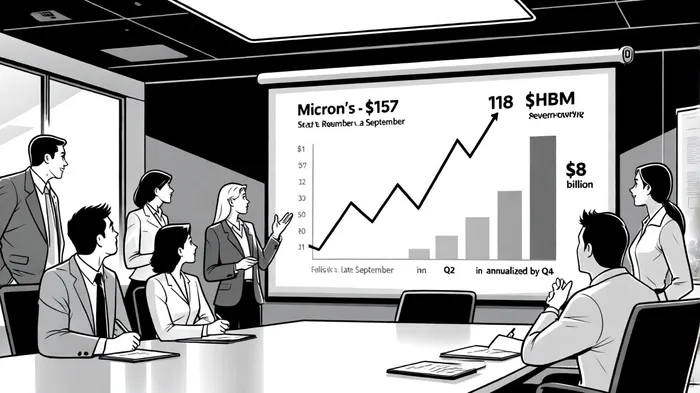
Micron's dominance in high-bandwidth memory (HBM) has positioned it to benefit from the AI-driven demand surge. In Q4 2025, the company reported $11.32 billion in revenue, with HBM alone contributing nearly $2 billion, reflecting a 56% contribution from its data center segment, according to Futurum's analysis. This growth is underpinned by partnerships with NVIDIA and early shipments of HBM4 samples, which offer bandwidth exceeding 2.8 TB/s and pin speeds over 11 Gbps, as detailed in a CEOWorld playbook. By Q4 2025, HBM revenue approached an $8 billion annualized run rate, with the company projecting $35 billion in HBM demand for 2025, as noted in an EarningsIQ article.
Micron's aggressive capital expenditures-$18 billion in FY 2026, including a $7 billion Singapore packaging facility and U.S. CHIPS program investments-signal its intent to secure supply chain resilience amid a projected 33% CAGR in HBM demand through 2030, according to Deloitte's outlook. These moves reinforce its leadership in high-margin memory solutions, a critical advantage as AI infrastructure spending accelerates.
Semiconductor Cycle: Booming Demand, Looming Risks
The broader semiconductor industry is experiencing a rare confluence of growth and uncertainty. Global chip sales are projected to reach $697 billion in 2025, driven by AI and data center expansions, according to a Kearney report. AI-specific chips alone are expected to generate $150 billion in revenue this year, with long-term forecasts suggesting a $400 billion market by 2027, per Serendipity Electronics' outlook. However, this growth is not uniform, as a Bain report notes.
While utilization rates for advanced nodes (e.g., HBM3E, 1-gamma DRAM) are near capacity, concerns about overcapacity in mature nodes persist. For instance, 28-nanometer technology could face oversupply if new production ramps too quickly, according to Blocks & Files coverage. Micron's NAND business, which saw $2.2 billion in Q4 2025 revenue, is already navigating underutilized fabrication plants and inventory corrections, as shown in Micron's press release. These dynamics highlight the industry's cyclical fragility, even as AI-driven demand surges.
Strategic Exit Timing: Balancing Momentum and Risk
For investors, the key lies in timing. Micron's current trajectory-bolstered by strong pricing power, a 50.5–52.5% non-GAAP gross margin guidance for Q1 2026, and a fully sold-out 2025 HBM supply-suggests the company is in a strong position to outperform in the near term, as a CNBC report noted. However, three factors warrant caution:
- Competitive Pressures: Rivals like Samsung and SK Hynix are scaling HBM3E and HBM4 production, potentially eroding Micron's pricing power as supply increases, according to Yole Group.
- Geopolitical Risks: Export controls and trade policies could disrupt supply chains, particularly for U.S.-based manufacturing under the CHIPS program, per PwC.
- Overcapacity in Legacy Segments: As resources shift to AI-focused memory, traditional DRAM and NAND markets may face downward price pressures, dragging on overall profitability, according to an Astute Group analysis.
Historical data from 2022 to 2025 offers additional context for timing decisions. A backtest of Micron's stock following earnings beats reveals that while short-term (1–3 day) reactions are muted, the win rate peaks at ~88% around day 29 post-earnings, albeit with high variance. This suggests that investors who hold through the initial volatility may capture modest alpha, though the 30-day cumulative excess return of +2.25 percentage points over the benchmark is not statistically significant. For risk-averse investors, this pattern underscores the importance of patience but also the need for caution given the lack of consistent outperformance.
Investors with a short-term horizon or risk-averse profiles might consider partial exits as HBM demand stabilizes and utilization rates peak. Conversely, those with a longer-term view-particularly those aligned with the AI infrastructure megatrend-should stay the course, as Micron's technological edge and capital discipline position it to outperform in the next cycle.
Conclusion
Micron's rally is a testament to its strategic foresight in the AI memory boom. Yet the semiconductor industry's cyclical nature and the risks of overcapacity mean investors must balance optimism with prudence. For now, the company's momentum is undeniable, but as the industry approaches inflection points in 2026, strategic exits may become necessary for those prioritizing risk mitigation. The rally isn't over-but it's evolving."""





Comentarios
Aún no hay comentarios