
Micron's Q4 Earnings Outperformance: A Strategic Win in the AI-Driven Memory Arms Race
Micron Technology's Q4 2025 earnings report has sent ripples through the semiconductor industry, with the company outperforming expectations by a staggering margin. Revenue surged to $11.32 billion, a 21.6% sequential increase and 46.1% year-over-year growth, driven by insatiable demand for high-bandwidth memory (HBM) in AI data centers [1]. This marks a dramatic reversal from Q4 2023, when the company posted a $1.43 billion GAAP net loss amid a collapsing memory market [2]. The transformation underscores Micron's strategic pivot to AI-driven memory solutions, positioning it as a key beneficiary of the sector's renaissance.
The AI-Driven Memory Boom: Micron's Strategic Edge
The AI revolution has redefined the memory landscape, with HBM emerging as the linchpin for large language model (LLM) training and inference. Micron's Cloud Memory Business Unit (CMBU) exemplifies this shift, generating $4.54 billion in Q4 revenue with 59% gross margins—a stark contrast to the industry's historical struggles with overcapacity and price wars [1]. By focusing on HBM3E and preparing for HBM4, MicronMU-- has aligned itself with the most lucrative segment of the market.
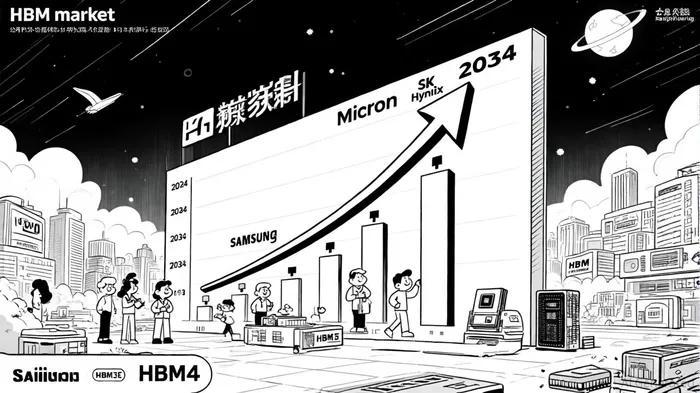
According to a report by TrendForce, the HBM4 market is projected to grow at a 26.2% compound annual growth rate (CAGR), reaching $25.9 billion by 2034 [3]. Micron's aggressive scaling of HBM production—planning to triple output to 60,000 wafers per month by late 2025—positions it to capture a significant share of this growth [4]. The company's HBM3E chips are already integrated into NVIDIA's Blackwell GB200 and GB300 platforms, securing a critical role in the AI infrastructure buildout [4].
Competitive Positioning: Navigating a Three-Way HBM Race
While Micron's momentum is undeniable, it faces fierce competition from Samsung and SK Hynix. Samsung, with its 44% DRAM market share, is validating HBM3E with NVIDIA and preparing for HBM4 mass production by late 2025 [1]. SK Hynix, meanwhile, has begun mass-producing 12Hi HBM3E and is projected to dominate over 50% of the HBM4 market [3].
Micron's differentiator lies in its focus on energy efficiency and scalability. The company's 12-Hi HBM3E samples emphasize power optimization—a critical factor for hyperscalers managing massive data centers [3]. Additionally, Micron's Cloud Memory Business Unit operates with 48% operating margins, outpacing the industry average and demonstrating its ability to monetize AI-driven demand [1]. This profitability, coupled with $5.73 billion in Q4 operating cash flow, provides a buffer against the capital-intensive nature of HBM production [1].
Market Dynamics and Long-Term Outlook
The AI memory market's concentration of value creation is evident: in 2024, the top 5% of semiconductor firms—including NVIDIA, TSMC, and ASML—generated $159 billion in economic value, while the rest struggled [5]. Micron's Q1 2026 guidance—$12.5 billion revenue and 50.5% gross margins—reflects its confidence in maintaining this trajectory [1]. The company's dividend declaration of $0.115 per share further signals financial stability, a rarity in a sector historically prone to cyclical downturns [1].
However, challenges persist. Chinese memory players like YMTC and CXMT are advancing 3D NAND and DDR5 technologies, while government subsidies threaten to disrupt global supply chains [6]. Micron's reliance on HBM, though lucrative, also exposes it to rapid technological obsolescence if HBM4 adoption lags. Yet, with its 1ß process roadmap for HBM4 and partnerships with hyperscalers, the company appears well-positioned to mitigate these risks [1].
Conclusion: A Defensible Position in a High-Stakes Market
Micron's Q4 outperformance is not an anomaly but a testament to its strategic foresight in capitalizing on AI's memory demands. While Samsung and SK Hynix remain formidable, Micron's focus on energy-efficient HBM, robust margins, and AI ecosystem integration creates a defensible position. As the HBM4 era dawns, investors should watch closely for execution risks, but the fundamentals suggest Micron is no longer a cyclical play—it's a cornerstone of the AI infrastructure revolution.





Comentarios
Aún no hay comentarios