
Micron's HBM S-Curve: Assessing the 2026 Memory Paradigm Shift
The memory market is undergoing a paradigm shift from a cyclical commodity to the foundational infrastructure of the AI era. This isn't just another upcycle; it's a structural realignment where the economic importance of memory, particularly High-Bandwidth Memory (HBM), has skyrocketed. The global semiconductor industry is projected to grow by more than 25% in 2026, with the memory segment expanding at a 30% growth rate. This surge is driven by a fundamental bottleneck: HBM has become the primary constraint on AI GPU shipments. As investments pour into servers for AI training and inference, the capacity of DRAM and HBM installed per server is steadily increasing, making memory a critical, non-negotiable component of the AI stack.
This shift sets the stage for companies like MicronMU--, which is strategically positioned at the center of this new S-curve. The company's recent financial performance signals accelerating demand. In its first quarter of fiscal 2026, Micron's revenue surged 57% year-over-year to a record $13.6 billion. More telling is the 100% year-over-year growth in its Cloud Memory segment, which hit $5.3 billion. This isn't just growth; it's the signature acceleration of a company transitioning from a cyclical supplier to a dedicated AI infrastructure builder. The market is pricing in this pivot, with shares rallying on a bullish Mizuho report that highlighted the insatiable appetite for advanced DRAM and HBM fueled by AI accelerators. The bottom line is that memory is no longer a cost center-it's the new compute rail, and Micron is building its capacity on the right side of the exponential adoption curve.
Execution on the Technology Curve: Capacity, Roadmaps, and Competition
Micron's position on the AI memory S-curve is now a test of execution against a backdrop of intense competition and shifting technical demands. The company has begun shipping HBM4 samples rated at up to 11 Gbps, a tangible step toward the next generation. Yet, its path to volume production is delayed, with mass manufacturing now expected no earlier than the end of Q1 2026. This gap, created by Nvidia's last-minute spec changes for its Rubin GPU platform, keeps HBM3 and HBM3e as the prevailing standards through at least the first quarter. For Micron, a more recent entrant, this delay is a critical vulnerability. It means the company must defend its market position and revenue with older, albeit still in high demand, technology while rivals push forward.
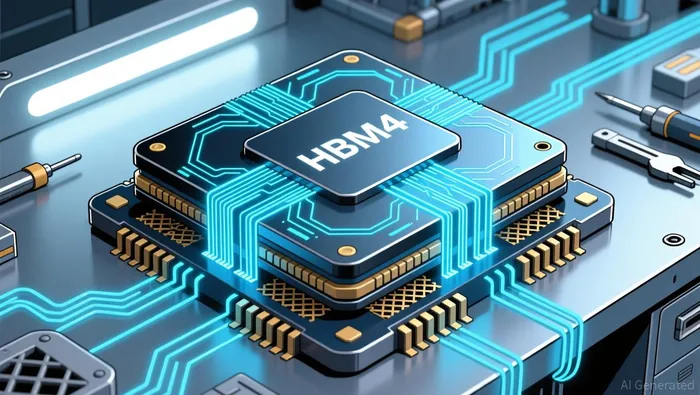
The technical hurdles are significant. Pushing speeds beyond 11 Gbps per pin, as required for Rubin, places new stress on base die logic and thermals. Micron is already working on future HBM4E products, but the company faces the same thermal and power envelope challenges as its peers. This isn't a minor engineering tweak; it's a fundamental race to scale the physical limits of memory density and speed. The delay offers a reprieve in terms of extra runway to optimize yields, but it also means Micron is playing catch-up in the qualification process. Samsung is reported to have a slight edge on qualification due to its newer base die process, while SK hynix is expected to maintain the majority share as the primary supplier to Nvidia.
This sets up a fierce battle for share in 2026. Samsung is forecast to regain ground in the HBM market above 30%, intensifying competition for the next-generation node. The three dominant suppliers are now moving from HBM3E into HBM4, with procurement strategies for AI accelerators increasingly dependent on securing next-generation memory bins and packaging capacity. Micron has locked in significant volumes with hyperscale clients, but its ability to meet the insatiable demand for advanced memory will be tested by its delayed volume ramp and the sheer scale of the technical challenge. The company's forecast of an HBM annualised revenue run-rate of around $8 billion is ambitious, but it hinges on successfully navigating this complex and crowded technology curve.
Financial Impact: Pricing Power, Margins, and the Valuation Gap
The S-curve dynamics are translating directly into financial results, but the valuation now reflects a high bar for sustained execution. Mizuho's bullish outlook hinges on a key assumption: a 50-60% increase in average DRAM prices for 2026. This projected price surge is the primary driver behind the record margin expansion Micron is already achieving. In its first quarter, the company's non-GAAP operating margin ballooned to 47.0%, more than doubling from 27.5% a year ago. This isn't just a cyclical rebound; it's the result of disciplined pricing and a portfolio shift toward high-margin AI memory, a clear sign of durable pricing power in a structurally tight market.
The financial setup is powerful. With HBM supply for the entire calendar year already committed to price and volume agreements, and broader DRAM/NAND bit growth constrained by industry capacity, Micron is positioned to capture premium value. The company's forecast of an HBM annualised revenue run-rate around $8 billion is ambitious, but the Q1 results show it can hit these targets. The bottom line is that the market is paying for this execution, with shares rallying on the Mizuho report that called valuations "attractive" for the year ahead.
Yet this optimism creates a valuation gap. While the stock trades at a forward P/E of about 10.5, a multiple that looks reasonable for a company growing earnings at 23%, the picture changes when viewed through a cash flow lens. Micron's trailing free cash flow is only $4.7 billion, significantly less than its reported earnings. Valued on that cash flow, the stock trades at a steep 78x multiple. This is the high bar for future execution. The current price embeds perfection: it assumes the company not only maintains its 47% operating margin but also converts its massive earnings into free cash flow at an even higher rate, all while navigating the intense technical and competitive race for the next HBM generation. The margin expansion is real, but the valuation demands that the entire AI memory paradigm shift plays out exactly as priced.
Catalysts and Risks: The 2026 Inflection Point
The path from Micron's record Q1 results to a sustained HBM-driven supercycle hinges on a few critical inflection points in the coming months. The primary catalyst is the successful ramp of HBM4 volume production in the first quarter of 2026. The company has already begun shipping samples, but mass manufacturing is delayed until the end of this quarter. Securing long-term customer commitments for these next-generation parts is now the immediate task. Management has stated that 2026 HBM supply is fully committed, but the real test is whether Micron can convert its HBM4 samples into volume orders with the same discipline it applied to HBM3E. This will determine if its forecast of an HBM annualised revenue run-rate of around $8 billion is achievable or merely aspirational.
A key structural risk to this thesis is the potential for increased DRAM production capacity from latecomers or regulatory shifts, which could compress the current pricing cycle. While industry-wide bit growth is constrained through 2026, the memory market is not immune to new entrants or capacity expansions that could disrupt the tight supply-demand balance. The Mizuho report's bullish case assumes a 50-60% increase in average DRAM prices for 2026, a scenario that depends on sustained supply discipline. Any unexpected capacity surge, whether from a new fab coming online or a strategic shift by a major player, could deflate this premium pricing and pressure the exceptional margins Micron is now commanding.
The competitive dynamics between SK hynix and Micron will be a major source of market share stability. SK hynix is uniquely positioned as the only supplier capable of delivering both HBM3E and HBM4 reliably, a dual-capability that gives it a strategic anchor in the AI memory stack. This sets up a direct battle for share as the industry moves to HBM4. Samsung is expected to regain ground in the HBM market above 30% next year, intensifying competition. For Micron, the risk is not just losing share to Samsung, but also being outmaneuvered by SK hynix, which could leverage its dual-product roadmap to lock in more customer commitments. The company's ability to defend its current position and grow its share will be a direct function of its HBM4 execution speed and customer relationships.
The bottom line is that 2026 is the year of validation. The financial results show the company is on the right side of the S-curve, but the market will judge its thesis on the delivery of next-generation capacity and the durability of its pricing power. The catalysts are clear, but the risks-capacity overhang and fierce competition-are equally tangible.





Comentarios
Aún no hay comentarios