
Micron's Exit from China's Server Chips Market and Global Semiconductor Reallocation: Strategic Implications for Investors
The semiconductor industry is undergoing a seismic shift as geopolitical tensions, regulatory actions, and market dynamics converge to redefine global supply chains. MicronMU-- Technology's recent exit from China's server chips market and mobile NAND segment epitomizes this transformation, offering critical insights for investors navigating a post-China tech landscape. This analysis explores the strategic implications of Micron's retreat, the broader reallocation of semiconductor production, and the investment opportunities and risks emerging in this fragmented environment.
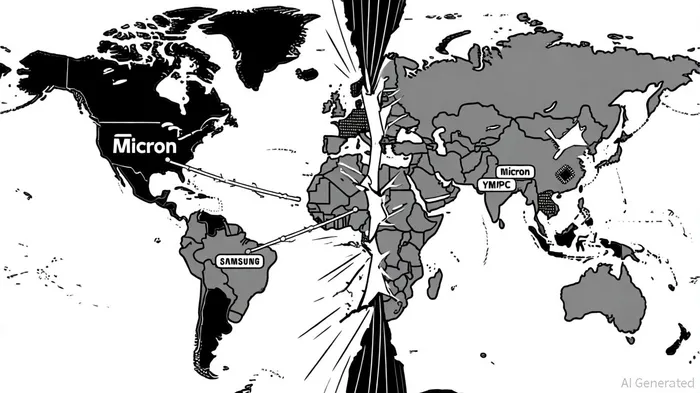
Micron's Strategic Retreat: Geopolitical and Market Forces
Micron's decision to exit China's server chips market follows a 2023 government ban on its products in critical infrastructure, rendering the business unsustainable, according to a Reuters report. Compounding this, the mobile NAND segment has underperformed due to declining global smartphone demand, prompting Micron to cut over 300 jobs in China and halt new product development, including its UFS5 program, according to an OpenTools report. This move reflects a broader industry trend: the U.S.-China technology rivalry has accelerated supply chain reallocation, with companies prioritizing resilience over cost efficiency.
For investors, Micron's exit underscores the risks of overreliance on politically sensitive markets. The company's recent financial performance-bolstered by strong AI-related demand for High-Bandwidth Memory (HBM)-has not offset the reputational and operational costs of its China-related challenges, according to an IC‑PCB article. However, Micron's pivot to SSDs and automotive NAND highlights its agility in capitalizing on growth areas, a trait that could stabilize its long-term prospects.
Competitor Strategies and Market Share Reallocation
Micron's retreat has created a vacuum in China's server chips and mobile NAND markets, which competitors like Samsung and Yangtze Memory Technologies Co. (YMTC) are poised to fill, according to a Digitimes report. SK Hynix, for instance, now holds a 62% bit shipment share in the HBM market, while Samsung's struggles to meet export requirements have eroded its HBM dominance, according to Mark Lapedus. Meanwhile, China's state-backed National Integrated Circuit Industry Investment Fund is accelerating self-reliance efforts, with SMIC and Huawei developing domestic alternatives, an Omdia analysis shows.
Investors should monitor how these competitors adapt to the "Silicon Curtain"-the fragmentation of semiconductor ecosystems along geopolitical lines. Companies with diversified supply chains and robust domestic manufacturing capabilities, such as Intel and TSMC, are better positioned to navigate this landscape, per Deloitte's outlook.
Global Semiconductor Reallocation: Opportunities and Challenges
The U.S. and Europe are investing heavily in domestic semiconductor production to counter China's influence. The U.S. CHIPS Act, allocating $52.7 billion, and the European Chips Act, aiming to double the EU's market share to 20% by 2030, have spurred over $500 billion in private investments, according to a Dow Theory Letters piece. However, these initiatives face hurdles: construction and operating costs in the U.S. and Europe are significantly higher than in Asia, where labor and subsidies remain competitive, per a McKinsey analysis.
For investors, the AI chip market presents a high-growth opportunity. Global AI chip sales are projected to exceed $150 billion in 2025, driven by demand for HBM and advanced packaging solutions, according to a WEF article. Yet, this sector is cyclical and talent-constrained, requiring careful risk assessment.
Strategic Implications for Investors
- Diversification and Resilience: Prioritize companies with diversified supply chains and investments in domestic manufacturing. Intel and TSMC's recent expansions align with this strategy, according to a Latterly article.
- AI and HBM Focus: Allocate capital to firms leading in AI chip design and memory production, such as SK Hynix and Naura Technology, a Chinese equipment champion, per a Castellano analysis.
- Geopolitical Hedging: Avoid overexposure to single regions. The easing of U.S. export controls on certain AI chips to China may offer short-term gains but should not overshadow long-term decoupling trends, according to an SCMP article.
Conclusion
Micron's exit from China's server chips market is a microcosm of the semiconductor industry's broader reallocation. While geopolitical tensions and regulatory actions pose risks, they also create opportunities for innovation and strategic realignment. Investors who balance exposure to high-growth AI segments with investments in supply chain resilience will be best positioned to thrive in this new era.





Comentarios
Aún no hay comentarios