
Micron's Earnings Report: A Pivotal Moment in the AI Memory Chip Boom
The semiconductor industry is at an inflection point, and Micron Technology's Q3 2025 earnings report has crystallized its role as a linchpin in the AI memory chip revolution. With record revenue of $9.3 billion, a 39.0% gross margin, and free cash flow exceeding $1.9 billion according to financial reports, Micron's performance underscores the explosive demand for high-bandwidth memory (HBM) and data center infrastructure. This is not just a quarterly win-it is a strategic validation of the secular growth thesis driving the AI era.
Earnings Momentum: A Reflection of Structural Demand
Micron's Q3 results were fueled by nearly 50% sequential surge in HBM revenue and a doubling of data center revenue year-over-year. These figures are not anomalies but symptoms of a broader shift. AI workloads, particularly in hyperscaler data centers, require memory solutions that traditional DRAM cannot meet. HBM, with its ability to handle massive parallel processing, has become indispensable for training large language models and generative AI systems.
According to a report by Morningstar, HBM sales accounted for 20% of total DRAM sales in 2024-a jump from just 6% in 2023. Micron's leadership in this segment, evidenced by its 3.5x revenue growth in the cloud memory business unit (CMBU) in the previous fiscal year, positions it to capture a disproportionate share of this expanding market. The company's non-GAAP net income of $2.18 billion-tripling the 2024 figure-further highlights its ability to convert this structural demand into profitability.
Strategic Investment Timing: Aligning with a $150 Billion Opportunity
The AI memory chip market is no longer a niche. Deloitte's 2025 semiconductor industry outlook projects AI-related chip sales to surpass $150 billion this year, with generative AI chips alone representing over 20% of total chip sales. This represents a compounding growth story that transcends cyclical semiconductor trends.
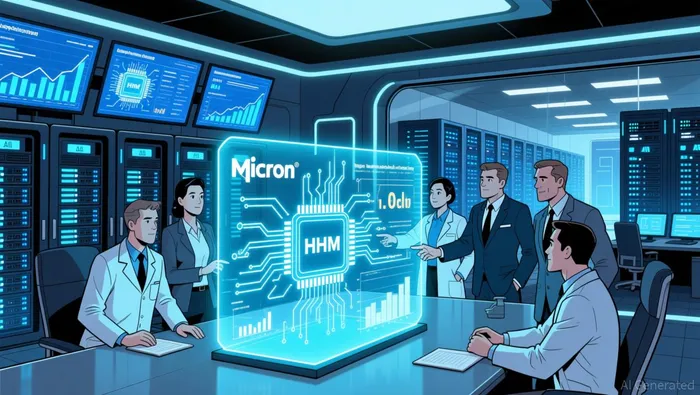 Micron's Q3 guidance-a 42% gross margin and $10.7 billion in Q4 revenue-suggests the company is not merely riding a wave but actively shaping it. Its 12.2 billion in cash and investments provides financial flexibility to fund R&D, expand HBM production, and potentially acquire complementary technologies. For investors, this is a rare combination: a company with both operational execution and a clear path to scaling in a market with insatiable demand.
Secular Growth vs. Cyclical Noise
While skeptics may argue that AI-driven demand is speculative, the data tells a different story. Morningstar's Q3 2025 Industry Pulse notes that AI accelerators already account for 20% of the global semiconductor market, a figure set to rise as enterprises and governments prioritize AI infrastructure. Micron's sequential HBM growth and data center revenue gains are not just aligned with this trend-they are accelerating it.
Moreover, the company's gross margin improvement to 39.0%-driven by pricing power and product mix-demonstrates its ability to navigate supply-side challenges. This is critical in a sector where capacity constraints and R&D costs often dampen margins. Micron's free cash flow of $1.9 billion according to financial reports, the highest in six years, further insulates it from volatility, making it a resilient play in a high-growth sector.
Conclusion: A Pivotal Moment for AI-Driven Capital Allocation
Micron's Q3 earnings are more than a financial milestone-they are a signal to investors that the AI memory chip boom is transitioning from hype to reality. With a 42% gross margin target for Q4 according to earnings calls and a cash position that enables aggressive reinvestment, the company is uniquely positioned to capitalize on the $150 billion AI chip market as projected by Deloitte. For those seeking strategic entry points into the secular growth story of the decade, Micron's current trajectory offers a compelling case: a business with proven execution, a dominant product in a critical bottleneck, and a balance sheet that can withstand the inevitable short-term headwinds.
The question is no longer whether AI will reshape the semiconductor industry-it already has. The next chapter belongs to companies like MicronMU-- that can scale with the speed and precision required to meet this unprecedented demand.





Comentarios
Aún no hay comentarios