
Is Micron's AI-Driven Earnings Surge a Sustainable Bull Case or a Cyclical Flash in the Pan?
The recent surge in MicronMU-- Technology's earnings, fueled by AI-driven demand for high-bandwidth memory (HBM) and data center infrastructure, has sparked intense debate among investors. With Q4 FY 2025 revenue hitting $11.32 billion-surpassing estimates and driven by a 56% contribution from data center sales-Micron's performance appears to signal a structural inflection point in the memory market. However, to assess whether this represents a durable bull case or a cyclical anomaly, one must contrast the current AI-driven demand with historical memory market cycles.
Historical Cycles: Cyclical Volatility vs. Structural Shifts
From 2000 to 2020, the DRAM market operated within predictable cyclical patterns, driven by demand from PCs, smartphones, and consumer electronics. Prices would spike during shortages and collapse during oversupply, with manufacturers adjusting production capacity accordingly. For instance, DDR4 and DDR5 adoption was tied to the refresh cycles of consumer devices, creating a self-correcting equilibrium. However, these cycles were inherently elastic: demand could be met through scaling production, and price corrections were often rapid.
The current AI-driven demand, by contrast, is reshaping the market's DNA. Unlike consumer electronics, AI infrastructure requires HBM and server-focused DDR5 at scales that outstrip traditional production capabilities. As noted by industry analysts, HBM's demand is so inelastic that it has effectively set a price floor for DRAM, with spot prices surging 187% year-on-year by late 2025. This is not a temporary correction but a strategic reallocation of wafer capacity and advanced substrates toward AI-specific memory solutions, leaving commodity DRAM and NAND in acute shortage.
Structural AI Demand: A New Paradigm
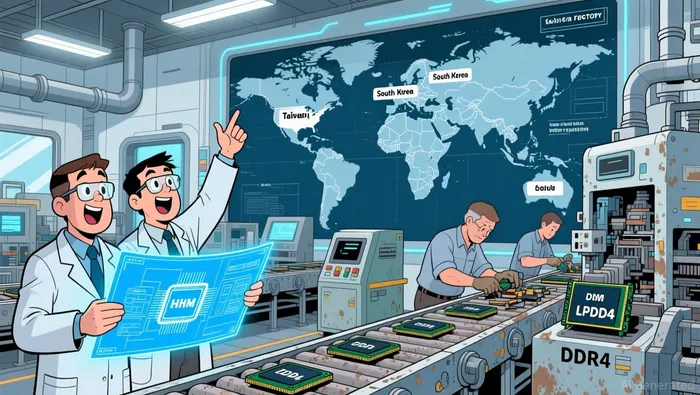
The structural shift is evident in how manufacturers are prioritizing production. Micron, Samsung, and SK Hynix have redirected resources to HBM4, 1-gamma DRAM, and G9 NAND, sidelining older technologies like DDR4 and LPDDR4. This reallocation has created a textbook supply shortage, with mid-range server OEMs reporting an inability to source DDR5 at any price. The result is a market where even legacy memory segments achieve unexpectedly high margins- Samsung's commodity DRAM margins hit 40% in Q3 2025, rivaling HBM profitability.
This divergence from historical norms underscores AI's role as a structural driver. Hyperscalers and enterprise clients are locking up memory capacity months in advance, leaving little for consumer electronics. The Windows 10 end-of-life refresh cycle and AI PC adoption further amplify demand, but these factors are secondary to the insatiable needs of data centers. As one industry report notes, AI servers require significantly more memory per system than consumer devices, creating a "voracious appetite" that traditional cycles cannot accommodate.





Comentarios
Aún no hay comentarios