
Micron's AI-Driven Earnings Surge: Can It Outpace the AI Bubble Fears?
The artificial intelligence (AI) boom has ignited a frenzy in the tech sector, with investors scrambling to identify companies positioned to benefit from the infrastructure demands of this transformative era. Micron TechnologyMU-- (NASDAQ: MU) has emerged as a standout, with its recent financial performance underscoring its role as a strategic "pick-and-shovel" play in the AI ecosystem. However, as concerns about an AI-driven valuation bubble grow, the question remains: Can Micron's AI-driven earnings surge sustain its momentum amid intensifying competition and market skepticism?
A Record-Breaking Earnings Trajectory
Micron's fiscal Q4 2025 results painted a picture of explosive growth, with revenue hitting $11.32 billion and gross margins exceeding 44.7%. This momentum carried into Q1 2026, where revenue surged 57% year-over-year to $13.64 billion, driven by insatiable demand for high-bandwidth memory (HBM) chips used in AI data centers. The company's guidance for Q2 2026-projecting revenue of approximately $18.7 billion-surpassed Wall Street estimates, reflecting its dominant position in the AI memory market. CEO Sanjay Mehrotra emphasized that MicronMU-- had already sold out its 2026 HBM supply, a testament to the company's critical role in enabling AI infrastructure.
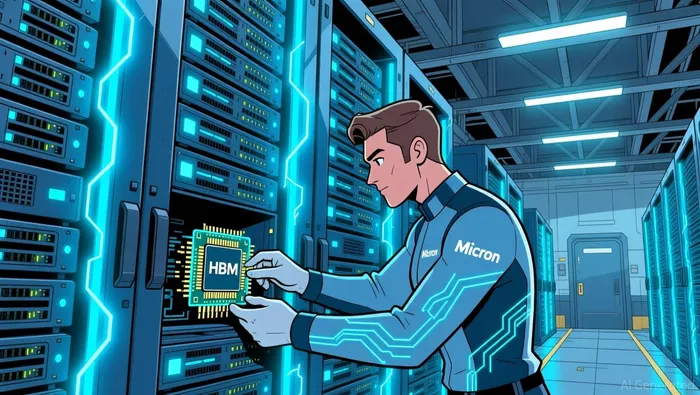 Micron's Core Data Center Business Unit, a key driver of its AI-related growth, reported $1.577 billion in Q4 2025 revenue. This segment's success is tied to the global shift toward AI, where HBM is indispensable for training large language models and other compute-intensive tasks. As AI adoption accelerates, Micron's ability to deliver high-performance memory solutions has positioned it as an "essential AI enabler," according to Mehrotra.
The Pick-and-Shovel Play in the AI Era
The concept of a "pick-and-shovel" play refers to companies that supply critical tools or infrastructure to an emerging industry. In the AI boom, this role is occupied by firms like Micron, which provides the memory and storage components that power AI hardware. Unlike AI software developers or chipmakers such as NVIDIA, Micron's value proposition lies in its ability to scale production of HBM, a commodity with no viable substitute in high-performance computing.
Micron's financial success is further amplified by a structural shortage in the memory market, which has allowed it to maintain pricing power and boost margins. Its stock price nearly tripled in 2025, reflecting investor confidence in its AI-driven growth trajectory. Analysts have highlighted that Micron's valuation-trading at under 11 times estimated earnings over the next 12 months-positions it as a relatively conservative bet in a sector prone to speculative excess according to Bloomberg.
Risks on the Horizon: Competition and the AI Bubble
Despite its current dominance, Micron faces significant challenges. The HBM market is highly concentrated, with SK Hynix and Samsung collectively controlling 80% of the market in 2025 according to market analysis. SK Hynix alone held a 62% share in Q2 2025, while Samsung leverages its broader electronics expertise to maintain a competitive edge according to financial analysis. These rivals are already developing next-generation HBM4 products and expanding production capacity, which could erode Micron's pricing power by 2027 according to industry reports.
Emerging threats also loom from Chinese manufacturers like ChangXin Memory Technologies (CXMT) and Yangtze Memory Technologies (YMTC), which are gaining traction in the DRAM and NAND markets through aggressive pricing strategies according to market research. While Micron has invested $2.5 billion in a Singapore-based manufacturing facility to secure supply chain advantages according to industry analysis, its ability to defend market share will depend on its capacity to innovate and maintain cost efficiency.
The broader AI sector is also grappling with valuation concerns. A report by Bloomberg noted that disappointing financial guidance from tech giants like Broadcom and Oracle has exacerbated fears of an AI bubble. While Micron's earnings have insulated it from some of this skepticism, its long-term success hinges on the sustainability of AI infrastructure spending. If demand for HBM slows or becomes commoditized, Micron's margins could face downward pressure.
Conclusion: A Strategic Bet with Caveats
Micron's AI-driven earnings surge has solidified its status as a key beneficiary of the AI infrastructure boom. Its record revenue, strong margins, and near-total sellout of HBM supply underscore its critical role in the ecosystem. However, the company's ability to outpace AI bubble fears will depend on its capacity to navigate competitive pressures and maintain pricing power in a maturing market.
For investors, Micron represents a compelling pick-and-shovel play, but caution is warranted. The HBM market is projected to grow to $130 billion by 2033 according to supply chain forecasts, offering long-term potential, but the path to sustained growth will require innovation and strategic agility. As the AI landscape evolves, Micron's ability to adapt will determine whether it remains a cornerstone of the boom or becomes a casualty of its own success.







Comentarios
Aún no hay comentarios