
MicroCloud Hologram's Quantum Simulator: Assessing a Bet on the Infrastructure S-Curve
MicroCloud Hologram is making a calculated play for a critical role in the quantum computing stack. Its new multi-FPGA quantum Fourier transform simulator isn't just another academic tool; it's an engineered solution designed to become foundational infrastructure. The company is betting that as quantum hardware advances, the need for powerful, scalable simulation to verify algorithms will become a non-negotiable bottleneck. By building the rails for this verification layer, MicroCloud HologramHOLO-- aims to position itself as an essential service provider in the paradigm shift.
The core function of this simulator is to serve as a high-fidelity verification engine. Quantum algorithms, especially those like the Quantum Fourier Transform that underpin many quantum advantage claims, are notoriously difficult to test on real, noisy hardware. This simulator provides a way to mathematically validate these algorithms at scale before deployment, a crucial step in the development pipeline. Its real innovation lies in overcoming a fundamental engineering hurdle: the memory bandwidth bottleneck. Traditional systems struggle with the non-continuous, wide-range data access patterns required by the QFT. MicroCloudHOLO-- Hologram's solution uses high-bandwidth memory (HBM) and a parallel distributed architecture with multiple FPGAs. This allows it to store massive quantum state amplitudes and perform updates at speeds far beyond standard DDR memory, directly addressing the computational choke point.
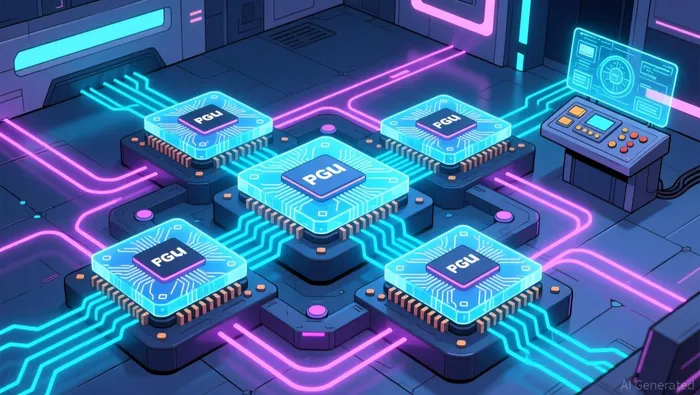
The company's engineering approach is a masterclass in adapting hardware to algorithmic structure. By leveraging the programmability of FPGAs, it constructs hardware circuits that mirror the QFT transformation itself, enabling a linear pipeline of quantum state updates. This is a stark contrast to CPUs, which must force complex data patterns into continuous access patterns, creating inefficiency. Furthermore, the multi-FPGA scalability is key. As quantum circuits grow, state space explodes exponentially. The simulator uses an efficient domain decomposition strategy to split work across FPGAs while minimizing costly cross-chip communication, a critical feature for future-proofing.
This strategic bet is placed squarely within a market on an exponential growth curve. The quantum computing sector is projected to expand at a compound annual growth rate of 32–42% toward 2030. With market sizes ranging from $1.8 billion to $3.5 billion in 2025, the addressable opportunity is massive and accelerating. This isn't a niche market; it's a foundational technology with investments pouring in from venture capital, governments, and tech giants. By focusing on the simulation infrastructure layer-a necessity for any serious quantum development-MicroCloud Hologram is aligning its growth trajectory with the very S-curve of quantum adoption it seeks to support. The question now is whether its specialized hardware solution can scale fast enough to capture a meaningful share of this foundational demand.
The Financial Engine: Funding the Quantum S-Curve with Cash Flow
For a company betting on the exponential growth of quantum computing, the ability to fund its own infrastructure build-out is the ultimate test. MicroCloud Hologram's financial engine provides a rare advantage: a profitable, cash-generating core business that can subsidize the high capital intensity of its quantum ambitions. This creates a self-sustaining model where the present fuels the future.
The foundation is a robust and rapidly expanding holographic services business. In the first half of 2025, the company achieved a dramatic turnaround, posting a net profit of RMB 238.1 million (US$33.1 million). This followed a 726.2% surge in revenue from holographic solutions, demonstrating strong market traction and operational efficiency. This profitability is not a one-off; it provides a steady stream of operating cash flow that can be directed toward R&D and capital expenditures for the quantum platform.
This cash flow is backed by a formidable balance sheet. As of June 30, 2025, the company's cash and cash equivalents increased 153% year-over-year to RMB 1.6 billion (US$223 million). This war chest, alongside a total current asset base of over $400 million, gives the company significant financial runway. It can fund the substantial upfront costs of scaling its FPGA-based quantum simulation platform-engineering teams, specialized hardware, and system integration-without immediate pressure to raise dilutive capital.
The strategic setup is clear. The established holographic business acts as the cash cow, while the quantum simulator represents the high-growth investment. This model allows MicroCloud to pursue the long-term, high-risk S-curve of quantum infrastructure development. The financial strength reduces execution risk, ensuring the company can weather the extended development cycles typical of foundational technology. In essence, the cash flow from today's holographic success is the fuel for tomorrow's quantum verification layer.
The Adoption Curve: Leveraging FPGA Market Growth for a Moat
The quantum simulator's path to exponential adoption is inextricably linked to the broader semiconductor S-curve. Its core technology-multi-FPGA architecture-is riding a powerful wave of market growth. The global FPGA market is projected to expand from $11.73 billion in 2025 to $19.34 billion by 2030, fueled by AI, IoT, and high-bandwidth communications. This isn't just growth; it's a paradigm shift where reconfigurable hardware is becoming central to modern electronics. By building its simulator on this established and accelerating platform, MicroCloud Hologram gains a critical advantage: it can leverage existing manufacturing scale, design ecosystems, and falling FPGA costs to drive down its own hardware expenses. The simulator isn't competing against the FPGA market; it's a high-value application that accelerates its adoption.
This positions the simulator for rapid uptake in its target market: researchers and institutions. The tool provides a cost-effective way to evaluate quantum algorithms, directly addressing a major bottleneck in development. For academic labs and corporate R&D teams, the ability to verify complex algorithms like the QFT at scale before running them on expensive, fragile quantum hardware is a game-changer. It accelerates development cycles, reduces costly trial-and-error, and lowers the barrier to entry for quantum algorithm research. This creates a powerful flywheel: as more researchers use the simulator, it becomes the de facto standard for verification, further cementing its role in the quantum workflow.
The competitive moat here is built on two fronts. First, there's the technical moat of the specialized FPGA architecture itself. The simulator's design, which directly maps the QFT's parallel structure onto hardware, is a significant engineering hurdle for competitors to replicate. Second, and perhaps more importantly, there's the financial moat. The company's established holographic services business provides a separate, funded revenue stream that can subsidize quantum R&D. This financial independence allows MicroCloud to invest aggressively in scaling the simulator and its FPGA platform without the pressure of short-term profits. It can afford to build the infrastructure layer while others scramble for funding.
The bottom line is that the simulator is not a standalone product but a node on a larger adoption curve. It taps into the exponential growth of the FPGA market, serves a critical need in the quantum development pipeline, and is backed by a cash-generating core business. This convergence of technological alignment, market timing, and financial strength creates a setup for exponential adoption. The company is building its moat not just in code, but in the fundamental hardware rails of the next computing paradigm.
Valuation, Catalysts, and Key Risks
The stock's current price of $2.98 reflects a market that has priced in significant skepticism. That's a steep drop from its 52-week high of $5.06, signaling that investors are discounting the commercial timeline for quantum computing. The valuation is a bet on the future S-curve, not today's earnings. For the thesis to gain traction, the company needs to generate clear, near-term milestones that prove its simulator is becoming the essential verification layer.
The key catalysts will be partnerships and commercial validation. The first major signal will be announcements of partnerships with quantum hardware vendors or academic labs to deploy the simulator. These are not just sales; they are endorsements that the tool is solving a real bottleneck. More importantly, the company needs to move from prototype to product. The next major catalyst is the signing of commercial licensing deals with research institutions. Each deal would demonstrate a path to recurring revenue and begin to quantify the addressable market.
The primary risks are long-term in nature but material. The biggest is the long commercialization timeline for quantum computing itself. If the hardware paradigm shift is delayed, the demand for simulation infrastructure is pushed further out, testing the patience of investors. Competition is another headwind. The company faces established players in simulation software, and its FPGA-based approach must prove it can outperform general-purpose solutions in both speed and cost for quantum algorithm verification. Finally, the high capital intensity of scaling the FPGA platform is a constant pressure. While the holographic business funds R&D, scaling the quantum simulator to handle ever-larger state spaces will require significant ongoing investment in specialized hardware and engineering talent.
The setup is a classic deep-tech bet. The stock's low price embeds a high probability of failure, but the potential upside is tied to the exponential growth of the quantum market. Success hinges on the company's ability to convert its technical moat into commercial partnerships and revenue before the broader quantum adoption curve begins its steep climb.





Comentarios
Aún no hay comentarios