
Michigan's Potential Bitcoin Reserve and Its Implications for Institutional Adoption
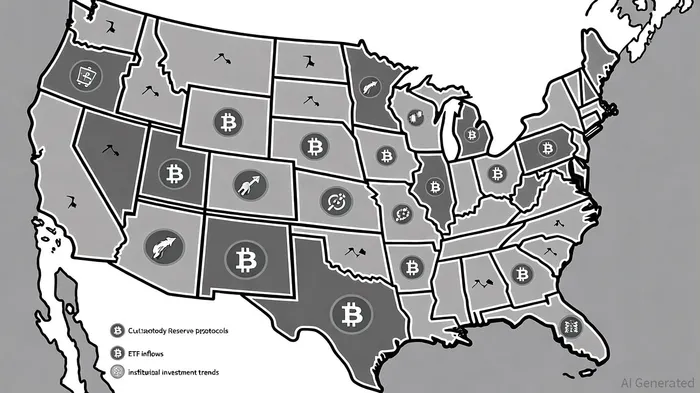
Michigan's proposed BitcoinBTC-- reserve, outlined in House Bill 4087, has advanced to a second reading in the state legislature after months of delay, signaling a pivotal moment in the U.S. states' race to embrace digital assets as part of their financial strategies [1]. If passed, the bill would allow the state treasurer to allocate up to 10% of funds from the countercyclical budget and economic stabilization fund into cryptocurrency assets, with strict security protocols such as government-controlled private keys and multi-party transaction authorization [3]. This move aligns Michigan with a growing coalition of states—including Texas, New Hampshire, and Arizona—that are redefining public finance through Bitcoin exposure [4].
State-Level Adoption as a Catalyst for Institutional Momentum
The institutional investment landscape has been reshaped by state-level Bitcoin adoption, with Michigan's proposal reflecting a broader trend of governments treating Bitcoin as a strategic reserve asset. Texas, for instance, became the first state to authorize a Bitcoin reserve in 2025, with the Texas State Board of Education investing in Bitcoin ETFs [2]. New Hampshire and Arizona have followed suit, testing small-scale reserves and exploring custody solutions like regulated banks and exchange-traded products [4]. These initiatives are notNOT-- isolated experiments but part of a coordinated effort to hedge against inflation and diversify treasuries in an era of macroeconomic uncertainty.
The institutional response has been swift. Major asset managers like BlackRockBLK-- and Fidelity have launched spot Bitcoin ETFs, which now hold over $138 billion in assets under management by mid-2025 [5]. These ETFs provide a regulated on-ramp for institutional investors, who are increasingly viewing Bitcoin as a legitimate asset class. For example, BlackRock's iShares Bitcoin Trust (IBIT) alone accounts for a significant portion of ETF inflows, with institutional investors contributing over $11 billion in just three months [5]. The correlation between Bitcoin and traditional assets like the S&P 500 has also tightened, suggesting that institutional portfolios are integrating Bitcoin as a complementary store of value [5].
Retail Investor Behavior and the Democratization of Bitcoin
State-level adoption has not only influenced institutional investors but also amplified retail demand for Bitcoin. The introduction of regulated ETFs in 2024 marked a turning point, enabling everyday investors to access Bitcoin through familiar financial tools. According to a report by JPMorgan ChaseJPM--, 80% of Bitcoin ETF demand is driven by retail investors, with 45% of ETF holders planning to allocate to digital assets in the coming year [6]. This surge is underscored by data showing that 50 million Americans (14.3%) now own Bitcoin, with 55% of those aged 18–34 either purchasing it or planning to do so in 2025 [6].
Michigan's proposed reserve could further accelerate this trend. By legitimizing Bitcoin as a state-backed asset, the bill may reduce skepticism among retail investors who previously viewed it as speculative. This is particularly relevant given the success of community-driven campaigns and meme projects that frame Bitcoin reserves as a new investment paradigm [2]. The interplay between state actions and retail behavior is creating a flywheel effect: as more states adopt Bitcoin reserves, institutional and retail investors gain confidence, driving further adoption and price appreciation.
Risks and the Road Ahead
Critics argue that Bitcoin's volatility and regulatory ambiguity pose risks to public funds. Historical corrections of over 64% in 2022 and 73% in 2018 highlight the potential for short-term losses [2]. However, proponents counter that a long-term holding strategy—such as the five-year minimum proposed by Illinois and the University of Austin—can mitigate these risks while capitalizing on Bitcoin's potential for appreciation [2]. Michigan's bill, which allows investments in digital assets with a minimum market cap of $500 billion, further reduces exposure to lower-liquidity tokens [4].
The cumulative impact of state-level adoption could trigger a “global accumulation race,” as experts like Isaac Joshua suggest. If even a few states formalize Bitcoin reserves, it may catalyze broader institutional and governmental interest, accelerating Bitcoin's journey toward becoming a mainstream reserve asset [2]. This, in turn, could drive institutional inflows to exceed $120 billion by the end of 2025 [6], further stabilizing Bitcoin's price and integrating it into traditional financial systems.
Conclusion
Michigan's Bitcoin reserve proposal is more than a local policy experiment—it is a microcosm of a larger shift in how governments, institutions, and individuals perceive digital assets. By joining states like Texas and Arizona in treating Bitcoin as a strategic reserve, Michigan could catalyze broader institutional adoption and retail demand, reinforcing Bitcoin's role as a hedge against inflation and a cornerstone of modern portfolios. While risks remain, the momentum behind state-level adoption suggests that Bitcoin is no longer a fringe asset but a transformative force in global finance.





Comentarios
Aún no hay comentarios