
MGP Ingredients' Q2 2025 Earnings: Navigating a Shifting Spirits Market and Building Long-Term Value
In the second quarter of 2025, MGP IngredientsMGPI-- (MGPI) delivered a mixed earnings report that reflects the challenges and opportunities inherent in the global spirits market's uneven recovery. While the company's overall sales declined by 24% year-over-year to $145.5 million, its strategic pivot toward premiumization and innovation in both spirits and food ingredients offers a compelling case for long-term value creation. For investors, the key question is whether MGP can stabilize its core operations while capitalizing on tailwinds in the premium spirits sector and ingredient solutions.
Operational Momentum: A Tale of Two Segments
MGP's Q2 results were split between a struggling Distilling Solutions segment and a resilient Branded Spirits division, with the Ingredient Solutions segment showing unexpected strength.
Distilling Solutions (Down 46% to $50.0M):
The segment's steep decline was driven by reduced demand for brown goods (e.g., bourbon and rye bases) due to industry-wide barrel inventory gluts. Gross profit plummeted 56% to $18.8 million, with margins collapsing to 37.6%. This highlights the cyclical nature of the contract distilling business, where MGP competes with companies like Sazerac and DiageoDEO--. However, management's proactive engagement with customers suggests they are managing expectations and pricing discipline, which could stabilize this segment in the near term.Branded Spirits (Down 5% to $60.5M):
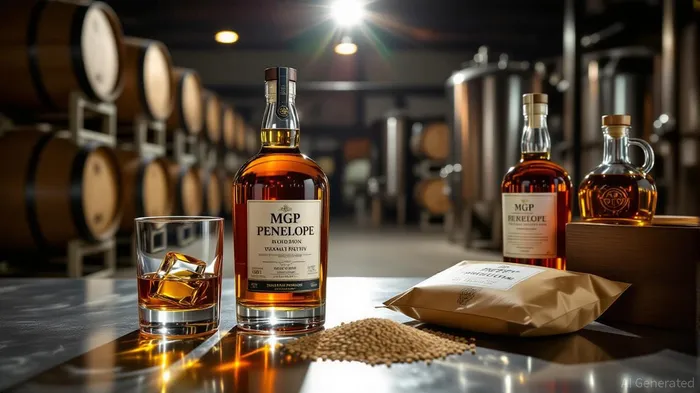
While mid-tier brands like tequila and liqueurs underperformed, the premium-plus portfolio—led by the Penelope bourbon brand—grew by 1% to $31.1 million. Penelope's “above-category growth” is a bright spot, as it aligns with the global shift toward premiumization. Gross margins here improved to 52.8%, outperforming industry averages for branded spirits. This segment's focus on differentiation (e.g., limited-edition releases like Rebel 10-Year Single Barrel Bourbon) positions MGP to benefit from the $4 billion no-alcohol spirits and RTD boom.Ingredient Solutions (Up 5% to $35.0M):
The segment's return to growth, driven by new domestic customers and improved execution, underscores MGP's diversification strategy. Specialty wheat proteins and starches are gaining traction in health-conscious food markets, a trend accelerated by rising demand for clean-label and functional ingredients. This segment's 21.7% gross margin, while lower than spirits, provides a stable cash flow buffer.
Strategic Shifts: Premiumization, Innovation, and Leadership
MGP's recent moves reflect a clear focus on long-term value creation:
Premium Spirits as a Growth Engine:
The company's Luxco portfolio (e.g., El Mayor tequila, Yellowstone bourbon) is being prioritized over mid-tier brands. New launches like Cortada Smoked Tequila and the annual Rebel bourbon releases cater to consumers seeking unique, high-quality experiences. With the global premium tequila market expected to grow at a 7% CAGR through 2028, MGP's 100% agave tequila production in Jalisco, Mexico, is well-positioned to capture this demand.Vertical Integration and Cost Control:
MGP's vertically integrated model—from grain sourcing to distillation and bottling—provides a competitive edge in managing costs and ensuring product consistency. This is critical in a market where raw material and logistics costs remain volatile. The company's recent capital expenditure cuts (down 17% YTD) also signal a leaner approach to capital allocation.Leadership Transition:
The appointment of Julie Francis as CEO in July 2025 brings a wealth of experience from Constellation BrandsSTZ-- and Coca-ColaKO--. Her focus on “sustainable growth” and “customer-centric strategies” aligns with the industry's shift toward brand-led differentiation. Investors should watch how her leadership impacts R&D spend and marketing effectiveness.
Market Context: A Recovering Spirits Industry with Structural Risks
The global spirits market is showing early signs of recovery, driven by moderation trends, on-trade revival, and RTD growth. However, MGP faces structural headwinds:
- Moderation and Health Trends: The rise of “light” drinkers and no-alcohol categories could cannibalize traditional spirits demand. MGP's foray into RTDs and its 100% agave tequila portfolio are key differentiators here.
- Regulatory and Economic Pressures: Excise duties and tariffs (e.g., U.S.-UK trade disputes) could squeeze margins. MGP's geographic diversification (U.S., Mexico, Northern Ireland) mitigates some of this risk.
- Competition in Premiumization: Brands like Jim Beam and Casamigos are also targeting premium bourbon and tequila markets. MGP's strength lies in its ability to balance scale with artisanal production techniques.
Investment Considerations: Cautious Optimism with a Long-Term Lens
MGP's Q2 results highlight both vulnerabilities and strengths. The company's updated 2025 guidance—$520–540 million in sales and $105–115 million in adjusted EBITDA—suggests management is managing through the downturn. However, the path to growth hinges on:
- Execution in Premium Segments: Can MGP scale Penelope and El Mayor without diluting brand equity?
- Distilling Solutions Stabilization: Will industry-wide barrel inventory normalization boost demand for brown goods in 2026?
- Ingredient Solutions Synergy: Can the food ingredient segment become a meaningful contributor to EBITDA?
For investors, MGP offers a compelling mix of resilience and innovation. While short-term volatility is likely, the company's focus on premiumization and strategic leadership changes make it a candidate for long-term value creation. A watchful eye on cash flow generation and capital allocation will be critical.
Historically, MGPI's stock has shown a 50% win rate over 10 days following earnings releases, though with an average return of -0.31%, suggesting that while there are opportunities for short-term gains, the long-term value creation thesis remains intact.
Final Take: MGP Ingredients is navigating a complex market with a clear-eyed focus on premiumization and operational efficiency. While Q2 results were mixed, the company's strong brand portfolio, vertical integration, and leadership transition provide a solid foundation for long-term growth. Investors with a 3–5 year horizon may find value in this underappreciated player in the evolving spirits and ingredients landscape.





Comentarios
Aún no hay comentarios