
MGK vs. IWO: Mega-Cap Efficiency or Small-Cap Diversification for Growth?
The rise of artificial intelligence (AI) has reshaped global markets, creating both opportunities and risks for growth-oriented investors. As AI-driven cycles intensify, the debate between concentrated mega-cap exposure and diversified small-cap strategies has taken center stage. This analysis examines the risk-return trade-offs of two prominent growth ETFs-Vanguard Mega Cap Growth ETF (MGK) and iShares Russell 2000 Growth ETF (IWO)-through the lens of AI's impact on market dynamics, regulatory shifts, and sector volatility.
Performance and Volatility: A Tale of Two Portfolios
MGK, with its 66-holding portfolio, is hyper-focused on mega-cap growth stocks, particularly in technology, communication services, and consumer cyclical sectors according to analysis. Its top three holdings-Nvidia, Apple, and Microsoft-account for 38.26% of assets according to market data, creating a high-conviction bet on AI-driven innovation. From 2020 to late 2025, MGKMGK-- delivered a 18.90% one-year return, outperforming IWO's 12.2%. However, this performance came at a cost: MGK's max drawdown over five years reached -36.02%, compared to IWO's -42.02%. The disparity reflects MGK's narrower focus, which amplifies gains during AI booms but deepens losses during sector-specific corrections.
IWO, by contrast, offers a broader, small-cap growth strategy spanning over 1,000 companies. As data shows, its sector allocation is more balanced, with exposure to technology, healthcare, and industrials. While IWO's 1.40 beta (vs. MGK's 1.20) signals higher volatility, its diversification mitigates single-sector shocks. For instance, during the EU AI Act's implementation in August 2025-which imposed stringent transparency requirements on general-purpose AI models-MGK's tech-heavy portfolio faced regulatory uncertainty, whereas IWO's broader holdings cushioned its downside according to regulatory sources.
AI-Driven Cycles: Opportunity and Overexposure
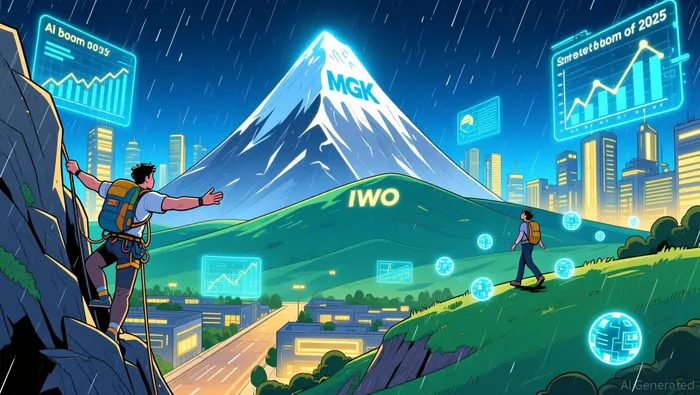
The AI sector's rapid evolution has magnified the strengths and weaknesses of both ETFs. MGK's concentration in AI leaders like Nvidia and Microsoft has fueled its outperformance during periods of AI adoption acceleration.
For example, the launch of GPT-5.2 in December 2025, which expanded AI capabilities in enterprise workflows, likely boosted MGK's holdings in AI infrastructure providers. However, this overexposure also leaves MGK vulnerable to regulatory headwinds. According to implementation timelines, the EU AI Act's February 2025 ban on high-risk AI practices, such as emotion recognition in workplaces, introduced sector-wide uncertainty, testing the resilience of MGK's concentrated portfolio.
IWO's small-cap focus, meanwhile, offers a different dynamic. While its smaller constituents may lack the AI-driven growth trajectories of mega-caps, they benefit from diversification across industries. For instance, during Q4 2025, when AI adoption remained fragmented with most firms in pilot phases), IWO's broader exposure allowed it to capture growth in non-AI sectors like healthcare and industrials. This balance, however, comes with higher volatility, as evidenced by IWO's steeper five-year drawdown according to performance data.
Risk-Return Trade-Offs: Cost, Liquidity, and Strategic Fit
MGK's 0.07% expense ratio and $32.68 billion in assets under management (AUM) make it a cost-effective option for investors prioritizing mega-cap growth. Its lower beta (1.20) also suggests reduced volatility compared to IWOIWO--. Yet, these advantages are offset by its lack of diversification. In contrast, IWO's 0.15% expense ratio and $18.4 billion AUM reflect its broader strategy. For investors seeking to hedge against AI sector-specific risks-such as regulatory crackdowns or AI ROI disappointments-IWO's diversification may justify its higher costs.
Conclusion: Navigating AI's Dual Edge
The choice between MGK and IWO hinges on an investor's risk tolerance and market outlook. MGK is ideal for those who believe AI's transformative potential will continue to outpace regulatory and economic headwinds, offering high growth at the expense of concentration risk. IWO, with its diversified small-cap approach, suits investors seeking to balance AI-driven opportunities with cross-sector resilience.
As AI-driven market cycles evolve, the interplay between innovation and regulation will remain pivotal. For now, MGK's efficiency and IWO's diversification present two compelling, yet distinct, pathways for growth.







Comentarios
Aún no hay comentarios