
MFA Financial's $0.36 Dividend: A High-Yield Gamble or a Sustainable Play for Income Investors?
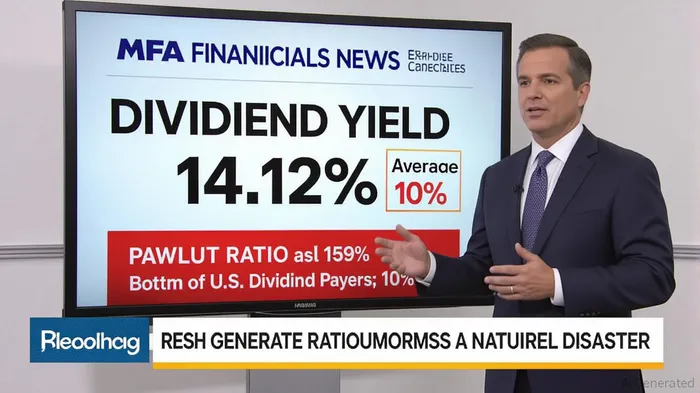
MFA Financial, Inc. (MFA) recently declared a quarterly dividend of $0.36 per share, up from $0.35 in the prior year [1]. At first glance, this 2.9% increase signals management's confidence in the company's earnings power, driven by high-yielding asset acquisitions and expanding net interest income [3]. For income-focused investors, the 14.12% dividend yield—a figure that dwarfs the bottom 25% of U.S. market dividend payers—appears enticing [1]. Yet, beneath the surface, the sustainability of this payout raises critical questions.
The Allure of High Yield, the Peril of Payout Ratios
MFA's dividend yield is a double-edged sword. While it offers a rare combination of income and growth potential, the company's payout ratio of 159%—meaning it pays out more in dividends than it earns—casts a shadow over long-term stability [1]. This metric is not uncommon in the real estate investment trust (REIT) and specialty finance sectors, where high leverage and asset-heavy models often justify aggressive distributions. However, MFAMFA-- operates in a hybrid space, blending commercial mortgage lending with insurance underwriting, which introduces unique risks.
According to a report by Market Report Analytics, MFA's earnings are increasingly exposed to property insurance market dynamics, where softening pricing and new entrants are eroding margins [3]. For instance, the influx of flexible underwriters in the property insurance space has forced traditional players to compete on price, squeezing spreads [3]. Compounding this, natural disasters like Hurricanes Helene and Milton in 2025 have highlighted the fragility of insurance models in regions with low homeowners' insurance penetration, such as North Carolina [3]. These events could trigger unexpected losses, further straining MFA's ability to maintain its dividend.
The Preferred Stock Conundrum: Adjustments and Uncertainty
MFA's recent corrections to its preferred stock dividends also warrant scrutiny. In August 2025, the company initially declared a $0.61889 per share dividend for its Series C Preferred Stock but revised it to $0.639521 just two weeks later, citing adjustments for accumulated unpaid dividends [2]. While such corrections are not unusual in complex capital structures, they underscore the volatility inherent in MFA's financial engineering. For common shareholders, this highlights the prioritization of preferred obligations, which could limit flexibility during earnings downturns.
A Balancing Act: Earnings Growth vs. Market Risks
MFA's management has pointed to “attractive asset spreads” and strategic acquisitions as pillars of its dividend sustainability [3]. However, the company's reliance on high-yielding assets—such as commercial mortgages and specialty insurance policies—comes with inherent fragility. For example, the shift toward Excess & Surplus (E&S) insurance lines, designed to address non-standard risks, could further fragment the market and reduce demand for traditional insurers like MFA [3].
Moreover, macroeconomic headwinds loom large. Rising interest rates, while beneficial for net interest income in the short term, could deter new borrowers and increase refinancing defaults. Meanwhile, trade policy shifts and inflationary pressures may amplify casualty risks, such as social inflation claims, which are notoriously difficult to model [3].
Conclusion: A High-Risk, High-Reward Proposition
For income investors, MFA's $0.36 dividend represents a tantalizing opportunity—but one that demands caution. The 14.12% yield is among the most attractive in the U.S. market, yet it is underpinned by a payout ratio that exceeds 100%, a red flag for dividend sustainability. While MFA's management has demonstrated a knack for capitalizing on high-yielding assets, the company's exposure to volatile insurance markets and natural disaster risks cannot be ignored.
Investors should monitor two key metrics: (1) the stability of MFA's net interest income amid rate fluctuations and (2) its ability to navigate the evolving E&S insurance landscape without sacrificing margins. Until these risks are mitigated, MFA remains a speculative bet for those seeking income, rather than a “safe” long-term holding.





Comentarios
Aún no hay comentarios