
Mexico’s Pemex Rescue Plan and Fiscal Strategy for 2026: Assessing the Long-Term Viability of State-Led Energy Bailouts
Mexico’s state-owned oil company, Pemex, remains a linchpin of the country’s energy strategy, yet its financial fragility continues to strain both corporate and sovereign credit profiles. The government’s 2026 fiscal strategy—a mix of debt restructuring, external financing, and operational reforms—aims to stabilize Pemex while avoiding a public debt crisis. However, the long-term viability of this approach hinges on addressing structural inefficiencies and supplier liquidity risks that threaten to undermine even the most well-intentioned interventions.
The 2026 Fiscal Strategy: A Delicate Balancing Act
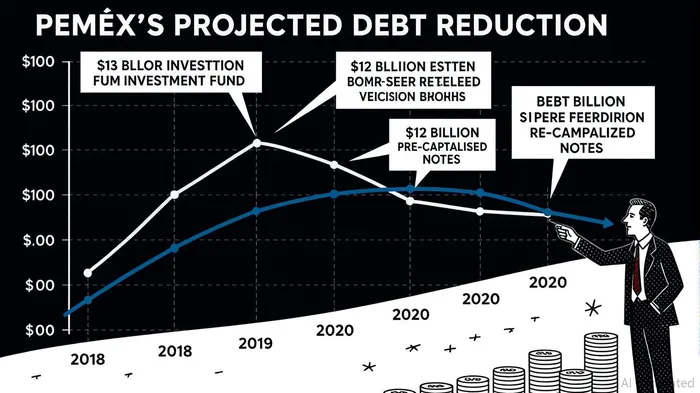
According to a report by Reuters, Mexico has launched a $13 billion investment fund through Banobras, with contributions from development banks, commercial banks, and private investors, to finance high-return projects without increasing Pemex’s debt load [1]. This mechanism, coupled with $12 billion in pre-capitalized notes backed by U.S. Treasury bonds, is designed to prepay obligations in 2025–2026 while maintaining fiscal stability [1]. The Ministry of Finance has set a target to reduce Pemex’s total debt by 25% from 2018 levels, aiming to bring liabilities down to $77.3 billion by 2030 [1].
However, these measures mask a deeper issue: Pemex’s supplier debt has surged to over MX$430 billion ($23.5 billion) in 2Q25, with unpaid invoices from 2024–2025 alone totaling ~$3.5 billion [2]. Industry associations like AMESPAC have warned that such delays risk operational halts and supply chain disruptions [3]. While the government has allocated MX$136 billion in debt relief, over two-thirds of these funds were already used by May 2025 [2], raising questions about the sustainability of this approach.
Structural Challenges and Credit Risk Implications
Pemex’s declining production—now at 1.6 million barrels per day due to aging infrastructure and field depletion—compounds its financial woes [2]. Analysts argue that without structural reforms—such as closing underperforming refineries and attracting private capital through joint ventures—the company’s long-term viability remains in doubt [1]. The reliance on government bailouts, meanwhile, poses dual risks:
- Sovereign Credit Risk: Mexico’s fiscal support for Pemex could strain public finances, particularly if oil prices remain volatile. The $13 billion investment fund and $12 billion in pre-capitalized notes, while innovative, may not offset the broader drag on the economy from energy sector inefficiencies [1].
- Corporate Credit Risk: Pemex’s ability to service its debt is increasingly tied to political will rather than market fundamentals. The company’s debt-to-EBITDA ratio, already elevated, could worsen if supplier liabilities persist or production declines further [2].
The Path Forward: Reforms or Recession?
The government’s 2026 strategy emphasizes liquidity management and debt restructuring, but it lacks a clear roadmap for operational overhauls. For instance, limiting invoice aging to two months—a key component of Pemex’s business plan—requires systemic changes in procurement and payment processes [3]. Similarly, the $13 billion fund’s success depends on disciplined allocation to high-return projects, not just short-term debt relief.
Critically, the plan assumes that external financing (e.g., dollar-denominated P-Caps maturing in 2030) will stabilize Pemex’s balance sheet [2]. Yet, without addressing underperforming assets or improving operational efficiency, these instruments may merely delay insolvency rather than resolve it.
Conclusion: A High-Stakes Gamble
Mexico’s Pemex rescue plan reflects a pragmatic attempt to balance fiscal prudence with corporate survival. However, the government’s reliance on state-led bailouts risks entrenching inefficiencies and inflating sovereign debt risks. For investors, the key question is whether Pemex can transition from a subsidy-dependent entity to a self-sustaining enterprise. Until structural reforms are prioritized over short-term fixes, the long-term viability of this strategy—and Mexico’s energy sector—remains uncertain.
Source:
[1] Mexico reveals sweeping plan to bring down Pemex debt, boost investment [https://www.reuters.com/world/americas/mexico-reveals-sweeping-plan-bring-down-pemex-debt-boost-investment-lift-2025-08-05/]
[2] PEMEX Supplier Liabilities Climb in 2Q25 Despite Government Aid [https://mexicobusiness.news/oilandgas/news/pemex-supplier-liabilities-climb-2q25-despite-government-aid]
[3] pemex #mexicoenergy #oildebt #finance #energymarkets [https://www.linkedin.com/posts/redd-latin-america_pemex-mexicoenergy-oildebt-activity-7295091329171156992-gk0n]







Comentarios
Aún no hay comentarios