
Mexico's Market Re-rating: Is the EWW Rally Sustainable Amid Deteriorating Fundamentals?
The recent rally in the iShares MSCI Mexico ETFEWW-- (EWW) has captured investor attention, with the fund posting an 8.3% gain in the last three months of 2025 despite broader market headwinds. However, beneath this optimism lies a complex web of deteriorating fundamentals, including Mexico's growing public debt, a negative credit outlook, and volatile U.S.-Mexico trade dynamics. This analysis examines whether the EWW's performance is sustainable in light of these risks and what investors should prioritize in a 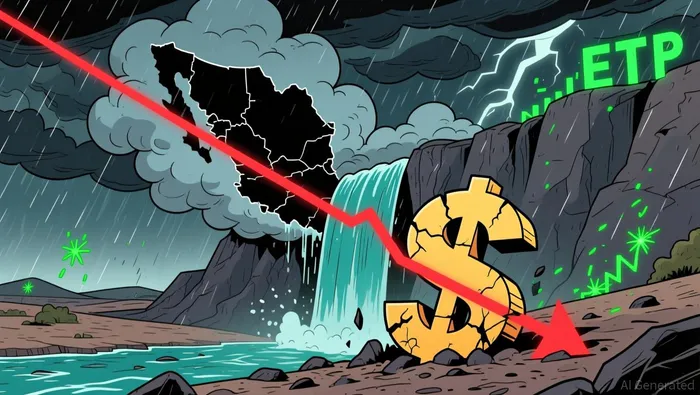 market increasingly defined by fragility.
Sovereign Downgrade Risks: A Looming Shadow
Mexico's sovereign credit ratings remain a critical vulnerability. As of September 2025, S&P affirmed its 'BBB' rating with a stable outlook, while Moody's maintained a Baa2 rating with a negative outlook, and Fitch assigned a BBB- rating with stable prospects. The divergence in outlooks reflects divergent assessments of Mexico's fiscal trajectory. Moody's explicitly cited weakening institutions and policies as risks to economic stability and government finances, while Fitch highlighted the country's proximity to speculative grade.
The core issue is Mexico's public debt, which has nearly doubled since 2018 to $1.067 trillion. The International Monetary Fund (IMF) projects the debt-to-GDP ratio will reach 60% by 2030, a threshold that could trigger downgrades. A loss of investment-grade status would likely exacerbate the peso's depreciation, as seen in historical episodes where currency volatility amplified capital flight. The Bank of Mexico's recent rate cuts-lowering the policy rate to 7.25% in November 2025-signal a fragile balance between supporting growth and managing inflationary pressures.
Trade Dynamics: A Double-Edged Sword
U.S.-Mexico trade relations remain a pivotal factor. Mexico's exports are projected to grow by 6% in 2025, driven by nearshoring and friendshoring trends, the sector faces headwinds. The U.S. extension of 25% tariffs on non-USMCA-compliant Mexican imports has created uncertainty, prompting Mexico's central bank to slash its 2025 growth forecast to 0.3%. This volatility is mirrored in EWW's performance, which is heavily weighted toward consumer staples and materials sectors sensitive to trade flows.
Foreign direct investment (FDI) offers a counterpoint. Mexico reported a record $41 billion in FDI in Q3 2025, a 15% year-over-year increase, driven by confidence in its manufacturing potential. Yet, this inflow contrasts with EWW's net outflow of $272.27 million over the past year, underscoring a disconnect between macroeconomic resilience and ETF-specific risks. The ETF's lack of currency hedging further exposes it to peso depreciation, which could erode gains for U.S. investors.
The EWWEWW-- Rally: Structural Risks and Investor Sentiment
The EWW's recent outperformance-despite Mexico's weak growth outlook-reflects a mix of factors. Declining U.S. interest rates and a weaker dollar have boosted emerging market assets, including EWW. Additionally, Mexico's ETF market has grown rapidly, with passive strategies outpacing active funds and attracting retail and institutional investors. However, this rally masks structural vulnerabilities.
A downgrade to speculative grade would likely trigger a flight to quality, disproportionately affecting EWW's energy and utilities sectors, which are already burdened by Pemex's debt and CFE's operational challenges. Deloitte's analysis warns of a potential recession in 2025, citing historical patterns of economic slowdowns following political transitions. Meanwhile, Moody's negative outlook underscores risks from constitutional reforms that weaken institutional checks and balances, a factor that could deter long-term capital.
Sustainability: A Delicate Balance
The EWW's rally hinges on a fragile equilibrium between optimism about nearshoring and pessimism about Mexico's fiscal health. While short-term gains are plausible-supported by FDI inflows and a weaker dollar-the ETF's sustainability depends on three critical factors:
1. Credit Rating Stability: A downgrade would likely trigger a sell-off in Mexican assets, including EWW. Investors must monitor Moody's and Fitch's assessments, particularly as Mexico's debt trajectory remains on a collision course with rating thresholds.
2. Trade Policy Clarity: The U.S. review of USMCA and potential tariff adjustments will shape export sector performance. A resolution favoring Mexico could bolster EWW, while further trade tensions would amplify volatility. This volatility is mirrored in EWW's performance, which is heavily weighted toward consumer staples and materials sectors sensitive to trade flows.
3. Domestic Reforms: Structural improvements in energy access, regulatory predictability, and crime reduction are essential to attract sustained investment. Deloitte's analysis warns of a potential recession in 2025, citing historical patterns of economic slowdowns following political transitions.
Conclusion: Navigating the Crossroads
Mexico's market re-rating presents both opportunities and risks. The EWW's rally reflects a blend of tactical positioning and structural optimism, but deteriorating fundamentals-particularly public debt and institutional fragility-pose a significant threat. Investors should adopt a cautious stance, balancing exposure to EWW with hedging strategies against peso depreciation and credit shocks. As the IMF and rating agencies underscore, Mexico's path forward will require fiscal discipline and policy reforms to avoid a self-fulfilling crisis. In this environment, patience and prudence may prove more valuable than exuberance.





Comentarios
Aún no hay comentarios