
Mexico's Interest Rate Cut: Implications for Emerging Market Equity and Debt Investors
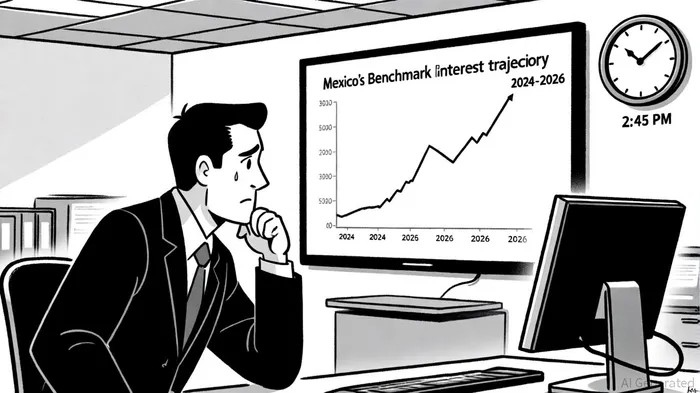
Mexico's central bank (Banxico) has embarked on a sustained easing cycle in 2025, cutting the benchmark interest rate to 7.50% by September 2025—a 25-basis-point reduction from 7.75%—marking the eleventh consecutive cut since early 2024[1]. This aggressive monetary easing reflects a delicate balancing act: addressing a slowing economy while managing inflation, which has eased to 4.21% as of December 2024[3]. For emerging market investors, these developments present both opportunities and risks, necessitating strategic asset reallocation and robust risk management frameworks in a shifting policy environment.
Monetary Easing and Its Dual Impact on Equity and Debt Markets
Banxico's rate cuts aim to stimulate domestic demand and ease borrowing costs for businesses and consumers. According to a report by Reuters, the projected further reductions—potentially reaching 7.00% by year-end 2025—could lower corporate financing costs, boosting equity valuations in sectors like real estate and manufacturing[1]. However, external uncertainties, such as U.S. President-elect Donald Trump's proposed 25% tariffs on Mexican exports, threaten to reintroduce volatility[3].
For debt investors, Mexico's government bond market has emerged as a standout performer in 2025, with yields attracting global capital amid a broader search for yield in a low-interest-rate world[2]. The IMF projects Mexico's GDP growth at 1.0% in 2025 and 1.5% in 2026, reinforcing the appeal of sovereign and corporate bonds, particularly USD-denominated instruments in energy and infrastructure sectors[1]. Yet, analysts caution that trade-related risks could disrupt this trajectory, urging investors to prioritize liquidity and credit quality[3].
Strategic Asset Reallocation: Sectors and Geographies in Focus
Emerging market investors are recalibrating portfolios to capitalize on Mexico's easing cycle. BBVA Market Strategy recommends overweighting local fixed-income assets, such as MBonos and Udibonos, while maintaining a short position on the Mexican peso (MXN) to hedge currency depreciation risks[1]. Real estate, particularly in high-growth regions like Mazatlán, Huatulco, and Yucatán State, has also drawn attention. These areas are benefiting from nearshoring trends, tourism-driven demand, and infrastructure investments, making them attractive for both equity and debt allocations[2].
Sectoral shifts are equally pronounced. Energy and industrial sectors are gaining traction as lower borrowing costs spur capital expenditures. Meanwhile, consumer discretionary and retail stocks face headwinds due to weak remittances and constrained government spending[3]. Diversification across sectors and geographies—such as pairing Mexican assets with Brazilian or Indian equities—has become a key strategy to mitigate regional-specific risks[2].
Risk Management in a Volatile Environment
Currency hedging has emerged as a critical tool for managing exposure to the MXN. Forward contracts and put options are increasingly favored to lock in exchange rates and protect against depreciation, especially given the peso's sensitivity to U.S. monetary policy and trade tensions[4]. Collar strategies, which combine put and call options, offer a cost-effective middle ground, capping downside risks while allowing limited upside potential[4].
Beyond currency risks, investors must also account for geopolitical uncertainties. The potential renegotiation of the USMCA trade agreement and U.S. fiscal policy shifts could disrupt trade flows and inflation dynamics. Diversification into alternative assets—such as private equity in Mexican real estate or infrastructure projects—provides additional insulation[5].
Conclusion: Navigating the New Normal
Mexico's interest rate cuts signal a prolonged accommodative phase, creating a fertile ground for strategic investments in equities and debt. However, the path forward is not without challenges. Investors must remain agile, leveraging hedging tools, sectoral diversification, and a nuanced understanding of macroeconomic interdependencies. As Banxico continues to navigate the delicate balance between growth and inflation, emerging market investors who adapt swiftly to shifting conditions will be best positioned to capitalize on Mexico's evolving landscape.







Comentarios
Aún no hay comentarios