
Mexico's 50% Tariff on Asian Cars: Reshaping Global Auto Supply Chains and Emerging Market Opportunities
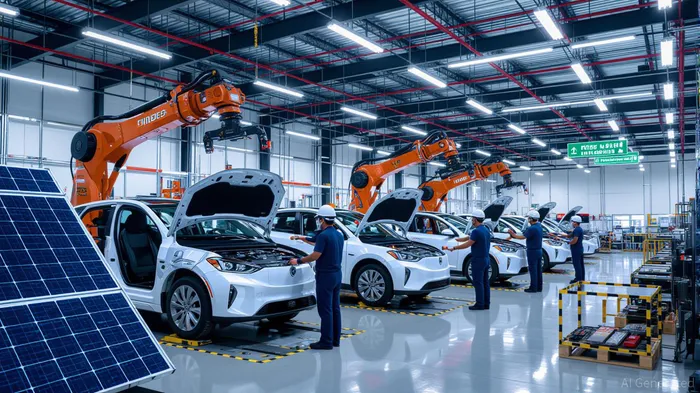
Mexico's proposed 50% tariff on Asian-made cars, announced by Economy Minister in August 2025, marks a pivotal shift in global automotive supply chains. This move, part of President 's “Plan Mexico” to boost local manufacturing, is not just a protectionist measure but a calculated strategy to accelerate nearshoring and reduce reliance on foreign imports. For investors, the policy's ripple effects—from disrupting Asian automakers to creating opportunities in Mexican and U.S. supply-side firms—demand a nuanced understanding of the evolving trade landscape.
Strategic Implications for Global Supply Chains
The 50% tariff, which will take effect 30 days after publication in Mexico's official gazette, targets light vehicles and parts from Asia, . . However, the tariff's implementation will likely force Asian automakers to either raise prices, absorb losses, or pivot to localized production in Mexico.
The U.S.-Mexico-Canada Agreement () provides a critical counterbalance. Under its , , incentivizing automakers to restructure supply chains within North America. For example, , while StellantisSTLA-- and Nissan are recalibrating Mexican operations. This trinational strategy—leveraging Mexico's low labor costs, U.S. tax credits, and Canada's logistics—highlights how tariffs are reshaping manufacturing geographies.
Disruption to Asian Auto Exporters
Asian automakers, particularly Chinese firms like BYD and JAC Group, face a dual challenge. , . In 2023, , but this share may shrink as U.S. and Mexican firms prioritize domestic content. South Korea and Japan, which also supply vehicles to Mexico, may see similar pressures unless they invest in local manufacturing.
The tariff's timing coincides with broader geopolitical shifts. As U.S. tariffs on steel and aluminum (now 50% under Section 232) raise production costs, Asian automakers must navigate a labyrinth of trade barriers. For instance, Japan's provisional 15% tariff on U.S. exports, , underscores the urgency for Asian firms to secure North American footholds.
Investment Opportunities in Mexican Manufacturing
Mexico's automotive sector, already the fourth-largest global exporter, is poised to benefit from nearshoring. . Key beneficiaries include:
- Arca Continental (AC): As a leading Coca-Cola bottler in Latin America, Arca's expansion into Mexico's growing EV market aligns with nearshoring trends. .
- Vesta (VST): This industrial real estate developer is capitalizing on nearshoring by expanding its footprint in industrial zones like Monterrey. .
- Mexican automakers: Companies like Foton and JAC Group, which have localized production in Mexico, stand to gain from reduced import dependencies.
U.S. Supply-Side Beneficiaries
U.S. automotive suppliers are also reaping rewards from Mexico's policy shift. The USMCA's preferential rates have spurred investments in Mexican facilities, with Ford and Stellantis expanding engine and component production. Additionally, U.S. suppliers like Aptiv (APTV) and Magna International (MGA) are securing contracts to supply parts to Mexican automakers, avoiding the 50% tariff on non-compliant imports.
The U.S. . For example, .
Equity Valuation Trends and Risks
Mexican equities remain attractively valued, . This disconnect between sentiment and fundamentals suggests potential upside for investors willing to navigate short-term volatility.
However, risks persist. The U.S. , . Additionally, rising material costs and supply chain bottlenecks may temper growth. Investors should prioritize companies with strong USMCA compliance and diversified revenue streams.
Conclusion: A New Era for Automotive Geopolitics
Mexico's 50% tariff on Asian cars is more than a protectionist tool—it's a catalyst for reshaping global supply chains. By accelerating nearshoring and leveraging USMCA advantages, Mexico is solidifying its role as a strategic hub for automotive manufacturing. For investors, the key lies in identifying firms poised to benefit from this shift, whether through localized production in Mexico or U.S. supply-side integration.
As the U.S. and Mexico navigate trade complexities, the automotive sector offers a compelling case study in how policy-driven disruptions can create both challenges and opportunities. For those with a long-term horizon, the current valuation discounts in Mexican equities and U.S. suppliers may represent a rare entry point in a sector poised for transformation.





Comentarios
Aún no hay comentarios