
MEXC's 0 Fee Lounge: A Strategic Gamble to Redefine Crypto Trading and Capture Market Share
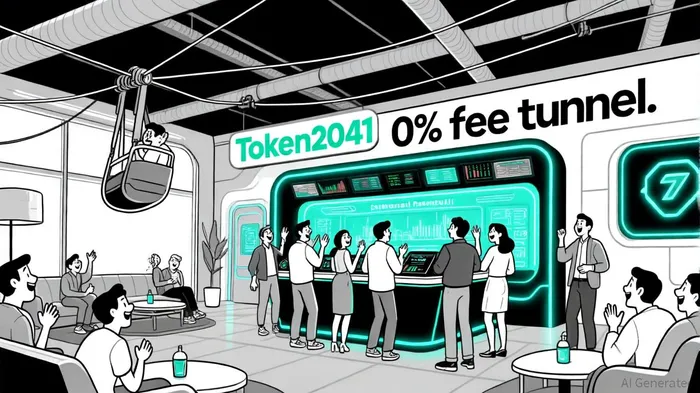
In April 2025, MEXC made a bold move at Token2049 Dubai by launching its 0 Fee Lounge, a zero-fee trading initiative paired with an immersive, travel-themed experience. This campaign, part of the exchange's 7th-anniversary celebrations, wasn't just a gimmick—it was a calculated strategy to disrupt traditional trading economics and capture a fragmented crypto market. By eliminating fees on key pairs like $TON/USDC and $ETH/USDT, MEXC aimed to lower barriers for retail traders while showcasing its DEX+ hybrid platform, which bridges centralized and decentralized liquidity. The results? A 170.2% surge in trading volume and a 17.8% increase in monthly active traders in Q1 2025[4]. But can this zero-fee model sustain long-term growth, and how does it position MEXC against rivals like Binance and Coinbase?
Zero-Fee Models: From Disruption to Normalcy
Zero-fee trading, once a radical idea in crypto, is now a mainstream tool for exchanges to attract liquidity. MEXC's approach—targeting high-demand pairs like TON/USDC (42% market share in Q2 2025) and ETH/USDT (33% market share)—mirrors strategies used by traditional brokers like RobinhoodHOOD-- in 2020[3]. The logic is simple: remove transaction costs, and you unlock trading frequency. Data from MEXC's Q2 2025 campaigns shows that zero-fee promotions drove explosive volume growth, particularly in emerging tokens like $POPCATUSDC and $HYPE/USDC[2].
But the impact goes beyond volume. Zero fees encourage portfolio diversification and risk-taking, as traders experiment with volatile assets without immediate cost concerns[2]. For example, MEXC's zero-fee access to memeMEME-- coins like $POPCATUSDC attracted speculative retail investors, while its stablecoin pairs (e.g., ETH/USDT) appealed to more conservative traders. This duality—catering to both high-risk and low-risk profiles—has allowed MEXC to broaden its user base[3].
Competitive Positioning: MEXC vs. Binance vs. Coinbase
MEXC's zero-fee strategy isn't unique, but its execution is. Binance, for instance, maintains a base fee of 0.10% but offers discounts via BNBBNB-- and volume tiers[1]. CoinbaseCOIN--, meanwhile, relies on its subscription-based Coinbase One model, which provides zero fees up to a monthly cap[1]. What sets MEXC apart is its hybrid revenue model. While it sacrifices short-term fee income, it offsets this through ecosystem development funds ($300M) and staking incentives[5]. This approach aligns with broader industry trends: exchanges are shifting from pure trading fees to diversified revenue streams like tokenized assets, derivatives, and ecosystem partnerships[4].
Moreover, MEXC's experiential marketing—think ziplines and “0% fee tunnels”—creates a sticky brand identity. At Token2049, the 0 Fee Lounge wasn't just about trading; it was about redefining the user experience. This contrasts with Binance's regulatory-focused strategy or Coinbase's institutional push. For MEXC, the goal is to become a Web3 ecosystem builder, not just an exchange[5].
Sustainability: Can Zero Fees Scale?
The long-term viability of zero-fee models hinges on tokenomics and ecosystem diversification. MEXC's $300M Ecosystem Development Fund and IgniteX CSR initiative (a $30M investment in Web3 talent) suggest a commitment to building a self-sustaining ecosystem[5]. By subsidizing public chains, wallets, and media platforms, MEXC creates a flywheel effect: more projects = more users = more liquidity.
However, risks persist. Zero fees can erode profit margins unless offset by alternative revenue streams like staking yields or listing fees[4]. For example, MEXC's DEX+ platform generates income by charging liquidity providers and offering premium data analytics[2]. Additionally, the rise of green cryptocurrencies (e.g., SolanaSOL--, Cardano) adds another layer of complexity. Exchanges that integrate energy-efficient blockchains may gain a competitive edge as ESG (Environmental, Social, Governance) criteria become more critical for institutional investors[4].
Investor Behavior: A New Era of Trading
Zero-fee models are reshaping how traders interact with crypto. According to a 2025 study, trading frequency increased by 40% on platforms with zero-fee promotions[2]. This aligns with MEXC's Q1 2025 results, where monthly active traders rose by 17.8%[4]. However, this surge in activity isn't without consequences. Speculative trading in meme coins and low-cap tokens has led to increased volatility, raising concerns about market stability[1].
For MEXC, the challenge is balancing accessibility with risk management. Its focus on high-liquidity pairs (e.g., TON/USDC) mitigates some of these risks, but the exchange must also address regulatory scrutiny. As seen with Coinbase's 2025 State of Crypto Summit, compliance is becoming a key differentiator[1]. MEXC's recent expansion into regulated markets (e.g., Singapore, Japan) suggests it's preparing for this reality[5].
Conclusion: A Strategic Bet on the Future
MEXC's 0 Fee Lounge is more than a marketing stunt—it's a strategic bet on the future of crypto trading. By combining zero-fee incentives with ecosystem-building and experiential marketing, MEXC has positioned itself as a disruptor in a crowded market. While sustainability remains a question mark, the exchange's diversified revenue streams and focus on user retention (e.g., loyalty programs, staking rewards) provide a blueprint for long-term growth.
For investors, the key takeaway is clear: zero-fee models are here to stay, but success will belong to exchanges that can balance short-term incentives with long-term profitability. MEXC's ability to innovate—whether through DEX+, green crypto integrations, or immersive user experiences—will determine whether it can maintain its market share in 2025 and beyond.





Comentarios
Aún no hay comentarios