
Metso's 2028 Sales Growth Target: Strategic Implications for Long-Term Investors
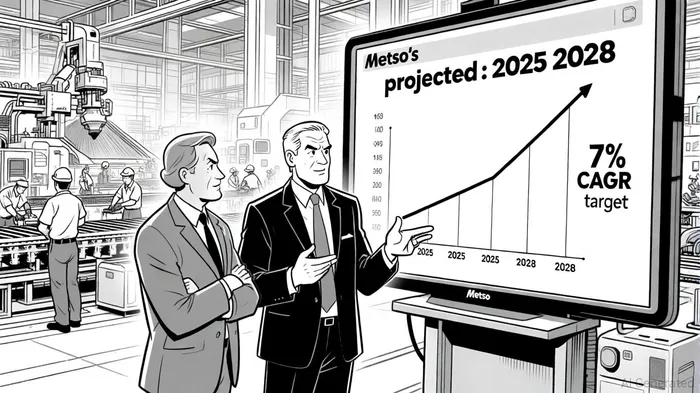
Metso's updated 2026–2030 strategy, titled “We go beyond,” has set a bold financial target: achieving a compound annual growth rate (CAGR) of at least 7% in annual sales by 2028[1]. For long-term investors, the feasibility of this target hinges on the company's operational readiness, market dynamics, and alignment with global megatrends. This analysis evaluates Metso's strategic pillars—customer-centricity, sustainability, and innovation—to determine whether its 2028 ambitions are grounded in actionable realities.
Operational Readiness: R&D, Capacity, and Digitalization
Metso's operational strategies are anchored in three pillars: R&D investment, capacity expansion, and digital transformation. The company allocated €103 million to R&D in 2024, with 78.1% of this spend directed toward Metso Plus products—sustainable solutions designed to enhance energy and water efficiency while reducing carbon emissions[2]. By 2030, Metso aims to dedicate 80% of R&D spending to Metso Plus development[3], a commitment that aligns with its goal of becoming a leader in sustainability.
Capacity expansion is another critical lever. In 2025, Metso broke ground on a 60% larger service center and training facility in Arizona, enhancing its ability to deliver OEM-quality repairs and digital training via tools like the Metso Geminex simulator[4]. This expansion, expected to be operational by late 2025, addresses labor shortages and strengthens after-sales service—a segment Metso aims to grow to 58% of total sales[5].
Digitalization further amplifies Metso's operational edge. The company's renewed partnership with Dynamox enables advanced asset performance management, leveraging condition monitoring and prescriptive maintenance to optimize customer operations[6]. Such innovations not only improve efficiency but also differentiate Metso in a competitive landscape where digital adoption is becoming table stakes.
Market Readiness: Demand Trends and Competitive Positioning
The Aggregates and Minerals sectors, which account for 25% and 75% of Metso's revenue respectively[7], are poised for growth driven by global megatrends. Aggregates will benefit from infrastructure development and construction material recycling, while Minerals will capitalize on rising copper demand from electrification and renewable energy projects[8]. Metso's strategic acquisitions—such as Diamond Z, Screen Machine Industries, and Swiss Tower Mills Minerals—have fortified its market presence, particularly in North America and energy transition minerals[9].
Competitive positioning is further strengthened by Metso's focus on aftermarket services. The company's 2024 annual report highlighted a 10% year-over-year increase in Aggregates orders, driven by seasonal demand and new acquisitions[10]. Meanwhile, the Minerals segment, despite a 4% sales decline in 2025, maintained an adjusted EBITA margin of 16.5%[11], demonstrating resilience amid macroeconomic headwinds. Analysts at SimplyWall Street note that Metso's 6.2% revenue growth forecast for 2025–2028 is “in line with its long-term strategic goals,” underscoring the feasibility of its 7% CAGR target[12].
Sustainability as a Strategic Differentiator
Metso's sustainability initiatives are not merely ESG compliance—they are core to its value proposition. The company achieved carbon-neutral certification at its Sorocaba foundry in Brazil in 2024[13], using biomethane to eliminate residual CO₂ emissions. By 2030, Metso aims for net-zero emissions in its operations and to help customers reduce their carbon footprints via Metso Plus solutions[14]. This aligns with a growing demand for circular economy practices, as seen in its acquisition of TL Solutions, which enables 90% recycling of mill liner components[15].
Third-party validation reinforces the credibility of these efforts. The Sustainable Flowsheet Explorer (SFX), a digital tool launched in 2025, allows mining companies to assess processing flowsheets with real-time data on energy use, water consumption, and emissions[16]. Such innovations position Metso as a leader in decarbonization—a critical factor for investors prioritizing climate resilience.
Feasibility of the 7% CAGR Target
While Metso's 7% CAGR target is ambitious, its operational and market readiness provides a strong foundation. The company's focus on organic growth (e.g., R&D, digitalization) and selective acquisitions has historically driven value creation. For instance, the 2024 acquisition of Miller Machinery and the 2025 acquisition of STM have expanded Metso's product portfolio and geographic reach[17].
However, risks remain. Tariff volatility and macroeconomic uncertainties could dampen demand, particularly in the Minerals segment[18]. Metso's ability to navigate these challenges will depend on its financial discipline—targeting a net debt/EBITDA ratio below 1.5 and maintaining a dividend payout of at least 50% of earnings per share[19]. Analysts at Inderes note that Metso's strong cash flow generation (€196 million in Q1 2025) provides flexibility to weather short-term headwinds[20].
Conclusion: A Strategic Bet for Patient Capital
Metso's 2028 sales growth target is underpinned by a coherent strategy that balances innovation, sustainability, and operational efficiency. For long-term investors, the company's focus on high-growth sectors (e.g., energy transition minerals), its leadership in circular economy solutions, and its disciplined capital allocation make it an attractive proposition. While execution risks exist, Metso's track record of adapting to market shifts—such as its rapid pivot to digital tools during the 2025 ERP upgrade—demonstrates resilience.
As the mining and aggregates industries evolve, Metso's ability to “go beyond” its peers will likely hinge on its continued investment in Metso Plus, strategic acquisitions, and digital transformation. For investors with a multi-year horizon, the 7% CAGR target represents not just a number, but a roadmap to sustained value creation.







Comentarios
Aún no hay comentarios