
METIS and the Future of Layer 2 Scalability: A Strategic Deep Dive into 2025's ReGenesis Revolution
In the ever-evolving blockchain landscape, Layer 2 (L2) solutions remain a critical battleground for Ethereum's scalability. As gas fees and throughput limitations persist, projects that innovate beyond mere transaction acceleration are capturing attention. MetisMETIS-- (METIS), once a conventional L2 player, has redefined its narrative with the ReGenesis initiative-a bold pivot toward AI integration and ecosystem diversification. This analysis unpacks how Metis is positioning itself as a long-term value creator in 2025 and beyond.
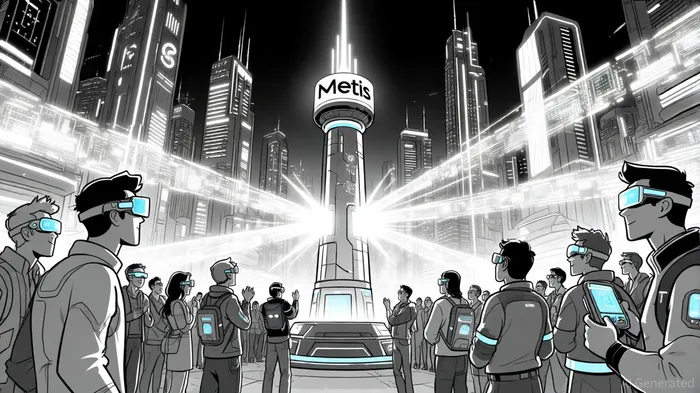
ReGenesis: Beyond Scalability, Into Ecosystem Dominance
Metis' 2025 ReGenesis plan is not just about faster transactions-it's a full-scale reimagining of what a Layer 2 can achieve. The Andromeda Network, Metis' core infrastructure, now boasts faster finality times, enhanced data availability, and gas fees reduced by 70% compared to 2024 levels, according to the Metis ReGenesis announcement. These upgrades are critical for Ethereum's mass adoption, but Metis is not stopping there. By introducing Hyperion, a high-performance chain compatible with EthereumETH--, the project is enabling low-latency, high-throughput applications tailored for AI and enterprise use cases, as detailed in the Hyperion announcement.
What sets ReGenesis apart is its strategic pivot toward AI-native blockchain solutions. Metis has launched LazAI, an open network designed to create a composable AI environment using blockchain primitives like iDAOs (intelligent Decentralized Autonomous Organizations) and Data Anchoring Tokens, as described in the LazAI launch. This fusion of AI and blockchain is not theoretical-it's a direct response to the growing demand for decentralized AI models, data provenance, and tokenized AI governance.
Strategic Partnerships and Ecosystem Expansion
Metis' value proposition is further amplified by its cross-industry collaborations. In Q3 2025, the project partnered with Wilshire Indexes, a leader in financial index solutions, to co-develop multi-factor and thematic portfolio designs, a move outlined in the Metis ReGenesis announcement. This partnership bridges traditional finance (TradFi) with blockchain, leveraging Metis' technical capabilities to create custom beta solutions for institutional investors. Such alliances validate Metis' infrastructure as a robust foundation for both crypto-native and non-crypto-native applications.
On the blockchain front, Metis has incubated projects like Quant Earth (sustainability-focused tokenomics) and Play PEPE (gaming on L2), demonstrating its ability to attract niche markets while maintaining a decentralized ethos - details of which were first described in the Hyperion announcement. These initiatives are not just diversification plays-they're ecosystem-building strategies that create network effects and sticky user bases.
AI-Driven Tokenomics and Governance
The integration of AI into Metis' tokenomics is perhaps its most disruptive move. Projects like Alith and LazAI are redefining governance by enabling AI-driven decision-making frameworks and dynamic token distribution models, concepts introduced in the Metis ReGenesis announcement. For instance, Alith uses machine learning to optimize validator rewards and reduce centralization risks, while LazAI's Data Anchoring Tokens allow users to monetize AI training data on-chain. These innovations could redefine how blockchain communities operate, shifting from human-centric governance to AI-assisted, decentralized coordination.
Market Positioning and Long-Term Value Potential
Metis' strategic focus on AI and enterprise-grade scalability positions it to capture a dual market: Ethereum's L2 scalability needs and the exploding AI blockchain sector. According to a Gate report, Metis' decentralized sequencer (DSEQ) technology and AI-native frameworks are already attracting developers and enterprises seeking low-cost, high-performance infrastructure. This dual appeal is rare in the L2 space, where most projects remain siloed in either scalability or niche use cases.
Moreover, Metis' emphasis on community engagement-through hackathons, developer grants, and open-source contributions-ensures a self-sustaining ecosystem, as noted in the LazAI launch coverage. This is critical for long-term value creation, as user and developer activity directly correlate with network utility and token demand.
Conclusion: A Blueprint for the Future
Metis' 2025 ReGenesis initiative is more than a technical upgrade-it's a blueprint for the future of blockchain. By merging L2 scalability with AI innovation, strategic partnerships, and community-driven governance, Metis is addressing Ethereum's pain points while pioneering new use cases. For investors, this positions METIS as a high-conviction play in a market where the winners will be those who adapt to the convergence of AI and decentralized infrastructure.
As the blockchain industry matures, projects that can scale, innovate, and integrate will dominate. Metis, with its bold vision and execution, is not just keeping up-it's leading the charge.






Comentarios
Aún no hay comentarios