
Metis 2026 Roadmap: A Strategic Play in AI-Optimized Ethereum Execution
The convergence of blockchain and artificial intelligence (AI) is reshaping the infrastructure landscape, with projects like MetisMETIS-- positioning themselves at the intersection of these two transformative technologies. As Ethereum's 2026 roadmap emphasizes scalability and execution efficiency, Metis has unveiled a vision to evolve into an AI-optimized multi-network architecture, leveraging its dual-layer infrastructure to support decentralized AI applications (AI dApps) and autonomous companies (DACs) according to its roadmap. This article assesses Metis as a high-growth infrastructure play, analyzing its technical innovations, strategic partnerships, and market positioning in the blockchain-AI convergence.
Metis's 2026 Roadmap: Bridging Ethereum's Execution Layer with AI
Metis's 2026 roadmap is anchored in its dual-network architecture: Andromeda, a secure general-purpose Layer 2 (L2) network, and Hyperion, an AI-optimized execution layer designed for high-performance computing according to Metis's technical documentation. Hyperion's architecture introduces parallelized transaction processing, on-chain large language model (LLM) inference, and dynamic opcode optimization via the MetisVM virtual machine. These features enable Metis to handle AI-native smart contracts and decentralized AI agents, addressing Ethereum's limitations in computational scalability as reported by YBB Capital.
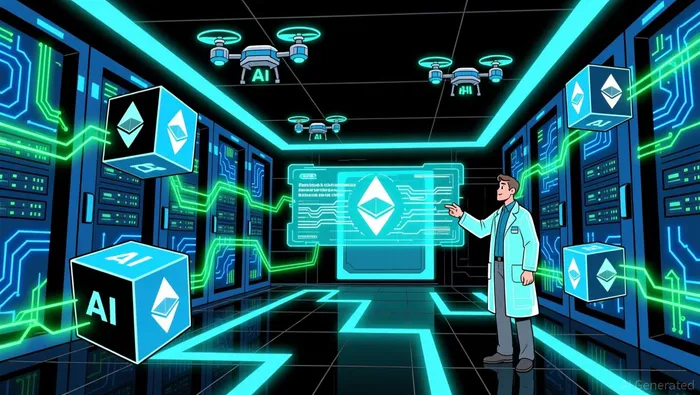
The platform's execution engine is further enhanced by MetisDB, a storage layer that employs memory-mapped Merkle trees and multi-version concurrency control to achieve nanosecond-level state access according to technical specifications. This technical stack positions Metis to support real-time AI inference on-chain, a critical capability for applications ranging from autonomous market makers to AI-driven governance systems. By aligning with Ethereum's 2026 upgrades-such as Glamsterdam (block proposer-builder separation) and Hegota (data growth mitigation)-Metis aims to integrate seamlessly with Ethereum's evolving execution layer while addressing decentralization risks as outlined in Ethereum's official roadmap.
Strategic Partnerships and AI-Optimized Infrastructure
Metis's 2026 roadmap is bolstered by strategic collaborations and infrastructure innovations. The Metis Strategy Summit in May 2026, hosted in the San Francisco Bay Area, will spotlight generative AI's role in business and technology, signaling Metis's commitment to fostering AI-driven ecosystems as announced by Metis Strategy. Additionally, METIS Power has developed AI-driven microgrid solutions to support data center energy needs, addressing a critical bottleneck in AI infrastructure scalability according to company documentation.
A notable technical partnership is the GMPayer project, which leverages the x402 protocol to enable automated, cross-chain micro-payments for AI agents. By integrating Data Anchoring Tokens (DAT), GMPayer ensures fair revenue distribution and service verification, creating a decentralized AI economy as reported by MEXC. These initiatives underscore Metis's ability to translate theoretical AI concepts into practical, interoperable solutions.
Market Dynamics and Growth Projections
The blockchain-AI market is projected to grow from USD 680.89 million in 2025 to USD 4,338.66 million by 2034, driven by a 22.93% compound annual growth rate (CAGR) according to market research. Metis is strategically positioned to capitalize on this growth, with its ReGenesis upgrade enabling user-owned AI agents and tokenized AI interactions via the $METIS utility token as detailed in blockchain analysis. The project's focus on decentralized AI infrastructure aligns with industry demand for secure, transparent data processing in sectors like logistics, healthcare, and decentralized finance (DeFi) according to market research.
However, Metis faces stiff competition in the L2 space. While Arbitrum's total value locked (TVL) stands at $3.1 billion compared to Metis's $52 million according to CoinMarketCap data, Metis's differentiation lies in its AI-first approach. The platform aims to onboard 100+ AI dApps by Q1 2026, directly linking $METIS to AI operations such as model ownership and transaction gas as projected by market analysis. This could drive token demand, particularly as Ethereum's execution layer becomes more AI-centric.
Challenges and Risks
Despite its ambitious roadmap, Metis must navigate several challenges. Technical hurdles include ensuring the security and decentralization of its AI-optimized execution layer, particularly with parallelized transactions and speculative execution mechanisms as detailed in technical documentation. Additionally, the broader blockchain-AI market faces scalability bottlenecks and a shortage of skilled developers according to industry research. Metis's success will depend on its ability to execute its roadmap without compromising decentralization and to differentiate itself from competitors like ArbitrumARB-- and zkSyncZK--.
Conclusion: A High-Growth Play at the Blockchain-AI Frontier
Metis's 2026 roadmap positions it as a pivotal player in the blockchain-AI convergence, combining Ethereum's execution layer upgrades with AI-native infrastructure. By addressing scalability, energy efficiency, and cross-chain interoperability, Metis is well-positioned to capture a significant share of the growing blockchain-AI market. While risks remain, the project's technical innovation, strategic partnerships, and alignment with Ethereum's evolution make it a compelling high-growth infrastructure play for investors seeking exposure to the AI-driven Web3 ecosystem.






Comentarios
Aún no hay comentarios