
MetaMask's Strategic Expansion into Solana and Its Implications for Token Utility
MetaMask's strategic integration of SolanaSOL-- and its accompanying rewards programs represent a pivotal shift in the blockchain ecosystem, signaling a broader redefinition of token utility and ecosystem dominance. By offering free Solana ID minting and incentivizing on-chain activity through its rewards program, MetaMask is not only expanding its user base but also reshaping the dynamics of token economics and cross-chain interoperability. This analysis explores how these initiatives are driving Solana's growth, enhancing token utility, and positioning MetaMask as a central player in the multi-chain future.
MetaMask's Solana Integration: A Catalyst for Ecosystem Growth
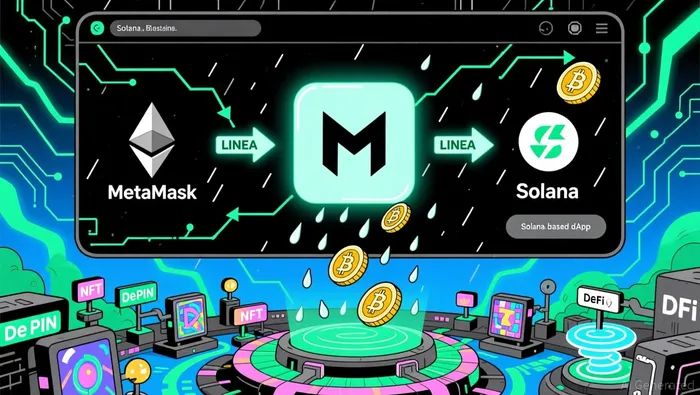
MetaMask's native support for Solana, launched in May 2025, marks the first time the wallet has integrated a non-EVM-compatible blockchain. This move allows users to manage Solana assets-such as sending, receiving, swapping, and bridging tokens-within the same interface as their EthereumETH-- accounts, reducing friction for multi-chain participation. With over 30 million monthly active users, MetaMask's integration has brought Solana's high-speed, low-cost network to a broader audience, potentially accelerating adoption of Solana-based DePIN (Decentralized Physical Infrastructure Network) projects and decentralized applications (dApps). According to reports, MetaMask's integration has significantly expanded Solana's reach.
The impact is already evident: Solana's DeFi Total Value Locked (TVL) surged by 32.7% quarter-over-quarter in Q3 2025, reaching $11.5 billion, driven by protocols like JupiterJUP-- and Kamino. Additionally, Solana processed approximately 2.98 billion transactions in June 2025, underscoring its dominance in transaction volume. MetaMask's integration has thus amplified Solana's utility, enabling seamless cross-chain liquidity and resource coordination between Ethereum, Solana, and other networks.
Rewards Programs: Incentivizing Token Utility and User Engagement
MetaMask's Rewards program, which allocates $30 million in LINEALINEA-- tokens during its inaugural season, is a cornerstone of its strategy to boost token utility. Users earn points through activities like token swaps, perpetual futures trading, and referrals, with rewards including Linea token allocations, fee discounts, and exclusive access to features like the AlphaFoxes Club. The program also offers retrospective points for historical activity, rewarding long-time users and fostering loyalty.
This initiative has directly influenced Solana's token economics. For instance, the LINEA token's price rose by 2.31% following the program's launch, and its daily trading volume surged to $244 million. Furthermore, the program's emphasis on Linea network swaps-offering 2x points for such transactions-has incentivized Ethereum Layer-2 adoption, potentially increasing L2 activity by 15–25%. By tying rewards to specific tokens and protocols, MetaMask is not only expanding the holder base for LINEA but also deepening its utility within the broader ecosystem.
Staking Participation and Transaction Volume: Metrics of Ecosystem Dominance
The integration of Solana staking into MetaMask via Figment has further enhanced token utility. As of May 2025, 67% of all SOL is staked across 1,300+ validators, with liquid staking tokens (LSTs) like JitoJTO-- and Marinade accounting for over 10% of staked SOLSOL--. MetaMask's user-friendly interface and institutional-grade infrastructure have simplified staking for retail and institutional participants, contributing to a 21% quarter-over-quarter increase in Marinade's native staking TVL to 5.3 million SOL.
Transaction volume on Solana has also seen a significant boost. Weekly transactions exceeded 600 million in Q3 2025, supported by improved network stability (99.99% uptime) and enhanced validator economics. MetaMask's integration has thus not only increased staking participation but also driven transactional activity, reinforcing Solana's position as a high-throughput, cost-effective blockchain.
Comparative Ecosystem Dynamics: Solana vs. Ethereum
While Ethereum maintains a larger TVL and more mature ecosystem, Solana's growth in 2025 Q3-Q4 highlights its competitive edge. Solana's TVL increased by 30% to $30.5 billion, driven by DEX volume ($365 billion) and new protocols like Jupiter Lend. In contrast, Ethereum's TVL growth was fueled by regulatory clarity and institutional adoption, including spot ETF inflows. However, Solana's focus on scalability and low costs-bolstered by MetaMask's integration-positions it as a formidable challenger, particularly for applications requiring high throughput and affordability.
Conclusion: A New Era of Token Utility and Ecosystem Dominance
MetaMask's expansion into Solana and its rewards programs are redefining token utility by incentivizing on-chain activity, expanding staking participation, and fostering cross-chain interoperability. The integration has not only amplified Solana's transaction volume and TVL but also positioned it as a viable alternative to Ethereum for specific use cases. For investors, these developments signal a shift toward a multi-chain future where token utility is no longer confined to a single ecosystem but is instead driven by strategic partnerships and user-centric incentives. As MetaMask continues to innovate, its role in shaping the blockchain landscape-and the tokens within it-will remain a critical factor in the evolution of Web3.






Comentarios
Aún no hay comentarios