
MetaMask's New Rewards Program and the Impending MASK Token Launch: A DeFi Incentive Revolution
In the ever-evolving landscape of decentralized finance (DeFi), user acquisition and retention have become critical battlegrounds for platforms seeking to capture value. MetaMask, the leading EthereumETH-- wallet, is poised to redefine these dynamics with its upcoming rewards program and the launch of its native $MASK token. By aligning incentives for on-chain activity, governance participation, and long-term user loyalty, MetaMask is crafting a blueprint for token adoption that could reshape DeFi's incentive architecture.
The Mechanics of MetaMask's Rewards Program
MetaMask's rewards program, set to launch in October 2025, introduces a points-based system that rewards users for on-chain activities such as token swaps, bridging transactions, and interactions with integrated protocols like LineaLINEA--, according to The Block. Users earn points redeemable for token rewards, partner incentives, and exclusive perks, with a multiplier system favoring long-term users and multi-chain participants, according to Blockonomi. This structure mirrors successful DeFi airdrop strategies-a tactic seen in UniswapUNI-- and Arbitrum's past distributions, per DeFi Planet.
The program's first season alone will distribute $30 million in LINEA tokens, a figure that underscores MetaMask's ambition to create one of the largest on-chain incentive campaigns to date, according to the MASK token website. Analysts suggest this could catalyze mass participation, particularly among retail users who may lack prior exposure to DeFi's complex incentive models, per CoinCentral. By simplifying value accrual through a familiar interface (the MetaMask app), the platform lowers barriers to entry while fostering a sense of ownership among users.
The $MASK Token: Governance, Staking, and Value Capture
The impending launch of the $MASK token, confirmed by Ethereum co-founder Joseph Lubin, represents a pivotal step in MetaMask's decentralization strategy. The token will grant holders governance rights, enabling them to vote on protocol upgrades, fee structures, and feature rollouts. This democratic framework aligns with DeFi's ethos of community-driven governance but introduces a novel twist: token holders can also stake $MASK to earn a share of ecosystem fees and treasury yields.
Crucially, the $MASK airdrop is expected to prioritize active users of MetaMask Swaps, the MetaMask Bridge, and Linea, with multipliers for historical activity. This approach creates a flywheel effect: the more users engage with MetaMask's ecosystem, the more they are rewarded, increasing both user retention and the token's utility. Early speculation suggests that the airdrop could rival the impact of Uniswap or ArbitrumARB--, potentially distributing millions of tokens to a broad user base.
Expanding the DeFi Ecosystem: Hyperliquid and mUSD Integration
MetaMask's strategic integrations further amplify its value proposition. The platform's partnership with Hyperliquid to offer perpetual trading capabilities marks a significant expansion into decentralized derivatives. By enabling users to trade perpetual contracts directly within the wallet, MetaMask bridges the gap between traditional finance (TradFi) and DeFi, attracting a new cohort of traders who value self-custody and low latency.
Simultaneously, the launch of MetaMask USD (mUSD), a stablecoin backed 1:1 by U.S. dollars or short-term Treasury assets, enhances liquidity and usability. Paired with the MetaMask Card-a Mastercard-linked spending tool-mUSD transforms the wallet into a hybrid Web3/TradFi platform, addressing a key pain point for mainstream adoption. These moves position MetaMask as a one-stop shop for DeFi users, consolidating trading, payments, and governance under a single interface.
DeFi Incentives as a Value-Capture Engine
MetaMask's approach exemplifies how DeFi incentives can drive token adoption and value capture. By rewarding on-chain activity, the platform creates a self-sustaining ecosystem where user growth directly correlates with token demand. The multiplier system for historical activity ensures that early users are disproportionately rewarded, incentivizing long-term commitment-a critical factor in sustaining token value over time.
Moreover, the integration of staking and governance rights into the $MASK token's utility ensures that holders have a vested interest in the platform's success. This aligns with broader DeFi trends, where tokenomics are increasingly designed to balance user incentives with protocol sustainability. The $30 million LINEA allocation in the first season also signals MetaMask's willingness to invest heavily in user acquisition, a strategy that could yield long-term value through network effects.
Risks and Considerations
While MetaMask's strategy is ambitious, risks remain. The success of the rewards program hinges on user participation and the perceived value of the $MASK token. If the airdrop is oversubscribed or if users perceive the token's utility as limited, adoption could stall. Additionally, regulatory scrutiny of DeFi incentives-particularly airdrops and staking-could introduce compliance challenges, as noted by industry commentators.
Conclusion: A New Paradigm for DeFi Incentives
MetaMask's rewards program and $MASK token represent a bold reimagining of DeFi incentives. By combining user-friendly design, governance participation, and multi-chain utility, the platform is creating a model where value capture is distributed yet aligned with long-term growth. For investors, the implications are clear: MetaMask is not just a wallet but a foundational layer for the next phase of DeFi, where incentives are engineered to drive both adoption and sustainability.
As the October 2025 launch approaches, the market will closely watch how these incentives translate into user behavior and token performance. If history is any guide, MetaMask's approach could set a new standard for DeFi platforms seeking to balance decentralization with scalability.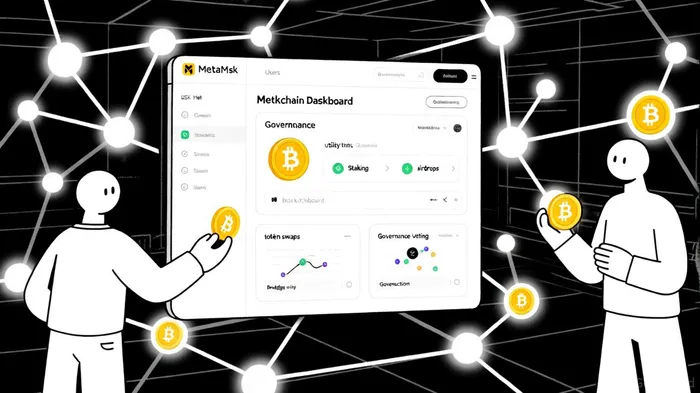






Comentarios
Aún no hay comentarios