
MetaMask's Rewards Program: A Catalyst for DeFi Engagement and Token Utility in 2025
The decentralized finance (DeFi) landscape in 2025 is defined by a critical shift: user engagement is no longer driven solely by speculative incentives but by structured, gamified ecosystems that reward active participation. At the forefront of this evolution is MetaMask, whose 2025 Rewards Program-centered on its "Missions" initiative and the impending launch of its native token-has emerged as a pivotal force in driving DeFi adoption and token utility. By analyzing MetaMask's strategic moves, we uncover how its approach notNOT-- only enhances user retention but also redefines the value proposition of DeFi for mainstream audiences.
Gamification and Tiered Rewards: A New Paradigm for Engagement
MetaMask's "Missions" program, launched in 2025, introduces a tiered NFT-based rewards system designed to incentivize on-chain activity. Users earn limited-edition "Mission Pass" NFTs by completing tasks such as swaps, bridges, and DApp interactions, with rewards escalating across three rarity tiers: Bronze, Silver, and Gold, as detailed in a JU analysis. Bronze holders receive base token rewards, while Gold tier participants gain exclusive access to airdrops and priority entry to initial DApp offerings (IDOs), as outlined in a UseTheBitcoin guide. This structure not only gamifies user behavior but also creates a feedback loop where increased participation directly correlates with higher-value rewards.
The program's success is underscored by its integration with ecosystem partners like Daylight, which enables personalized incentives based on on-chain and social metrics. For instance, the 2025 campaign offered $500 worth of AUSDC, ONDO, and LDOLDO-- to users completing weekly challenges. Such targeted incentives ensure that rewards are distributed to high-value users, fostering a sense of exclusivity and community.
Token Utility and the Road to Decentralization
MetaMask's upcoming native token, often referred to as the MASKMASK-- token, is poised to amplify the program's impact. As confirmed in a ConsenSys announcement, the token will play a strategic role in decentralizing aspects of the MetaMask platform. While specific use cases remain undisclosed, the token is expected to govern access to premium features, reward active users, and facilitate decentralized decision-making within the ecosystem. This aligns with broader trends in 2025, where token utility is increasingly tied to governance and user participation rather than speculative trading.
The MASK token also serves as a potential precursor to airdrops, with active participation in "Missions" tasks-such as bridging, swapping, and NFT claims-likely increasing eligibility for future distributions. This creates a dual incentive: users are rewarded both immediately through token rewards and speculatively through airdrop potential. Such a model mirrors successful precedents like Uniswap's $UNI airdrop, which rewarded early liquidity providers and catalyzed mass adoption.
Multi-Chain Expansion and Frictionless Onboarding
MetaMask's 2025 roadmap extends beyond token-based incentives to address foundational barriers to DeFi adoption. The wallet now supports multiple blockchains, including Binance Smart Chain (BSC), Polygon, AvalancheAVAX--, and SolanaSOL--, according to the TrueIO roadmap. This multi-chain interoperability has expanded MetaMask's user base to over 30 million monthly active users, with Nigeria alone accounting for 12.7% of the total. By enabling cross-chain transactions without requiring users to switch wallets, MetaMask has streamlined the user experience, reducing friction that historically hindered mass adoption.
Further, the introduction of gasless transactions and batched actions has made on-chain activity more accessible to non-technical users. For example, the Social Login feature allows users to onboard via Google or Apple accounts, significantly lowering the entry barrier for first-time crypto users. These improvements are critical for DeFi's long-term viability, as they ensure that engagement is not limited to a niche audience but scales with broader Web3 adoption.
Strategic Partnerships and DeFi Synergies
MetaMask's collaboration with platforms like Brevis and LineaLINEA-- has further solidified its role as a DeFi engagement catalyst. The recent rewards program, which offers a 2.4% APR boost on USDCUSDC-- lending or borrowing via Aave's Linea market, leverages zero-knowledge proofs to verify on-chain activity. This innovation not only enhances trust but also demonstrates the practical applications of decentralized systems in real-world financial scenarios. Such partnerships align with 2025's broader trend of integrating DeFi protocols with ZKZK-- technology to improve security and scalability.
Data-Driven Growth and Future Implications
MetaMask's impact on DeFi is quantifiable. As of 2025, the wallet facilitated $34.15 billion in swap volume in September 2024, according to MetaMask statistics, a metric that underscores its role as a primary gateway to DeFi. The wallet's user base is also geographically diverse, with 4.6 million users on BNBBNB-- chain and 2.4 million on EthereumETH--. This cross-chain activity not only drives liquidity but also fosters a more interconnected DeFi ecosystem.
Conclusion: A Blueprint for Sustainable DeFi Growth
MetaMask's 2025 Rewards Program exemplifies how DeFi platforms can balance user incentives with long-term ecosystem sustainability. By gamifying engagement, introducing token utility, and reducing onboarding friction, MetaMask has positioned itself as a leader in the Web3 usability revolution. For investors, the wallet's strategic moves-particularly the impending launch of the MASK token-signal a maturing DeFi landscape where utility-driven models outperform speculative ones. As the industry evolves, MetaMask's approach offers a blueprint for platforms seeking to bridge the gap between decentralized innovation and mainstream adoption.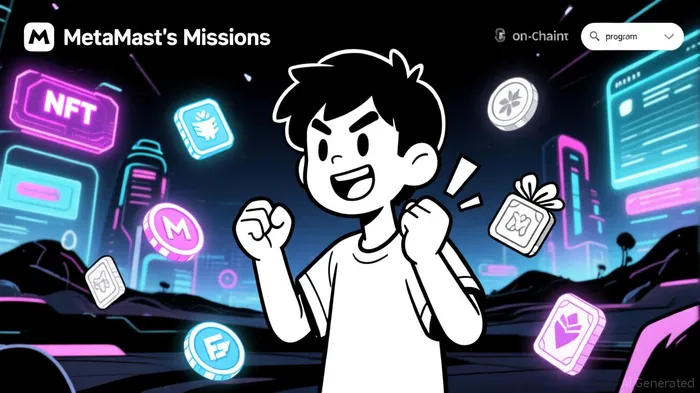






Comentarios
Aún no hay comentarios