
MetaMask's Hyperliquid Integration: A Game-Changer for On-Chain Futures Trading
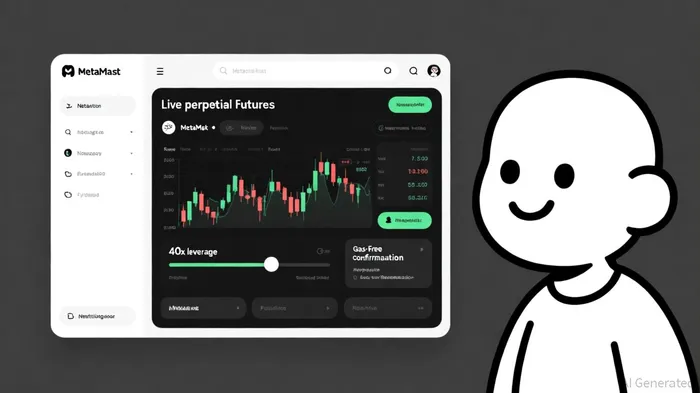
The integration of Hyperliquid's perpetual futures trading into MetaMask marks a pivotal moment in the evolution of decentralized finance (DeFi). By embedding advanced derivative instruments directly into the world's most popular crypto wallet, MetaMask and Hyperliquid are addressing one of the most persistent barriers to mass adoption: user experience (UX). This collaboration notNOT-- only simplifies on-chain futures trading but also aligns with a broader trend where UX innovations are proving to be the catalyst for DeFi's mainstream breakthrough.
The UX Bottleneck in DeFi
For years, DeFi has struggled to balance decentralization with usability. While protocols like UniswapUNI-- and AaveAAVE-- have democratized access to liquidity and lending, the average user still faces a fragmented experience. Trading derivatives, for instance, traditionally requires switching between wallets, centralized exchanges, and Layer 2 networks—a process riddled with gas fees, security risks, and cognitive friction. According to a report by OKX, 78% of retail crypto users cite “complexity” as their top concern when engaging with DeFi platforms .
MetaMask's partnership with Hyperliquid directly tackles this issue. By enabling users to sign, execute, and settle perpetual futures trades within the wallet interface, the integration eliminates the need for external platforms. Hyperliquid's Layer 1 blockchain further enhances this experience by offering gas-free transactions and on-chain settlements, ensuring transparency while reducing costs to zero for end-users . For the 30 million MetaMask users, this means access to sophisticated financial tools without compromising the security and autonomy that DeFi promises.
UX as a Growth Engine: Data-Driven Evidence
The correlation between improved UX and DeFi adoption is not speculative—it's empirically validated. Consider Uniswap, which achieved a historic $3 trillion in cumulative trading volume by 2025. This growth was driven by innovations like Uniswap v4, which introduced modular liquidity pools and on-chain limit orders, alongside cross-chain integrations with EthereumETH--, ArbitrumARB--, and Base . Crucially, 75% of Uniswap's trades now occur on its Layer 2 solution, Unichain, highlighting how cost efficiency and speed directly translate to user retention and volume .
Layer 2 solutions, in particular, have been a game-changer. Data from Coinasity reveals that Uniswap's Layer 2 trading volume surged 37% year-over-year in June 2025, reaching $32.04 billion monthly . This aligns with broader industry trends: DEXs accounted for 7.6% of global crypto trading volume in H1 2025, up from 3% in 2023, as platforms like SushiSwapSUSHI-- and PancakeSwapCAKE-- reported daily active user counts of 310,000 and 290,000, respectively . The common denominator? Frictionless UX, enabled by scalable infrastructure and intuitive design.
Hyperliquid's Value Proposition: Beyond the Wallet
Hyperliquid's integration with MetaMask is more than a technical feat—it's a strategic move to onboard a new wave of traders. The platform's features, such as 40x leverage, liquidity vaults, and real-time analytics, cater to both retail and institutional demand for derivatives. By pooling resources through liquidity vaults, users can share strategies and amplify returns, creating a community-driven trading ecosystem .
Moreover, Hyperliquid's gas-free model is a masterstroke. Traditional futures trading on-chain is often deterred by high gas costs, which disproportionately affect small investors. Hyperliquid's Layer 1 infrastructure absorbs these costs, making derivatives accessible to a broader audience. As Blocknews notes, this “democratization of derivatives” could accelerate DeFi's transition from niche experimentation to mainstream utility .
The Bigger Picture: UX as the New Infrastructure
The MetaMask-Hyperliquid integration is part of a larger narrative: UX is becoming the new infrastructure in DeFi. Platforms that prioritize simplicity, speed, and cost efficiency are outpacing competitors that cling to complexity for the sake of decentralization. For investors, this means prioritizing projects that bridge the gap between innovation and usability.
Consider the projected growth of the DeFi market: valued at $84.3 billion in 2025, it's expected to reach $231.19 billion by 2030 at a 53.7% CAGR . This trajectory hinges on UX-driven adoption, as evidenced by the rise of hybrid trading models (e.g., automated market makers combined with on-chain order books) and tokenized real-world assets. The latter, projected to exceed $10 trillion in value by 2030, will further depend on seamless user experiences to attract traditional investors .
Conclusion: A Win for DeFi's Future
MetaMask's Hyperliquid integration is not just a product update—it's a blueprint for the future of DeFi. By embedding advanced derivatives into a user-friendly wallet, the collaboration demonstrates that mass adoption is not about choosing between decentralization and usability but about designing systems that serve both. As UX innovations continue to lower barriers, DeFi's potential to disrupt traditional finance grows exponentially. For investors, the lesson is clear: the next wave of value creation will belong to platforms that make DeFi as intuitive as a mobile app.






Comentarios
Aún no hay comentarios