
Meta's Strategic Share Buyback and Its Implications for Value Investors
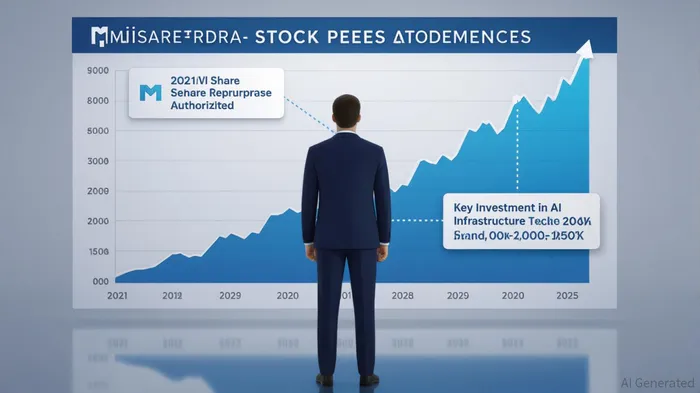
Meta's 2021 share repurchase authorization of $150 million marked a pivotal moment in the company's transition from Facebook to its new identity as MetaMETA--. This move, announced during the Connect 2021 event, was framed as a strategic commitment to bolster shareholder value while redirecting capital toward high-potential initiatives in the metaverse[1]. For value investors, the authorization signaled a calculated balance between rewarding existing shareholders and reinvesting in long-term growth, a duality that remains central to evaluating Meta's capital efficiency.
A Strategic Repurchase in Context
The $150 million repurchase was part of a broader restructuring effort as Meta shifted focus from social media dominance to immersive technologies. According to a report by Bloomberg, the authorization reflected management's confidence in the company's ability to generate sustainable cash flows despite the nascent state of the metaverse market[1]. By reducing the number of shares outstanding, Meta aimed to enhance earnings per share (EPS) while maintaining flexibility to fund R&D in augmented reality (AR) and artificial intelligence (AI). This approach aligns with value investing principles, which prioritize disciplined capital allocation and undervalued assets.
However, the absence of a similar repurchase authorization in 2025—despite Meta's recent $1 billion investment in a Kansas City data center and the launch of Orion AR glasses—raises questions about the company's evolving priorities[2]. Data from Meta's 2024 financial disclosures indicates a shift toward infrastructure and AI-driven product development, with buybacks taking a backseat to projects expected to yield higher long-term returns[2]. This suggests that while the 2021 repurchase was a tactical move to stabilize investor sentiment, Meta's current strategy emphasizes reinvestment in scalable technologies over short-term shareholder rewards.
Implications for Value Investors
For value investors, the 2021 repurchase serves as a case study in strategic capital allocation. By authorizing a buyback during a period of brand uncertainty, Meta demonstrated its commitment to maintaining a strong balance sheet while signaling confidence in its metaverse vision. As stated by Meta's CFO in a 2021 earnings call, the company sought to “optimize capital returns by aligning repurchases with our long-term growth trajectory”[1]. This dual focus on shareholder returns and innovation has since been mirrored in subsequent investments, such as the $150 million immersive learning initiative and the $1 billion Kansas City data center[1][2].
Yet, the lack of a 2025 repurchase authorization does not necessarily indicate a lack of confidence. Instead, it reflects Meta's prioritization of high-impact projects that align with its AI and metaverse ambitions. For instance, the development of Orion AR glasses and AI-powered tools for Facebook and Instagram underscores a strategy of reinvesting cash flows into areas with higher growth potential[2]. This approach, while diverging from traditional value investing metrics, aligns with the long-term horizon required to realize the metaverse's economic potential.
Conclusion
Meta's 2021 share repurchase authorization was a calculated move to reinforce investor trust during a transformative period. While the absence of a 2025 buyback may disappoint some value investors, it highlights the company's willingness to adapt its capital strategy to emerging opportunities. For those focused on long-term value creation, Meta's continued investments in AI, infrastructure, and immersive technologies suggest a commitment to building a durable competitive advantage—one that may ultimately justify its current valuation.





Comentarios
Aún no hay comentarios