
Meta's Strategic Reallocation Toward AI Devices and Its Implications for Tech Sector Realignment
The tech sector is undergoing a seismic shift as companies like MetaMETA-- Platforms (NASDAQ: META) pivot from speculative bets on the metaverse to capital-intensive AI infrastructure. This reallocation, driven by investor demands for capital efficiency and tangible returns, is reshaping the competitive landscape and forcing a reevaluation of long-term value creation in the AI era.
The Metaverse to AI Transition: A Capital Efficiency Dilemma
Meta's decision to redirect $60–65 billion in 2025 capital expenditures toward AI hardware-compared to its earlier $70+ billion metaverse losses since 2020-reflects a stark recalibration of priorities. While the metaverse was marketed as a "next-generation" platform, its inability to generate monetizable use cases left Reality Labs hemorrhaging cash. By contrast, Meta's AI investments are already yielding incremental revenue through ad optimization and user engagement tools, such as AI-enhanced ad systems on Facebook and Instagram.
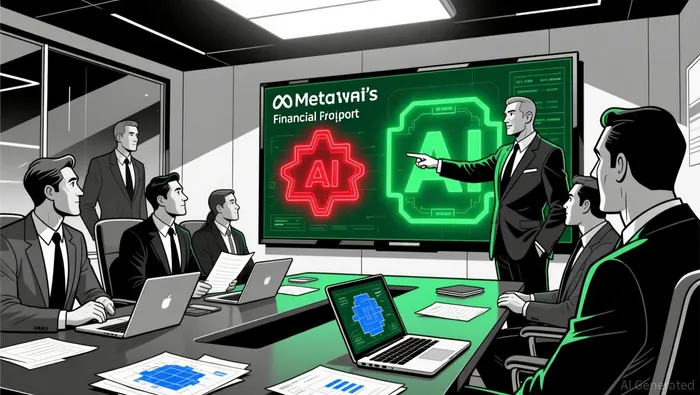
However, the capital efficiency of this shift remains contentious. Meta's AI spending now outpaces its revenue growth, with Q3 2025 capital expenditure guidance raised to $70–72 billion-the highest in its history-despite a 12% stock price drop as investors questioned ROI. This mirrors the structural risks of the AI infrastructure boom, where annual depreciation ($40 billion) exceeds current AI revenue ($15–20 billion), raising concerns about sustainability. Unlike Alphabet, which has demonstrated clearer monetization pathways through Google Cloud and enterprise services, Meta's AI pivot risks repeating the metaverse's overbuild cycle.
Sector Rotation: AI's "Great Rebalancing" and Investor Sentiment
The broader tech sector is witnessing a late 2025 "Great Rotation" as institutional capital shifts between AI and traditional industries. Meta has benefited from this rebalancing, leveraging its open-source AI strategy and proprietary hardware (e.g., Ray-Ban Meta smart glasses) to create a competitive moat. Meanwhile, Microsoft and Alphabet are adopting more disciplined approaches. Microsoft's CFO, Amy Hood, emphasized sequential AI spending increases in fiscal 2026, tying investments to cloud infrastructure and enterprise partnerships. Alphabet, by contrast, has maintained investor favor through disciplined capital allocation and strong cash flow, despite its own AI ambitions.
Investor sentiment is polarized. While 61% of investors still view technology as a top investment sector over the next three years, skepticism about AI ROI is growing. A PwC 2025 Global Investor Survey noted that over half of investors feel companies are not transparent enough about AI strategies, demanding clearer governance and innovation roadmaps. This has led to a flight to traditional sectors like energy and industrials, which offer predictable cash flows amid macroeconomic uncertainty.
Strategic Implications for Meta and the Tech Sector
Meta's AI-first strategy hinges on its ability to monetize agentic AI systems and hardware. Unlike the metaverse, which lacked a clear revenue model, Meta's AI initiatives are already improving ad performance and user retention, potentially justifying long-term spending. However, the company faces a critical test: can it scale AI-driven monetization without repeating the capital inefficiencies of its metaverse experiment?
For the broader sector, the realignment underscores a maturing market. Investors are prioritizing capital-efficient innovation over speculative growth, favoring companies that demonstrate tangible ROI. This trend is reshaping the "Magnificent 7" narrative, with Meta's stock volatility highlighting the risks of overreliance on AI hype. Meanwhile, Microsoft and Alphabet's disciplined approaches suggest that AI's long-term value will depend on integration with existing revenue streams, not just infrastructure overbuild.
Conclusion
Meta's pivot to AI is emblematic of the tech sector's broader realignment. While the company's aggressive spending has positioned it as a leader in agentic AI, the sustainability of this strategy remains unproven. As investors rotate capital between AI and traditional industries, the focus will shift to companies that balance innovation with capital efficiency. For Meta, the path forward lies in proving that its AI investments can deliver returns that outpace the metaverse's costly legacy.





Comentarios
Aún no hay comentarios