
Meta's S-Curve Bet: Cutting the Metaverse to Fuel AI Infrastructure
Meta is making a classic infrastructure bet, cutting a high-loss venture to fund a faster-adoption compute layer. The move is a disciplined response to competing technological adoption curves, where the metaverse's slow, uncertain climb is being sacrificed for the exponential growth of AI.
The scale of the cut is significant. MetaMETA-- plans to lay off roughly 10% to 15% of Reality Labs' 15,000 employees, a fraction of its total workforce but a decisive blow to the metaverse and VR product teams. This follows years of financial strain, with Reality Labs racking up more than $70 billion in losses since 2020. The unit has been a costly bet, struggling to generate revenue from its core immersive products.
The strategic driver is clear. CEO Mark Zuckerberg has confirmed that AI expense growth will accelerate into 2026, with the company's AI initiatives resulting in a 2026 year-over-year expense growth rate that is above the 2025 expense growth. This isn't just a budget shift; it's a signal that Meta is doubling down on the AI compute layer, a fundamental infrastructure play for the next paradigm. The company is reallocating capital from a low-adoption curve to a high-growth one.
The signal of decisiveness came from the top. Reality Labs chief Andrew Bosworth called a key division-wide meeting, urging staff to attend in person and describing it as the "most important" of the year. This framing echoes his earlier warning that 2025 would determine whether the unit is remembered as visionary or a legendary misadventure. The layoffs are the operational execution of that hard choice.
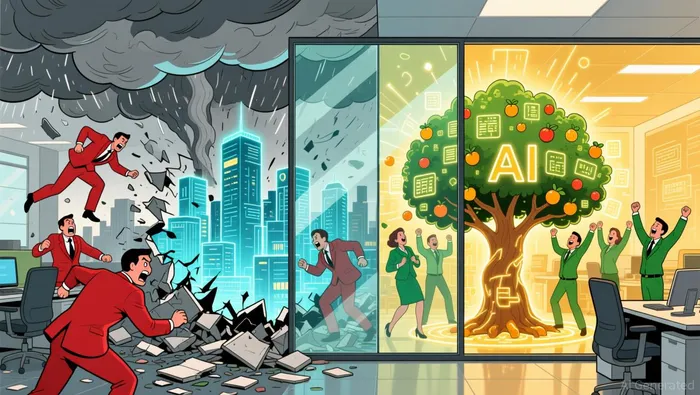
In essence, Meta is choosing the steeper S-curve. It's cutting a venture that has yet to cross the chasm into mainstream adoption, using those freed resources to fuel the infrastructure for a technology-AI-that is already demonstrating exponential adoption and revenue potential. This is a pivot from building a digital universe to building the compute rails for the next one.
Assessing the Technological S-Curves and Financial Impact
The core of Meta's decision lies in comparing two very different adoption trajectories. The metaverse has followed a steep but uncertain S-curve. Despite years of billions in losses, it has yet to cross the chasm into mainstream consumer use. Reality Labs has been a costly bet, racking up more than $70 billion in losses since 2020. The recent layoffs, targeting roughly 10% to 15% of its 15,000 employees, underscore the plateau of this curve. The unit's fate now hinges on a single year, with leadership framing 2025 as the decisive moment to prove its vision or accept its legacy as a misadventure.
Contrast that with the AI compute layer. Here, the adoption curve is not just steep-it's already in the exponential growth phase. The critical difference is that Meta's AI spending is not a speculative bet; it's a direct lever on its core engine. The integration of AI tools into ad products has demonstrably driven performance. In the third quarter of 2025, this translated to ad impressions up 14% year over year and the average price per ad increasing by 10% year over year. This isn't future promise; it's immediate return on investment that is accelerating revenue growth across the board.
This financial buffer is what makes the pivot possible. Meta's massive $44.8 billion in trailing free cash flow provides a deep cushion. It allows the company to fund its aggressive AI blitz without immediate strain on its balance sheet. This capital position is the luxury that enables a strategic S-curve shift. The metaverse was a high-cost, high-risk venture with uncertain returns. AI is a high-return, high-growth infrastructure play, and Meta has the financial runway to build it.
The bottom line is a clear trade-off. Meta is sacrificing a venture that has failed to gain mass-market appeal for one that is already fueling its business. The financial impact is a pivot from a money-losing curve to a revenue-generating one, funded by a war chest that was never meant for consumer hardware. This is the disciplined calculus of a company choosing the steeper, more certain path forward.
The AI Infrastructure Play: Metrics, Catalysts, and Risks
The market's initial reaction to Meta's AI spending was a classic fear of a repeat metaverse. Shares fell 22% from Oct 29 to Nov 20, 2025, as investors worried about a new money pit. But the recovery since then shows a crucial difference: the AI investments are already driving results. The catalyst for validation is the visible, exponential adoption of AI tools within Meta's core ad platform. When AI demonstrably boosts ad impressions and prices, as it did with a 14% year-over-year increase in ad impressions and a 10% rise in average price per ad last quarter, it proves the infrastructure layer is generating revenue. The next catalyst is the rollout of new AI products, like the Ray-Ban Meta smart glasses, which Zuckerberg sees as the ideal form factor for daily AI interaction. Success here would show the company can build the next paradigm, not just run it.
The primary metric to watch is the return on AI capital. Investors need to see that the accelerating expense growth-Meta's AI initiatives are expected to drive 2026 year-over-year expense growth above 2025-translates into sustained, exponential growth across the ad business. The $44.8 billion in trailing free cash flow provides a buffer, but the test is whether AI spending fuels a faster adoption curve for Meta's services, not just higher costs.
Two key risks could challenge the new thesis. First, the metaverse may not be fully abandoned. While the recent cuts target 10-15% of Reality Labs, executives had previously discussed budget cuts as high as 30% for the metaverse group. Any lingering commitment to that low-adoption curve could dilute focus and capital. Second, and more critical, is the risk that AI spending fails to maintain its growth momentum. The market is betting that AI is the steeper S-curve; if adoption plateaus or costs spiral without proportional revenue gains, the strategic pivot could falter. The company's ability to integrate AI tools across its apps at scale will be the ultimate proof. For now, the integration is working. The question is whether it can keep accelerating.





Comentarios
Aún no hay comentarios