
Meta Bets $Billions on Google TPUs, NVIDIA's Lead in Jeopardy
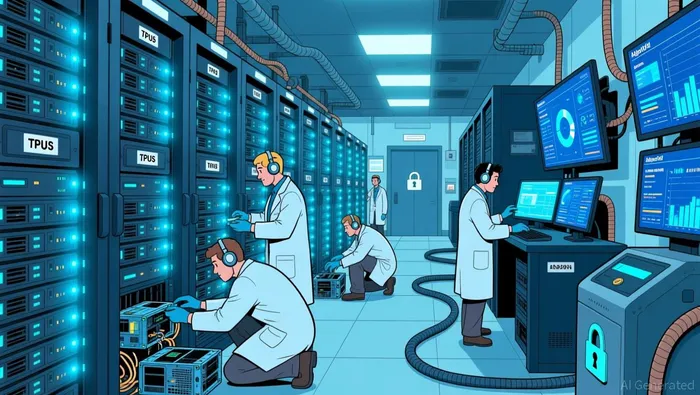
Alphabet Inc. (GOOGL) is escalating its rivalry with NVIDIA CorporationNVDA-- (NVDA) as it moves to directly sell its custom-built tensor processing units (TPUs) to Meta Platforms Inc.META-- (META), a shift that could significantly disrupt the AI chip market according to reports. The move, reported by The Information and corroborated across multiple outlets, marks a departure from Google's traditional model of leasing TPUs through its cloud division. MetaMETA--, which has historically relied on NVIDIANVDA-- GPUs for its AI infrastructure, is now in talks to deploy Google's TPUs in its data centers starting in 2027.
The potential deal, valued in the billions of dollars, reflects Google's broader strategy to expand its TPU footprint beyond its own data centers and into the infrastructure of third-party clients. Executives at GoogleGOOGL-- Cloud have hinted that capturing up to 10% of NVIDIA's annual AI chip revenue-a figure in the billions-could be within reach. This ambition is bolstered by Google's recent success with its Gemini 3 AI model, which is trained on TPUs and has demonstrated competitive advantages in benchmarks.
The market has already reacted to the news. Alphabet shares rose as much as 2.7% in after-hours trading, while NVIDIA stock fell nearly 1.8%. The shift signals a more aggressive phase in the AI chip wars, as Google positions TPUs as a secure and cost-effective alternative for enterprises with stringent data compliance needs. The company has already secured a $1 billion order from Anthropic PBC and is now targeting large financial institutions.
For NVIDIA, the challenge is twofold. Not only does it face direct competition from Google, but it must also contribute to a broader industry trend toward vertical integration. Meta's decision to diversify its chip suppliers mirrors Amazon's recent investments in in-house AI hardware and Microsoft's partnership with AMD. Meanwhile, NVIDIA's reliance on the Hopper architecture-its current flagship GPU-may be tempered by rising costs tied to advanced packaging technologies like CoWoS.
The financial stakes are enormous. AI capital expenditures are projected to surge to $600 billion by 2027, with hyperscalers like Alphabet, Meta, and Amazon collectively issuing nearly $90 billion in bonds this year to fund data center expansions. Google's TPU push aligns with its broader $3.84 trillion market capitalization and 13.9% three-year revenue growth, while NVIDIA's recent $57 billion Q3 2026 revenue underscores the scale of the market it seeks to defend.
The ripple effects extend beyond chipmakers. Broadcom Inc. (AVGO), Google's long-time TPU partner, saw its shares surge 10% on Monday, reflecting investor confidence in the duo's AI ambitions. Conversely, AMD and Intel, which have yet to secure major hyperscaler contracts, face renewed pressure to innovate.
As the AI landscape evolves, the battle for dominance in AI accelerators is becoming a test of ecosystem strength. Google's vertical integration strategy-paired with NVIDIA's software leadership highlights the dual pillars of hardware and platform control that will define the next phase of the market. For now, the TPU-Meta deal remains a pivotal development, with analysts suggesting it could reshape the competitive dynamics as AI demand continues its exponential growth.







Comentarios
Aún no hay comentarios