
Meta's AI Infrastructure Expansion: Reshaping Semiconductors and Cloud Computing Markets
Meta's 2025 strategic investments in AI infrastructure are catalyzing a seismic shift in the semiconductor and cloud computing sectors, with implications that extend far beyond the company's own ecosystem. By committing up to $72 billion in 2025 capital spending and announcing a $600 billion U.S. infrastructure expansion by 2028, MetaMETA-- is not only redefining its role in the AI era but also intensifying competition and demand across critical technology markets. This analysis explores how Meta's bold moves are reshaping semiconductor dynamics, cloud computing partnerships, and the competitive landscape for industry giants like NVIDIANVDA--, AMDAMD--, AWS, and Azure.
Semiconductor Sector: A New Era of Demand and Competition
Meta's AI ambitions hinge on custom silicon and GPU-based infrastructure, driving a surge in demand for high-performance computing chips. The company's focus on "Total Cost of Ownership" (TCO) over raw performance metrics is reshaping procurement strategies, favoring cost-efficient solutions that balance power consumption and scalability. NVIDIA remains the dominant player, with its Blackwell architecture and GB200 NVL72 systems powering Meta's large-scale AI workloads. However, AMD is gaining traction with its MI350 series, particularly for inference tasks tied to Meta's Llama models.
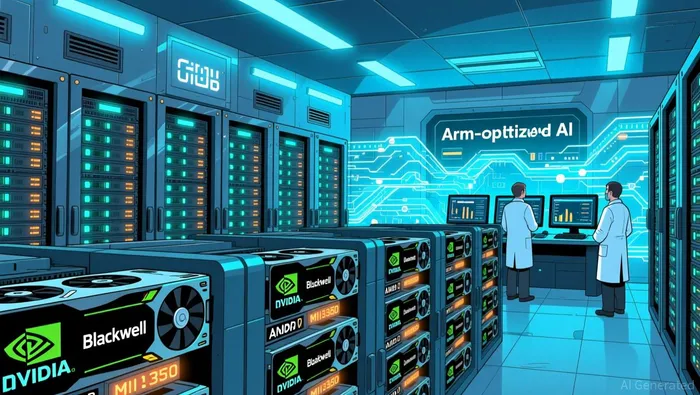
This bifurcation of demand is creating opportunities for specialized chipmakers while intensifying pressure on traditional suppliers. Meta's collaboration with Arm to optimize AI software for power efficiency further underscores its push for hardware-software synergy, potentially influencing broader industry standards. Meanwhile, the company's partnerships with small modular reactor developers to meet its 20-year power needs highlight the energy constraints driving innovation in chip design and cooling technologies.
Cloud Computing: Strategic Alliances and Market Realignment
Meta's approach to cloud infrastructure in 2025 reflects a hybrid strategy of self-building and strategic partnerships. The $10 billion, six-year agreement with Google Cloud and a $20 billion contract with Oracle exemplify a trend where tech rivals collaborate to diversify dependencies and secure cost advantages. These deals, alongside a 49% stake in Scale AI for $14.3 billion, signal a shift toward joint ventures and private credit financing to accelerate deployment without full ownership costs.
The ripple effects are evident in the cloud market. AWS and Azure are responding by developing custom chips like AWS's Trainium3 and Azure's specialized AI accelerators to retain market share. Oracle's aggressive expansion, fueled by Meta's partnership, projects cloud revenue to reach $166 billion by FY2030, challenging AWS's dominance. Meta's open-source infrastructure innovations, such as Twine and ZippyDB, also set new benchmarks for distributed systems, indirectly pressuring cloud providers to enhance scalability and performance.
Financial and Strategic Implications for Investors
Meta's $10.6 billion Q3 2025 free cash flow underscores its financial capacity to sustain massive investments while maintaining shareholder returns. This financial flexibility positions the company to outpace competitors in AI infrastructure deployment, but it also raises questions about long-term debt sustainability and regulatory scrutiny of its expanding ecosystem. For semiconductor firms, the shift toward TCO-driven procurement could favor companies like AMD and Google, which offer cost-effective inference solutions, while NVIDIA's dominance in training remains secure.
In the cloud sector, Meta's partnerships may mitigate the risk of over-reliance on AWS or Azure, fostering a more fragmented but competitive market. However, the concentration of resources among major players-via minority stakes, licensing deals, and shared infrastructure-could stifle smaller competitors, a concern regulators may address in 2026.
Conclusion
Meta's AI infrastructure expansion is a masterclass in strategic foresight, blending self-sufficiency with ecosystem collaboration to dominate the next phase of the digital economy. For investors, the key takeaways are clear: the semiconductor sector is entering a phase of heightened competition and specialization, while the cloud market is evolving into a hybrid landscape of alliances and in-house innovation. As Meta's $600 billion U.S. investment plan unfolds, the ripple effects will likely redefine industry benchmarks and reshape the fortunes of tech giants and startups alike.





Comentarios
Aún no hay comentarios