
Meta's AI Capital Intensity: A High-Stakes Bet on Future Value Creation?
Capital Intensity and Financial Commitment
Meta's AI investments now rival those of industry titans like MicrosoftMSFT--, which projects $88 billion in 2025 spending, according to a New York Times report. The company's 2025 capex represents 36–38% of its revenue-a historically high ratio that underscores its prioritization of infrastructure over short-term profitability, as noted in a Yahoo Finance article. This spending is directed toward data centers, AI researchers, and partnerships such as the $3 billion agreement with Nebius Group to secure GPU resources for next-generation models like Llama 4, a Nebius deal that has been reported.
Such intensity is not without precedent. Microsoft and Google have similarly ramped up AI infrastructure spending, with Alphabet's 2025 capex forecast at $91–93 billion, as reported in a Wired article. However, Meta's approach diverges in its lack of immediate revenue-generating AI products. While Microsoft's Azure cloud business has seen 39% year-over-year revenue growth, a CNBC article notes, Meta's AI initiatives-such as the Meta AI app and Vibes video generator-are still in experimental phases. This asymmetry raises concerns about whether Meta's spending will translate into comparable returns.
Margin Pressures and Profitability Trade-offs
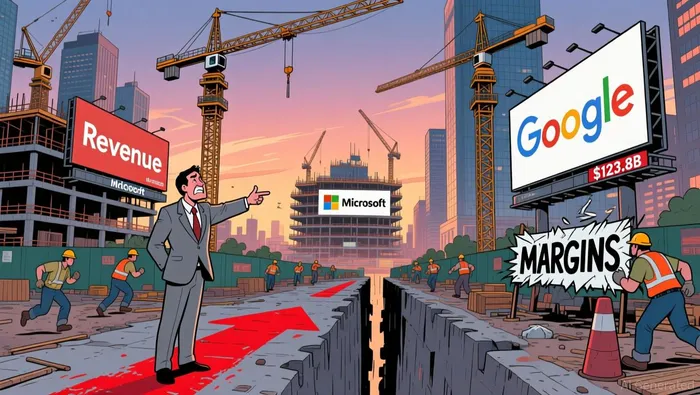
Meta's financial strategy hinges on sacrificing near-term cash flow for long-term dominance. In Q3 2025, the company reported $51.2 billion in revenue-a 26% year-over-year increase-but net income plummeted by 83% due to a $15.9 billion non-cash tax charge and rising AI-related expenses, as reported in a Saxo article. Total 2025 expenses are expected to hit $116–118 billion, driven by infrastructure depreciation, cloud costs, and talent acquisition, the Saxo article notes.
This trade-off has already impacted investor sentiment. Following the Q3 earnings report, Meta's stock fell 7–8% as analysts questioned the ROI of its AI bets, the Saxo article reports. Unlike Google and Microsoft, which tie AI spending to cloud revenue growth, Meta lacks a direct monetization pathway for its AI infrastructure, as noted in a CNBC article. As one analyst noted, "Meta is building a moat, but it's unclear if the castle is there yet."
Strategic Rationale and Competitive Advantages
Meta's leadership, particularly CEO Mark Zuckerberg, argues that front-loading AI spending is essential to avoid being left behind. The company's strategic goals for 2025–2027 include advancing Llama 4, expanding cross-platform AI integration, and leveraging its 3.54 billion daily active users to drive adoption, a Analytics Insight article notes. The new Meta AI app, with features like visual search and offline mode, aims to enhance user engagement and position AI as a core differentiator, the Analytics Insight article reports.
Competitive advantages are also emerging. Meta's global reach, financial flexibility ($47.5 billion in Q2 2025 revenue, according to a Meta investor report), and partnerships with neocloud providers like Nebius, a Nebius deal that has been reported, provide a foundation for scaling AI capabilities. Additionally, its hardware ecosystem-smart glasses and Quest headsets-offers unique integration opportunities for real-time AI interactions, the Analytics Insight article notes.
Analyst Perspectives and Market Skepticism
Despite these strengths, analysts remain divided. On one hand, Meta's $600 billion AI investment plan by 2027, reported in a TradingView article, signals confidence in its long-term vision. On the other, the absence of clear revenue streams from AI initiatives has fueled concerns about overvaluation. A Goldman Sachs report cautions that "the AI market may be entering a bubble phase, with capital expenditures outpacing demand," a point made in a Wired article.
Microsoft's experience with OpenAI-where a $13 billion investment led to a $3.1 billion net income hit, as reported in a Wired article, serves as a cautionary tale. For Meta, the risk is amplified by its reliance on self-built infrastructure rather than cloud partnerships, which could delay ROI. As CFO Susan Li acknowledged, "These investments are a marathon, not a sprint."
Long-Term Value Creation and Sustainability
The ultimate test for Meta will be whether its AI infrastructure can unlock new revenue streams. The company's focus on user-centric AI-enhancing engagement across Facebook, Instagram, and WhatsApp-could drive advertising growth, its primary revenue source (98% of total income, according to a Saxo article), could drive advertising growth, its primary revenue source (98% of total income, according to a Saxo article). Additionally, enterprise AI tools or subscription-based services might emerge as profit centers in the coming years.
However, sustainability hinges on operational efficiency. Nebius Group, Meta's AI infrastructure partner, projects an annualized revenue run rate of $7–9 billion by 2026, a Nebius deal that has been reported, but it currently operates at a $119.6 million net loss. If Meta's infrastructure costs continue to rise faster than revenue, margin pressures could persist.
Conclusion
Meta's AI capital intensity reflects a strategic bet on the future, but the path to value creation remains uncertain. While the company's financial strength and user base provide a solid foundation, the absence of immediate monetization and rising expenses pose significant risks. For investors, the key will be monitoring whether Meta's infrastructure investments translate into tangible innovations and revenue diversification by 2027. In the AI arms race, Meta has chosen to spend now to win later-but the clock is ticking.





Comentarios
Aún no hay comentarios