
Meta's $600B AI Infrastructure Bet: Riding the Compute S-Curve
Meta's $600 billion pledge is a strategic, front-loaded bet on the exponential adoption curve of AI. The company has announced plans to invest US$600 billion in the next three years to expand its U.S. artificial intelligence and data center infrastructure. This marks one of the largest capital commitments ever made by a U.S. technology company, a necessary infrastructure bet for the next paradigm shift.
The front-loaded nature of this investment is critical. MetaMETA-- is "front-loading compute capacity to prepare for the most optimistic cases in AI development," according to CEO Mark Zuckerberg. This isn't just about funding incremental ad growth; it's about securing the fundamental compute rails for the most ambitious AI development scenarios. The company is racing to build the physical and technical infrastructure needed to scale its AI ambitions, knowing that data centers from the pre-AI era are generally ill-equipped for modern workloads.
This aggressive buildout is already in motion. In its recent earnings report, Meta said it plans to more than double its spend on building AI infrastructure, with 2025 capital expenditures expected to be in the range of $66-72 billion. That represents an approximate $30 billion year-over-year increase at the midpoint. The company plans to continue this ramp into 2026, expecting a similarly large increase in spend to bring additional capacity online.
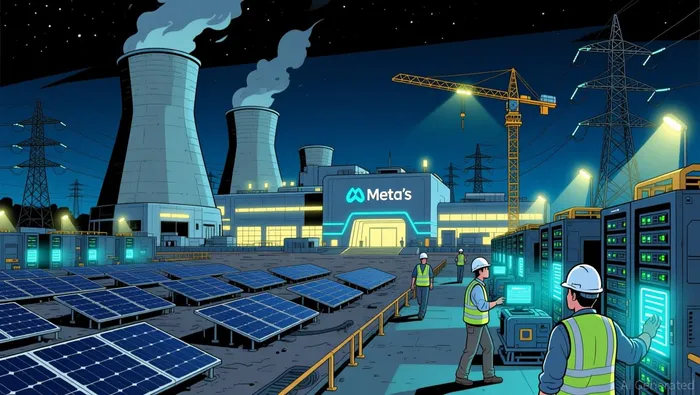
The scale of these projects underscores the paradigm shift. Meta's announced AI "titan clusters," like the Prometheus supercluster in Ohio and the Hyperion cluster in Louisiana, are designed to be among the most powerful computing facilities in the world. They promise to soak up enough energy to power millions of homes, a physical manifestation of the exponential compute demand AI will drive. For Meta, this massive, front-loaded capex is the essential first step to securing a core advantage in developing the best AI models and product experiences.
Financial Execution on the S-Curve: Funding the Exponential Growth
The aggressive buildout is already exerting direct financial pressure. Meta's costs and expenses surged 32% year-over-year in the third quarter, driven by the ramp in AI infrastructure spend. This capex growth is the primary reason for the strain, as the company front-loads its investment to secure compute capacity ahead of demand. The impact on profitability is stark. Net income collapsed 83% year-over-year to just $2.7 billion, while the operating margin fell to 40% from 43% a year ago. This is the direct cost of riding the exponential growth curve-funding the future infrastructure while current profits are compressed.
Meta is responding with high-risk financial engineering. The company is pursuing tens of billions of dollars in external financing and exploring strategic capital partnerships to fund projects beyond traditional debt. This is a deliberate move to de-risk the balance sheet and accelerate deployment. The appointment of Dina Powell McCormick as president and vice chairman, with a mandate to guide strategic capital partnerships, underscores this shift. Her role is to build alliances with governments and investors, a necessary step to secure the massive capital needed for projects like the proposed $50 billion data center in Louisiana.
The bottom line is that Meta is employing sophisticated financial maneuvers to stay on the S-curve. By tapping external capital and forming partnerships, the company aims to maintain its aggressive investment pace without over-leveraging. This is the high-stakes financial execution required to fund a paradigm shift. The current profit compression is a known friction in the buildout, but the strategy is to absorb it now to capture the exponential payoff later. The success of this plan hinges on the company's ability to convert this massive infrastructure investment into the next generation of AI products and services.
Leadership Catalyst: Accelerating the Infrastructure Buildout
Meta's new leadership appointment is a direct catalyst for executing its exponential infrastructure bet. The hiring of Dina Powell McCormick as President and Vice Chairman signals a decisive strategic shift. She is not a legacy advertising executive but a former Goldman Sachs banker and top adviser to President Trump, bringing deep expertise in global finance and high-stakes dealmaking. This is a critical hire for a company now prioritizing the financial and geopolitical execution of its $600 billion AI buildout.
Her explicit mandate is to build and maintain strategic capital partnerships. Meta stated she will drive an effort to build new strategic capital partnerships and find innovative ways to expand our long-term investment capacity. This is the core need for funding projects like the proposed $50 billion data center in Louisiana. Her role is to partner with governments and sovereigns to build, deploy, invest in, and finance Meta's AI and infrastructure. As JPMorgan CEO Jamie Dimon noted, she is a better banker and has more or better relationships than many big finance CEOs. These connections are the essential currency for securing the tens of billions in external financing Meta is pursuing.
Viewed another way, this appointment moves Meta away from a pure advertising background toward a finance and infrastructure-centric leadership. It reflects a new era where the company's growth is defined by multi-billion-dollar compute investments, not just ad revenue. Her joining the management team to partner with the compute and infrastructure teams ensures that the massive capital deployment is tightly aligned with technical execution. The bottom line is that Powell McCormick is the catalyst Meta needs to navigate the complex financial and political landscape of its exponential buildout.
Catalysts, Scenarios, and Key Risks
The success of Meta's exponential bet now hinges on a clear sequence of forward-looking milestones. The primary catalyst is the successful ramp of AI infrastructure capacity in 2026. This is the make-or-break event that will determine if the front-loaded investment yields a tangible product and cost advantage. The company expects to ramp its investments significantly in 2026 to support its AI work, with the first major physical manifestation being the Prometheus supercluster in Ohio, slated to come online with 1 gigawatt of compute power. If Meta can bring this and other titan-scale clusters online on schedule, it will secure the compute rails needed to train its most advanced models and integrate them into its products. The stock's recent pop on earnings shows the market is watching this buildout closely, but the real validation will come from operational execution, not just promises.
The major funding risk is failure to secure sufficient external capital. While Meta expects to finance most of its AI spend internally, it is explicitly exploring ways to work with financial partners to co-develop data centers. The company has already sought tens of billions of dollars in external financing for projects like the proposed $50 billion Louisiana data center. If Meta cannot attract this external capital, it faces a costly slowdown or, more likely, dilution of its balance sheet. The new leadership appointment of Dina Powell McCormick is a direct response to this need, tasked with building strategic capital partnerships. Her success in de-risking the balance sheet will be a key performance indicator for the entire strategy.
Geopolitical and regulatory uncertainty represents a significant, non-financial risk to the partnership-focused strategy. Meta's plans involve massive data centers in rural communities, which have already caused local strain, like water taps running dry in Newton County, Georgia. This creates a volatile siting environment where local opposition and regulatory hurdles could delay or derail projects. Furthermore, the company's push to partner with governments and sovereigns for funding introduces a layer of political risk. Shifts in policy around data sovereignty, energy procurement, or foreign investment could complicate these alliances. The strategy assumes a stable, cooperative environment for its $50 billion-plus projects; any major regulatory or political headwind would directly threaten the financial and operational timeline.
The bottom line is that Meta's exponential bet is a dual-track race. It must execute on the technical S-curve of AI compute deployment while simultaneously navigating the complex financial and geopolitical landscape of its infrastructure buildout. The 2026 capacity ramp is the product catalyst. Securing external capital is the financial lifeline. And managing local and global regulatory friction is the operational necessity. Success requires flawless execution on all three fronts.





Comentarios
Aún no hay comentarios