
Merus NV's Stock Rating Downgrade: Reassessing Growth and Market Position in the Shadow of the Genmab Acquisition
The recent downgrade of MerusMRUS-- N.V. (NASDAQ: MRUS) by Leerink Partners from "Outperform" to "Market Perform" has sparked renewed scrutiny of the biotech firm's growth prospects and market positioning. This shift, announced in October 2025, follows Genmab's $8 billion all-cash acquisition of Merus, a deal that has fundamentally altered the dynamics of Merus's valuation and strategic relevance, according to an Investing.com article. While the acquisition promises to bolster Genmab's pipeline with Merus's late-stage asset petosemtamab, the downgrade signals a recalibration of expectations for Merus as an independent entity.
Strategic Reorientation: From Standalone Growth to Acquisition-Driven Valuation
Leerink Partners explicitly tied the downgrade to the GenmabGMAB-- acquisition, noting that Merus's stock is now "driven more by news flow than traditional fundamentals," the Investing.com article noted. This observation underscores a critical shift: Merus's future is no longer defined by its own operational performance but by the execution risks and synergies of the Genmab deal. The firm's price target was adjusted to $97.00, aligning with the acquisition price of $97.00 per share, according to a GlobeNewswire release. This move reflects a pragmatic acknowledgment that Merus's standalone growth potential has been subsumed by the transaction, leaving investors to speculate on the deal's execution timeline and regulatory hurdles.
The acquisition itself is a strategic pivot for Genmab, which aims to transition from a collaboration-driven model to a wholly-owned product development approach, as the GlobeNewswire release explained. By acquiring Merus, Genmab gains exclusive rights to petosemtamab, a bispecific antibody with Breakthrough Therapy Designations for head and neck cancer. Analysts project that petosemtamab could achieve $1 billion in annual sales by 2029, with multi-billion-dollar potential thereafter. However, these long-term gains are contingent on clinical data releases, including interim Phase III results in 2026, according to MarketBeat. Until then, Merus's stock remains tethered to the binary outcomes of the acquisition process.
Financial Realities: Profitability Challenges and Revenue Resilience
Despite the acquisition's promise, Merus's financials reveal persistent operational challenges. In Q1 2025, the company reported an EPS of -$1.40, missing consensus estimates, though revenue grew 20.4% year-over-year to $26.49 million, according to MarketBeat. Forward-looking projections are equally sobering, with EPS expected to decline further to -$4.17 per share in the next fiscal year, per MarketBeat. These metrics highlight a stark disconnect between Merus's revenue resilience and its inability to achieve profitability-a concern echoed by Leerink Partners in its revised earnings outlook, according to a Benzinga analysis.
The firm's profitability ratios, including a net margin of -1792.23% and a ROE of -22.01%, underscore the scale of its financial underperformance, as the Benzinga analysis reported. While revenue growth is a positive signal, it is insufficient to offset the drag from recurring losses. This dynamic has led to mixed analyst sentiment, with Citigroup lowering its rating to "Neutral" and Barclays maintaining a bullish stance with a $112.00 price target, according to a StreetInsider report. The average 12-month price target of $98.75 suggests a consensus that Merus's intrinsic value is now closely tied to the Genmab deal's terms rather than its operational trajectory, as StreetInsider noted.
Market Positioning: A Biotech M&A Case Study
The Genmab acquisition exemplifies a broader trend in biotech M&A, where late-stage assets with high unmet medical need command premium valuations. Petosemtamab's dual Breakthrough Therapy Designations and its position in Genmab's pipeline position the combined entity to compete in the oncology space, as noted in an Investing.com analysis. However, this also raises questions about Merus's ability to maintain its market relevance post-acquisition. As Leerink Partners noted, the deal's success hinges on Genmab's capacity to integrate Merus's pipeline and execute on commercialization plans-a process that could take years.
For investors, the downgrade serves as a cautionary signal. While the acquisition offers a clear floor for Merus's valuation (the $97.00 offer price), upside potential is capped until Genmab demonstrates progress on key milestones. This contrasts with Merus's pre-acquisition trajectory, where its bispecific antibody platform was seen as a differentiator in a crowded oncology market, as highlighted in a MarketScreener transcript. The shift from innovation-driven growth to acquisition-driven stability reflects the inherent risks of betting on a company's standalone potential in an industry increasingly shaped by consolidation.
Conclusion: Balancing Risk and Reward in a Post-Downgrade Landscape
Leerink Partners' downgrade of Merus NV encapsulates the dual-edged nature of strategic acquisitions in biotech. While the Genmab deal provides a clear path to liquidity for Merus shareholders, it also eliminates the company's autonomy to pursue independent growth. For investors, the key question is whether the acquisition's long-term value-driven by petosemtamab's commercial potential-justifies the current valuation. Given the mixed analyst sentiment and Merus's financial challenges, a cautious approach seems prudent. The stock's performance will likely remain range-bound until critical data readouts in 2026, after which the market may reassess Genmab's ability to capitalize on its newly acquired assets.
In the interim, Merus's story is one of transition rather than transformation. Its market positioning is now defined by the Genmab acquisition, and its growth potential is contingent on the success of a single asset. For investors seeking high-conviction biotech plays, Merus may no longer fit the bill. However, for those with a longer-term horizon and a tolerance for execution risk, the acquisition offers a unique opportunity to participate in the development of a potential blockbuster.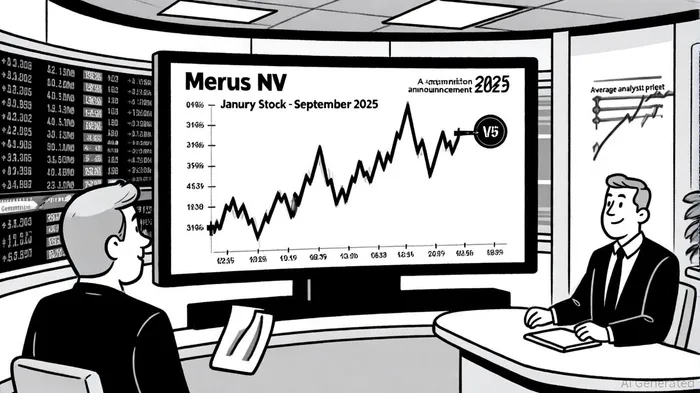





Comentarios
Aún no hay comentarios